
No single origin story is preserved in the collected folk accounts; the figure appears in local popular tradition as a monstrous crone attached to named landscape features. Modern commentators have proposed competing hypotheses: some 20th-century writers suggested speculative links to ancient mother-goddess figures (comparative suggestions connecting names such as Anu/Danu), while other scholars (notably Ronald Hutton in summary sources) argue the legend may derive from folk memory or distortion of an historical person (proposals include an anchoress or a figure named Agnes Scott). These interpretive proposals are scholarly reconstructions and not presented in the folk corpus as canonical origin narratives.
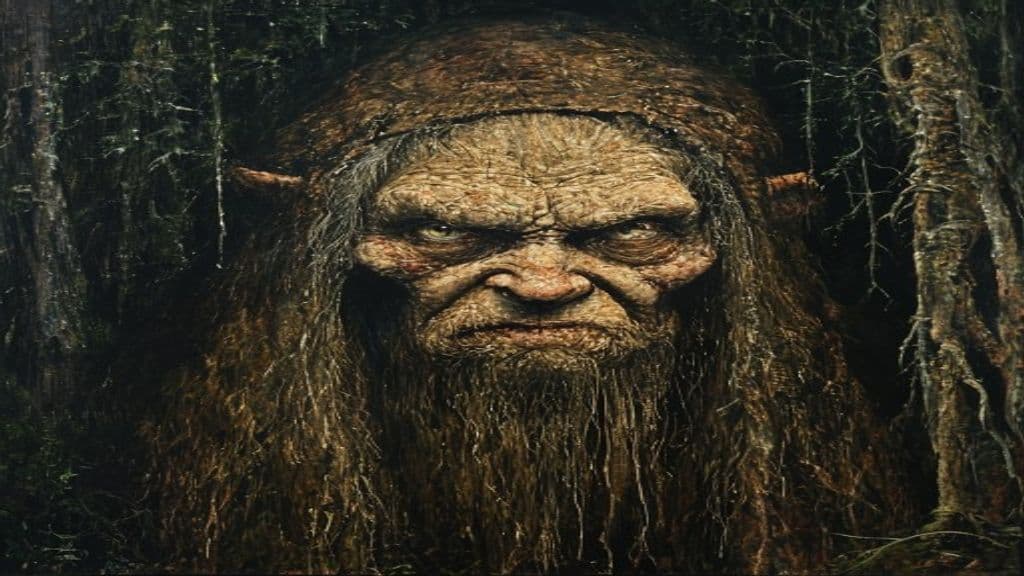
Described in the tradition as a blue-faced hag or witch wearing tanned skins around her waist, equipped with iron claws she used to dig her cave and to seize victims, and possessing pointed teeth. In some local variants she is represented in a monstrous-cat form (referred to in sources as 'Cat Anna' in alternative traditions).
According to tradition she ventures out at night hunting children and lambs to eat; she would reach inside houses to snatch people and hide in the branches of her oak tree waiting to leap upon unsuspecting prey. After killing victims she is said to tan their skins by hanging them on a tree and to wear those skins. Her teeth-grinding or howling was said to be audible and to warn villagers to secure their dwellings. Local tradition attributes to her the ability to excavate a cave in sandstone with iron claws; some variants describe an underground passage between Leicester Castle cellars and Dane Hills associated with her movements.
Weaknesses
- conditionsecure dwellings (bolted doors and small windows)
- otherhouseholders' ad hoc protections (fastening skins across windows)
- otherplacement of protective herbs above windows
Wards
- conditionsmall-window construction (cottages built with small windows so only one arm could reach in)
- otherfastening skins across windows when her howling was heard
- otherplacing protective herbs above windows when warned by her grinding/howling
- ritualEaster Monday drag-hunt ('Black Monday')
Boggart
A polyvalent supernatural being in north‑west English and adjacent dialect traditions, the boggart can be a household spirit attached to a family or dwelling or a localized landscape spirit tied to a particular place. Accounts vary widely by locality, recording mischievous, malicious, and sometimes frightening behaviours rather than a single fixed form.
Seventh son of a seventh son
A folkloric birth-status applied to a male who is the seventh consecutive male child in an unbroken male line whose father was also a seventh son; across several European-derived and Latin American traditions this status is associated variously with exceptional healing or with dangerous supernatural transformations. The figure functions as a social/biological category that explains extraordinary capacities or misfortunes rather than a single mythic individual or species.
Bixi
Bixi (Bi Xi) is a named figure in Chinese mythological lists—traditionally counted among the nine sons of the dragon—and is the canonical form for tortoise-bodied, dragon-crowned stone mounts that bear commemorative stelae. The form functions primarily as an architectural and commemorative sculptural motif used in funerary complexes, imperial mausoleums, and public commemorations from at least the late Han dynasty through the Ming and Qing.
Bizarra
Bizarra is a fictional, mirror-counterpart of the DC Comics superhero Wonder Woman: a deliberately inverted, simplified version created as part of the Bizarro concept. She appears across multiple comic-book continuities as a member of Bizarro-themed communities (Bizarro Justice League, Htrae) and in alternate-universe stories.
Bizarro
Bizarro is a fictional superhuman character from American comic books, created as a mirror-opposite duplicate of Superman. Introduced in 1958, the character functions within the comics as a flawed imitation or inverse counterpart—sometimes antagonist, tragic figure, or antihero—produced by duplication technologies or deliberate creation within the narrative.
Bizhan (Shahnameh)
Bizhan (also Bijan, Bejan, Bezhan; Persian: بیژن) is one of the main Iranian heroes in Ferdowsi's Shahnameh. Presented as a mortal warrior of an aristocratic heroic house, he appears in several notable episodes (including slaying Nastihan and being rescued from a pit by Rostam) and is depicted frequently in illustrated Shahnameh manuscripts.
Black Adam (Teth‑Adam)
Black Adam (originally Teth‑Adam) is a fictional superhuman character from American comic books published by DC Comics (originating at Fawcett Comics). Within the comics' internal cosmology he is a human chosen by the wizard Shazam, transformed into an overwhelmingly powerful magical champion whose moral alignment has shifted between antagonist and antihero across publication history.
Black Arab
In Slavic mythology, the Black Arab is a malevolent chthonic demon that kidnaps women and girls. (Note: 1. Power tier should be Primordial, not Ancient (Ancient implies deity-level abilities, but the Black Arab's abilities are more limited). 2. Origin story is speculative and unsupported by source mater)
Black Bolt
Black Bolt (Blackagar Boltagon) is a fictional character published by Marvel Comics, portrayed as the king of the Inhuman city-state Attilan and a member of the Inhuman Royal Family; his defining trait is a destructive voice-linked power that forces him into near-total silence.
Black Canary
Black Canary is a legacy costumed heroine identity appearing in American comic books published by DC Comics, borne most notably by Dinah Drake (Golden Age) and her daughter/successor Dinah Laurel Lance. The persona functions as a crime-fighter and team member in serialized superhero narratives rather than as a folkloric spirit; sources emphasize the legacy nature of the mantle and its cultural role as a strong, sexually-styled female protagonist in mid‑20th‑century and later popular culture.
Black Condor
Black Condor is a legacy superhero identity used by three different fictional characters originating in Quality Comics and later appearing in the DC Comics universe. The persona is avian-themed and consistently associated with unaided flight and aerial motifs; individual incarnations have differing additional powers and origins.
Black Darna
Black Darna is attested in the provided sources only as a named character entry within the Darna comics/television franchise of the Philippines. Available materials identify it as a comics/media character label (Wikidata) and place it in the broader context of the modern Philippine fictional character Darna (Mars Ravelo) and a 2005 television adaptation; no folkloric, mythological, or ritual information about Black Darna is present in the cited sources.
Community Record
- [1]Black Annis - Wikipedia. Wikipedia: 'Black Annis' article (summary of traditional attributes, customs, name variants, and scholarly debates)wiki
- [2]Skinned (novel archive blurb). Archive blurb cited in research notes (modern fictional depiction referenced for distinction from traditional corpus)literary
- [3]At the Edge archive: Black Annis. Folk-legend summary and local tradition notes (archival web summary)folk
- [4]Black Annis - leicester legend or Widespread Myths. Article discussing legend variants and cultural afterlifeother
- [5]Black Annis Morris (contemporary group). Modern cultural afterlife: Morris dance side named for Black Annis and event listingsother
- [6]Finding Black Annis | Landscape Tales. Local landscape and folklore commentary on Black Annis' sites and topographical anchoringfolk