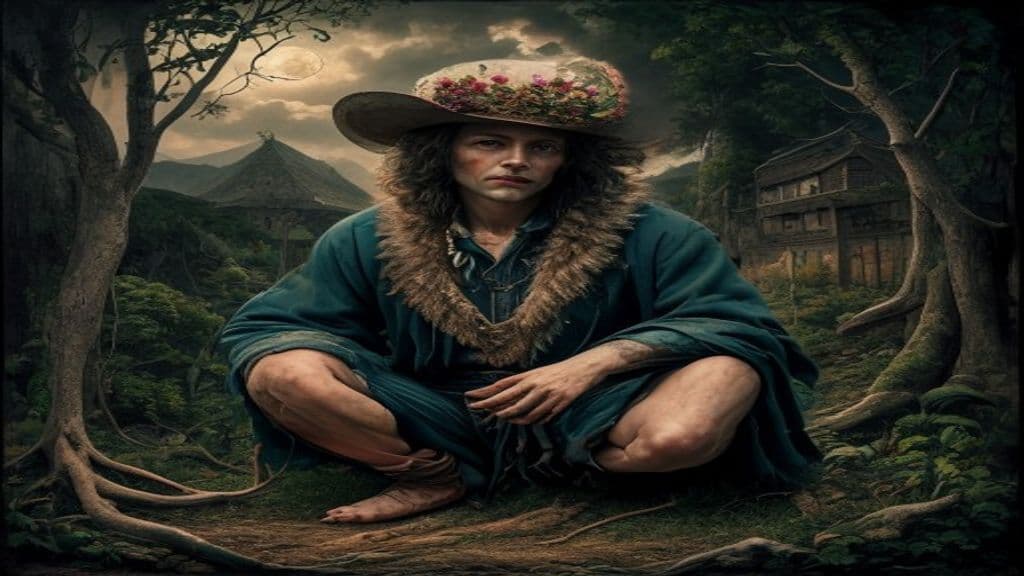
There is no single mythic origin recorded in the provided sources; the status derives from genealogical counting within communities and draws on a broader cultural valuation of the number seven (e.g., seven virtues, Seven Heavens) to confer cosmological resonance. Local legends tie particular named exemplars to the category (for example, the Montenero di Bisaccia legend naming Ciarallo as a seventh son who charms snakes), but comparative accounts indicate the idea arises independently in multiple regions rather than from a single origin narrative.
As a classificatory birth-status, the seventh son of a seventh son has no fixed outward appearance across traditions. Some localized accounts add contingent physical markers: an early 19th-century U.S. travel account reports that, in one mining-related belief, a seventh son of a seventh son born in February and with a caul on his head could scry with a black stone. Such markers are specific to particular local beliefs rather than general features of the status.
Reported capacities vary by region. In England (Lancashire/Blackburn) and Ireland the status is associated with healing: seventh sons (and especially seventh sons of seventh sons) were sometimes addressed as 'Doctor' and regarded as folk healers within the 'cure' or 'charm' tradition. In Montenero di Bisaccia, an individual named Ciarallo, described as a seventh son, could enchant and recall snakes, was immune to snake venom, could attract snakes with a whistle, and could initiate others via an inciaramazione rite using a special oil for protection. In Latin American and some Iberian traditions the status is instead feared as a mark that may doom the person to transform into werewolf-like beings (lobizón/Luison/lobisomem); in Transylvania some accounts associate the status with becoming a vampire. A U.S. account links a very specific scrying ability (discernment of subterranean things) to a narrowly specified cluster of birth-order, month, and physical traits.
Weaknesses
- ritualbaptism in seven churches (prevention in Latin American lore)
- ritualbaptism under the name Benito with eldest brother as godfather (alternative prevention in Latin American lore)
Wards
- ritualbaptism in seven different churches (preventative measure against werewolf outcome)
- ritualbaptism under the name Benito with eldest brother as godfather (preventative naming/godparenting)
- ritualinciaramazione with special oil (Italian protection from snakes administered by a seventh-son specialist)
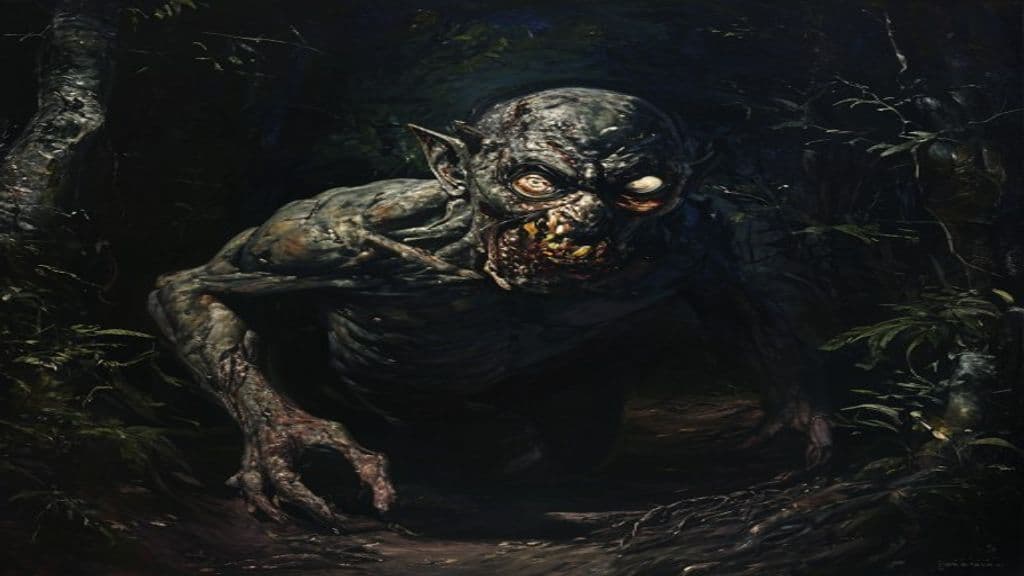
Pishacha
Flesh-eating spirits of Hindu mythology that haunt cremation grounds and are associated with disease, madness, and possession. The lowest class of demon in the Vedic hierarchy.
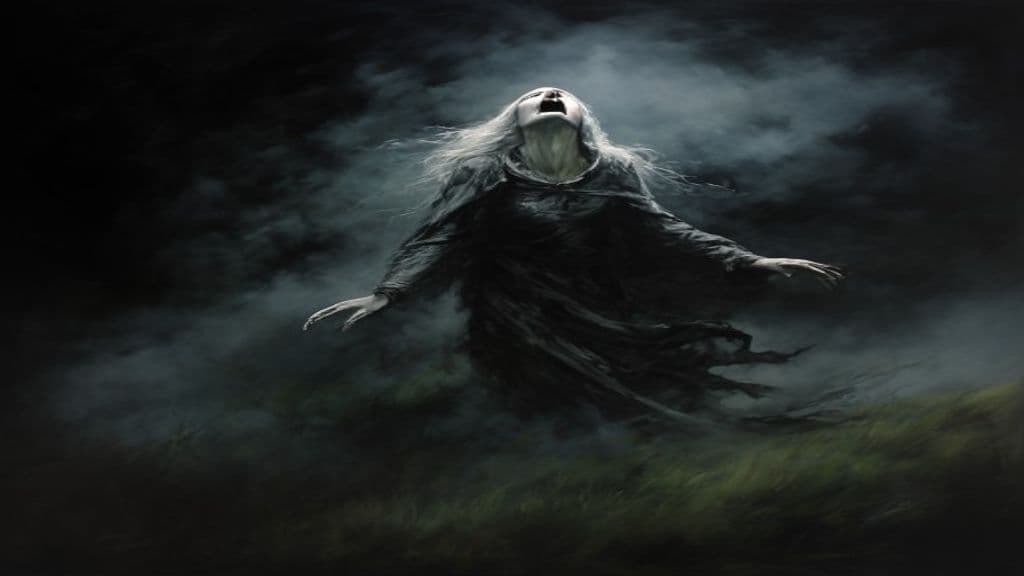
Banshee
A female spirit of Irish and Scottish folklore whose wail heralds an impending death in a family of Gaelic descent. Not a cause of death — a witness to it.

Werewolf
A figure of European folklore of a human who can change into a wolf or wolf–human hybrid, variously portrayed as voluntary shapeshifter, cursed afflicted person, or clinical delusion (lycanthropy). Belief in werewolves was entwined with medieval and early modern witchcraft accusations and persisted into Gothic and popular fiction.
Black Annis
Black Annis is a Leicestershire bogeywoman in English folklore: a blue-faced, clawed hag said to haunt Dane Hills and a cave called Black Anny's Bower Close. Traditionally portrayed as a nocturnal predator of children and lambs who tans victims' skins to wear, she inspired local customs including an Easter Monday drag-hunt.
Boggart
A polyvalent supernatural being in north‑west English and adjacent dialect traditions, the boggart can be a household spirit attached to a family or dwelling or a localized landscape spirit tied to a particular place. Accounts vary widely by locality, recording mischievous, malicious, and sometimes frightening behaviours rather than a single fixed form.
Serpents in Jewish Tradition (Biblical Context)
Symbolic representation of evil and positive aspects, reflecting the complex nature of their symbolism. (Note: - Power tier: Downgrade to Greater (they are described as representing "evil power" but also have positive aspects) - Appearance: Add note that there is no physical description provided in source mate)
Seth
Two distinct traditional personae share the name 'Seth' in the supplied corpus: (1) the Abrahamic Seth, the third son of Adam and Eve and an antediluvian patriarch associated in later traditions with righteous lineage and transmission of knowledge; and (2) the Egyptian god Set/Seth, a powerful deity ritually opposed in the cult of Osiris, for whom a temple rite titled 'The book of the victory over Seth' prescribes the making of a red-wax figure to effect his downfall.
Seven Deadly Sins
A classificatory schema in Christian theological and monastic tradition that groups seven principal vices—capital or 'head' sins—understood as formative dispositions that incline persons to further wrongdoing and threaten their relationship with God.
Seven Great Lords of Narnia
A group of seven Telmarine noblemen in C. S. Lewis’s The Chronicles of Narnia who were sent beyond the Eastern Ocean during Miraz’s reign and disappeared; their fates (goldification, dragon-related death, enchanted sleep, nightmare-entrapment, and settlement) are the central quest of The Voyage of the Dawn Treader.
Seven Hathors
A grouped manifestation of the Egyptian goddess Hathor appearing as seven attendant female deities associated with birth, fate, and the transition of souls. They are attested in temple iconography and literary tales as visitors who foretell a newborn's destiny and appear in liminal contexts between life and death.
Sexual vampire (Daoist sexual vampirism)
A conceptual category and set of practices in Chinese Daoist sexual-alchemical literature describing the absorption of another person's qi and jing through sexual techniques; also a literary motif comparing seductress spirits to practitioners who 'feed' on vital substances. It functions as both an esoteric technique aimed at longevity and a mythic trope of sexual predation in stories of fox spirits and reanimated corpses.
Shachihoko
A Japanese mythic sea-creature and roof-ornament (shibi) combining a predator head (dragon or tiger) with a carp body. In Japanese architectural and folkloric contexts it functions as an apotropaic roof guardian believed to store water and control rain, used primarily to protect wooden buildings from fire and as a status emblem.
Shaddād
A legendary king in Arabian folklore, described as tyrannical. (Note: 1. The power tier should be Greater (deity-level abilities are implied by association with a lost city and connection to Qur'anic lore). 2. Add appearance description from source material, mentioning )
Shade
A shade is the shadowy spirit or ghost of a dead person in classical and ancient Near Eastern literary and religious cosmologies, understood as the diminished, insubstantial residuum of a person who dwells in the underworld (Hades, Sheol/tsalmavet) rather than among the living.
Shadow (concept)
A polyvalent term used across optics, psychology, computing/administration, and popular paranormal conversation. In the supplied sources it is primarily an optical phenomenon and a psychological archetype; other uses are metaphorical or technical rather than descriptions of a single, traditional supernatural being.
Community Record
- [1]Seventh son of a seventh son (Wikipedia). Wikipedia, 'Seventh son of a seventh son'.wiki
- [2]Wikidata: Seventh Son of a Seventh Son. Wikidata entry Q641620.other