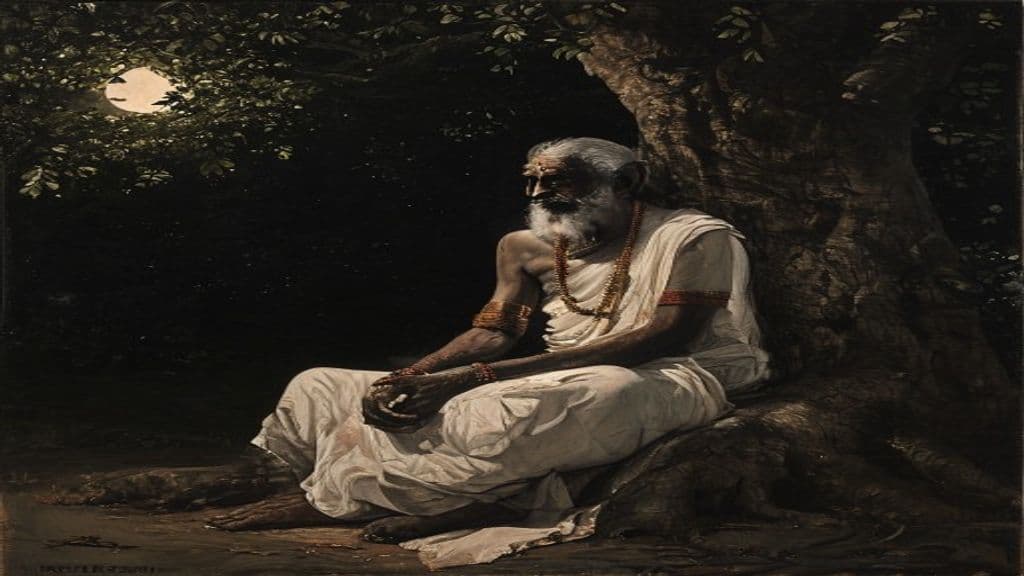
The Brahmadaitya is a specifically Bengali supernatural category — distinct from the North Indian Brahmpret in origin, behaviour, and treatment. Where the Brahmpret arises from a Brahmin who died with unfulfilled worldly obligations (debts, incomplete ceremonies, family duties), the Brahmadaitya is the spirit of a Brahmin who died celibate: either a young scholar who died before marriage, or a man who took brahmacharya (celibacy vows) and died while keeping them.
The accumulation of unshared knowledge and unreleased worldly experience makes the Brahmadaitya a powerful and peculiar presence. It is not angry at a specific person. It simply has nowhere to put what it accumulated.
In Bengali tradition, the Brahmadaitya is said to inhabit old peepul and banyan trees near ancient Brahmin learning centres — the remnants of traditional tols (schools). The areas around Navadvip, the classical centre of Sanskrit learning in Bengal, have particularly strong Brahmadaitya traditions.
The Brahmadaitya appears as a thin, scholarly-looking man in white dhoti, with the sacred thread visible. He is tall — described as unusually so — and carries himself with the quiet authority of a teacher. In daylight or lamplight he might pass for an eccentric living Brahmin of the old school.
The signs of his non-living nature are subtle: he casts no shadow, or his shadow moves at a slightly different rate than he does. He is often described as being observed sitting beneath a specific tree, reading or reciting, who simply is not there when approached directly.
The Brahmadaitya's most documented ability is the transmission of Sanskrit knowledge — there are numerous Bengali folk accounts of a scholar encountering a Brahmadaitya who teaches him texts no living person knew. This double-edged gift comes at a price: the student becomes increasingly withdrawn and otherworldly after the lessons.
He can also cause the household of whoever disturbs his tree to develop a specific pattern of misfortune: not violent or rapid but a gradual greyness over the household's happiness, as if his unresolved unfulfillment has leaked into the living space.
Weaknesses
- ritualPerforming the marriage ceremony posthumously on behalf of the celibate Brahmin
Wards
- substanceOffering of the Brahmin's favourite texts placed beneath his tree with respect
- mantraRecitation of the Brahma Gayatri at dawn near his tree
Agiya Baital
The fire-form of the Vetala — a cremation ground spirit of UP and Bihar that manifests as a wandering flame rather than a corpse-inhabitor, leading night travellers off roads and into marshland or flames with a dancing fire that seems always just ahead.
Aleya
Ghost lights of the Sundarbans delta — flickering flames over swamp water said to be the souls of dead fishermen, luring the living off safe paths into drowning waters.
Angiras
Angiras (Sanskrit Aṅgiras/Aṅgirāḥ) is primarily a Vedic rishi (sage) and eponymous lineage (Angirasa) associated with authorship of Vedic hymns, priestly/fire functions, and transmission of mantras; later Puranic accounts multiply his identities in genealogies and lists of sages.
Ap (the Waters)
Ap (Vedic áp-, Classical Sanskrit āpas/āpa-) denotes the sacred category of 'the waters' in Vedic/Hindu thought: a physical element (water), an animate cosmic principle addressed in Rigvedic hymns, and an elemental category later counted among the Panchamahabhuta. The term names collective waters invoked in ritual, is linked to deities such as Varuna and the epithet Apām Napāt, and survives in related Indo-Iranian vocabularies (Avestan āpō/Aban, Persian āb).
Apsara
Celestial dancers and water nymphs of Hindu cosmology — beautiful semi-divine beings who dance at the court of Indra and, by his command, descend to earth to distract sages from excessive asceticism.
Bhoma
Primordial earth deity in Balinese mythology associated with fertility and vegetation. (Note: 1. Power tier should be Primordial, which is correct. 2. Appearance description matches source material; no corrections needed. 3. Abilities: Add "liminal space between wilderness and human settlement)
Bhoot (bhoota)
A bhoot (also bhoota, bhoot, bhut) is the culturally specific term across parts of the Indian subcontinent for a perturbed, restless spirit generally understood to be the ghost of a deceased person. Sources describe bhoots as arising when a person's death or post-death circumstances prevent them from moving on — for example violent death, unresolved affairs, or failures in funerary rites — and the term appears frequently in modern South Asian media and discussions.
Bidadari
Bidadari is a Southeast Asian regional term related to the South Asian apsara: a class of celestial/ethereal female beings originally associated with clouds and water in Hindu and Buddhist cosmology, later represented in regional art and performance as nymph- or fairy-like figures. The term is also widely used in modern Southeast Asian toponymy and popular culture (place names, media, vessel names), distinct from detailed mythic narratives in the provided sources.
Bordoisila
The storm deity of spring in Assamese tradition — Bordoisila is the daughter of Brahma who visits her mother's home at the end of winter, and whose journey back creates the violent pre-monsoon storms of April and May. She is a goddess-spirit propitiated in Assam for thousands of years.
Brahmarakshas
The most learned and terrible of spirits — the ghost of a Brahmin who misused his scriptural knowledge in life and was condemned after death to be both demon and scholar, haunting places of learning.
Brahmarakshasa
Demon-spirit of a Brahmin who misused sacred knowledge for evil ends — described in the Ramayana and Mahabharata, the Brahmarakshasa combines the destructive force of a Rakshasa with the ritual knowledge of a priest. Among the most dangerous entities in Hindu demonology.
Brahmpret
The ghost of a Brahmin who died before fulfilling his dharmic obligations — more powerful than any ordinary preta, the Brahmpret retains Sanskrit learning, ritual authority, and the capacity to curse. The most feared ghost-class in North Indian villages.
Brahmpret is the ghost of any Brahmin who died with unfulfilled desires; Brahmadaitya is specifically a Brahmin who became a powerful protective spirit, often benevolent and attached to a family or sacred tree.
Brahmarakshasa is a demon-class entity born from a Brahmin's sins and misuse of sacred knowledge — purely evil. Brahmadaitya is a spirit born from incomplete rites — it can be protective and appeased.
Community Record
- [1]Bhoot-pret: The Undead in Bengal. Bandyopadhyay, P. (2001). Bhoot-pret: The Undead in Bengal. Kolkata: Ananda Publishers.folk
- [2]The Tribes and Castes of Bengal. Risley, H.H. (1891). The Tribes and Castes of Bengal, Vol. 1. Bengal Secretariat Press, Calcutta.academic
- [3]Brahmadaitya — Wikipedia. Wikipedia contributors. Brahmadaitya. Wikipedia, 2024.wiki