
The sources do not preserve a single origin myth for the Bøyg. Folkloric summaries and modern reference entries place the Bøyg in the family of troll-figures of Norway and localize notable examples to Telemark and Gudbrandsdalen (including epithets such as the "Great Bøyg of Etnedal"). Later literary appropriation (most prominently Ibsen's Peer Gynt) adapts the figure as a narrative obstacle, but primary source material does not provide a traditional genealogy or creation story; speculative modern genealogies linking it to serpent-lineage monsters (e.g., Midgard Serpent offspring or linnorms) appear only in later, non-traditional reconstructions.
Descriptions in the available sources are varied but cohere around an image of a large, obstructive, often serpentine creature. The principal folkloric description in reference summaries calls the Bøyg a "giant, slimy serpent" and also classifies it among troll-like beings. Some modern or derivative accounts give alternate images (gnome-like, or hybrid humanoid-with-serpent-tail forms), but these variants are attested in secondary or modern reconstructions rather than in the core traditional summaries; therefore the most consistently documented appearance is that of a great, wet/oozing, bending/curved being that physically occupies and obstructs paths.
The defining function attested across sources is obstruction: the Bøyg stands as a hindrance to travellers, blocking or forcing a change of course on paths and in the wild. In literary treatment (Ibsen's Peer Gynt and some retellings based on that episode) the encounter is dramatized and sometimes given dialogic features — e.g., the Bøyg addressing the traveller or speaking in riddles in modern audio retellings — but traditional material emphasizes its role as an embodied impediment rather than enumerating magical powers. Modern mythic reconstructions attribute greater monstrous lineage or capabilities, but those claims are speculative and not part of the primary folkloric record.
Weaknesses
- otherNo documented traditional weaknesses
Wards
- otherNo documented traditional wards or preventive rituals specific to the Bøyg
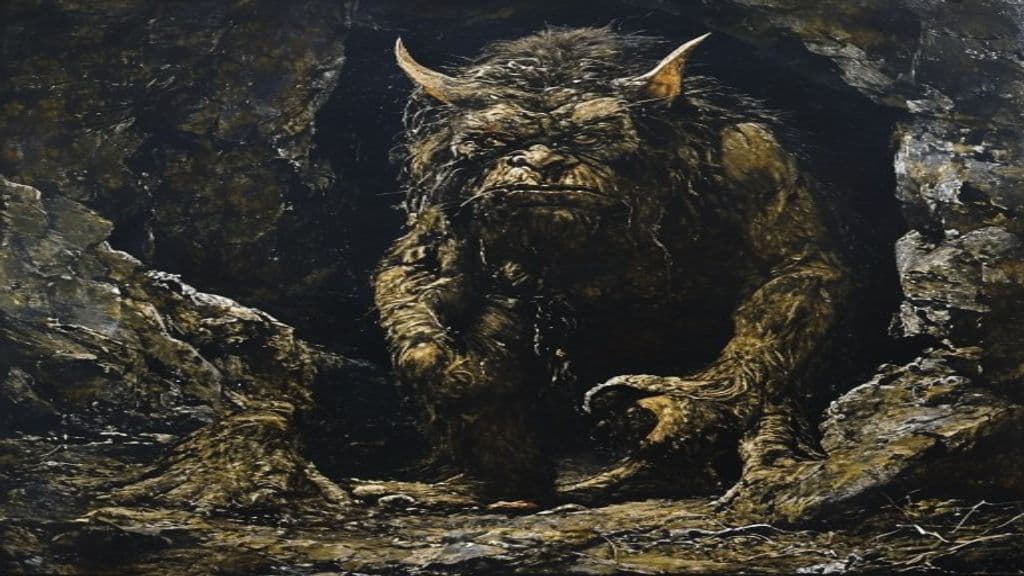
Troll (Germanic Tradition)
In Germanic folklore, a troll is a being that dwells in isolated areas of rocks, mountains, or caves, living together in small family units and rarely interacting with humans. (Note: - Power tier should be changed from Primordial to Ancient (trolls' origins from primordial forces don't necessarily imply cosmic-level power). - Ability description is not entirely accurate; it's stat)

Lindworm
The lindworm is a European serpent/dragon‑like monster attested across Northern, Western and Central Europe. Varieties range from limbless giant forest serpents in Scandinavian lore to two‑limbed or winged dragonic forms in Central European art and legend; it appears in both treasure‑guardian and cursed‑bridegroom narrative cycles.
Deildegast
A Norwegian folkloric ghost bound to boundary stones as postmortem punishment for those who moved or tampered with property markers; compelled to attempt to restore displaced stones but never succeeding, it serves as a social deterrent against moving borders.
Selma (Seljordsormen)
Selma, known in Norwegian as Seljordsormen ('the Seljord serpent'), is a localized lake‑monster tradition associated with Lake Seljord (Seljordsvatnet) in Seljord municipality, Telemark, Norway. Traditionally described as a serpentine sea‑serpent inhabiting the lake, Selma appears in folklore, eyewitness reports (the oldest cited written account dates to 1750), modern cryptozoological investigations, and as a civic emblem of Seljord.
Bêlit
Bêlit is a fictional Shemite pirate-queen from Robert E. Howard's Hyborian Age, captain of the ship Tigress and romantic partner of Conan in the short story "Queen of the Black Coast" (1934). Presented as a mortal warrior-leader whose life and death intersect with supernatural elements in the tale, she is remembered as an avaricious and charismatic sea-queen in later adaptations and comics.
Bölþorn
Bölþorn (also attested as Bölþor) is a named jötunn in Norse mythic genealogies, recorded as the father of Bestla and thus an ancestor of Odin, Vili, and Vé. He appears only briefly in the extant poetic and prose Eddaic material and functions primarily as a genealogical forebear rather than an active narrative figure.
Bönpo Lu (local mountain spirits)
A research label for local mountain-associated spirits situated in Himalayan/Tibetan ritual worlds; the term as presented is not documented in detail in the supplied sources. The available materials place such landscape spirits within a broader Bön and Tibetan Buddhist milieu where mountains and local non-human agents are engaged through offerings and ritual specialists.
Böri Shad
Böri Shad (fl. c. 627) is a historical Turkic princely governor and military commander (shad/ishad) of the Western Turkic Khaganate who operated in the far western North Caucasus and led campaigns into the South Caucasus during the Perso-Turkic conflicts of 627–630. He combined kinship status (son of Bagha Shad; nephew of Tong Yabghu Khagan) with delegated frontier authority and military command, and fled to Central Asia after Tong Yabghu's murder in 630.
Böðvildr
Böðvildr is a human princess of Germanic heroic legend, daughter of a king (Níðuðr / Niðhad / Niðung) whose fate is entwined with the smith Wayland (Völundr). In older poetic sources she is presented as a tragic figure—victim of the smith's revenge (murder of her kin and rape)—while later prose redactions (Þiðrekssaga) report that she bore Wayland a son (Viðga) and later married him.
Búri
Búri is an Old Norse primordial divinity attested in the Prose Edda and a skaldic verse as an early ancestor of the Æsir. He is presented as a first-born godlike figure who is freed from salty rime by the primeval cow Auðumbla and is genealogically prior to later gods such as Borr and, by descent, the Æsir.
Býleistr
Býleistr is an Old Norse mythic name attested as a brother of Loki. He appears only as a kin-term in skaldic and Eddic contexts and in Snorri Sturluson's prose lists; no independent deeds or narratives are preserved for him in the cited sources.
Bāṇasura
Bāṇasura (Bana, Bāṇāsura) is an asura-king of Śoṇitapura in Hindu Purāṇic narratives: a mighty ruler and ardent devotee of Śiva whose penances and boons grant him great protection and power. He is best known from the Bhagavata Purāṇa cycle concerning Uṣā and Aniruddha, which culminates in a divine confrontation between Śiva (protecting Bāṇa) and Kṛṣṇa (rescuing Aniruddha) and ends with Bāṇa's defeat, maiming, repentance, and reconciliation.
Błędnica
A Slavic forest demoness who misleads travelers, abandoning them deep in the woods to die of exposure, starvation, or be taken by wild animals. She is typically depicted as a young, attractive woman and is countered in tradition by strong spells or by making sacrifices at home or during the hunt.
Bǫðvarr Bjarki
Bǫðvarr Bjarki is a legendary Scandinavian heroic figure associated with King Hrólf Kraki. A great warrior of human birth who bears or manifests an independent ursine spirit (hugr/hamr) that fights as a monstrous bear on his behalf, he appears in the Hrólfs saga kraka tradition and related medieval accounts.
Community Record
- [1]Bøyg. Wikipedia: 'Bøyg' article, describing the creature as a gnome-like creature and a great troll; notes serpentine, obstructive character and regional associations.wiki
- [2]Bøyg (Wikidata). Wikidata entry classifying the Bøyg as a troll in Scandinavian folklore.wiki
- [3]Peer Gynt, II, 7 (stage business). Logos Virtual Library: Ibsen stage direction and dialogue showing Peer attempting to force a passage and striking against something ('Who are you?'), evidence of the narrative encounter.literary
- [4]GRIEG: Peer Gynt (complete) / 'Scene with the Bøyg' (track listings). Archive recordings and track lists for Edvard Grieg's incidental music to Peer Gynt, which include a 'Scene with the Bøyg', confirming the creature's role in the play's dramatic sequence.other
- [5]Peer Gynt. Wikipedia: article on Peer Gynt noting the folktale source and the inclusion of the Bøyg episode in Ibsen's play.wiki
- [6]Storynory: 'Peer Gynt. The Bøyg'. Storynory retelling of the Peer Gynt episode which dramatizes the Bøyg speaking in riddles to Peer (literary/retelling source).folk
- [7]Böyg (Norse monster for BECMI / Pandius). Pandius page giving modern/roleplaying-oriented reconstructions (hybrid forms, speculative lineages); used only as a modern secondary source and noted as non-traditional.other
- [8]Bøyg | Cryptid Wiki | Fandom. Cryptid/fandom summary listing variant spellings and appearance variants; treated as a modern compilation rather than primary traditional source.other