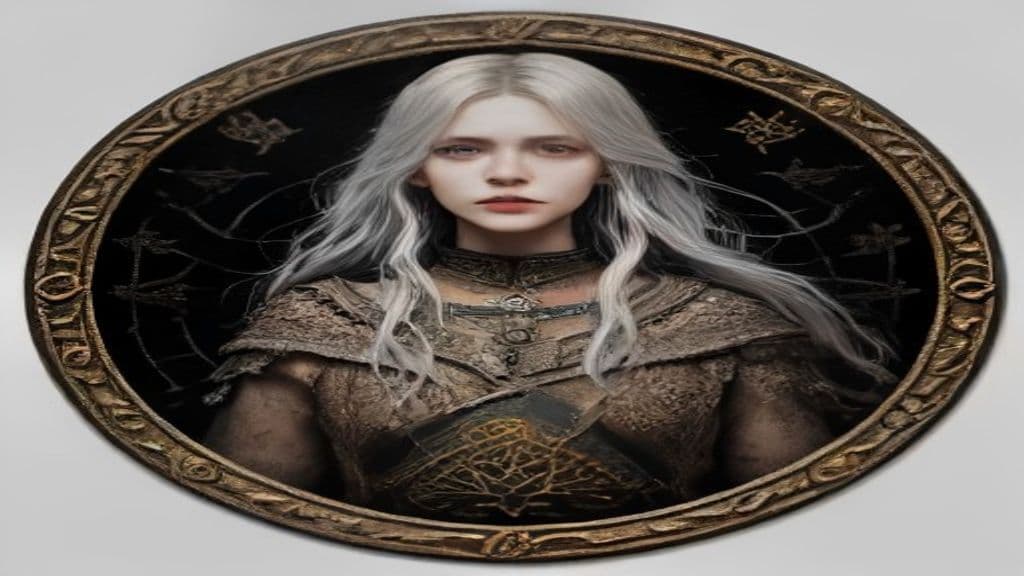
Böðvildr appears across Germanic sources as the daughter of a king named Níðuðr / Niðhad / Niðung. In the Poetic Edda poem Vǫlundarkviða Wayland (Völundr), imprisoned and hamstrung in the smithy, takes revenge by murdering the king's sons and fashioning objects from their remains; Böðvildr visits Wayland to have a broken ring mended, receives crafted tokens (a brooch made from teeth is mentioned) and is raped by Wayland before he departs. The Anglo‑Saxon Deor alludes to the murder of her brothers and explicitly references her rape. In the later prose Þiðrekssaga Wayland fathers a son by Böðvildr named Viðga; the saga reports a subsequent marriage and a peace settlement with the king’s successor, showing a redactional trajectory from tragic victim to political consort and mother.
The primary sources supply minimal sustained physical description. Böðvildr is identified by social markers: a royal daughter who possesses a gold ring made by Wayland and who, in Vǫlundarkviða, is given or associated with a brooch fashioned from her brothers' teeth. In Þiðrekssaga she is depicted as pregnant and later the mother of a son, Viðga. No detailed bodily or clothing descriptions are provided in the cited materials.
Böðvildr is presented as a mortal human with no supernatural powers in the cited sources. Her enacted roles vary by tradition: in the poetic tradition she seeks Wayland as a client to repair a broken ring (a socially normative action), and serves narratively as the recipient of Wayland's vengeful acts (the murder of her kin and her rape, attested in Vǫlundarkviða and Deor). In Þiðrekssaga she becomes mother to Wayland's son Viðga and later his wife after political reconciliation, participating in dynastic resolution rather than displaying agency through supernatural ability.
Bisterne Dragon
A place‑bound legendary dragon from the New Forest (Hampshire, England) said to have laired on Burley Beacon and to have demanded milk from nearby Bisterne; slain in medieval pedigree tradition by a knight of the Berkeley family, its corpse is said to have formed a local hill (Boltons Bench).
Blue Ben (of Kilve)
A local Somerset dragon-legend tied to the coastal landscape of Kilve. The tale explains coastal features and a fossil ichthyosaur skull by attributing them to the life and death of a fire-breathing dragon sometimes said to have been ridden by the Devil.
Háma (Hama / Heime / Heimir)
Háma (also rendered Hama, Heime, Heimir) is a named figure of the Germanic heroic-legend tradition attested in Anglo‑Saxon and continental Germanic sources. He appears as a legendary warrior or retainer — often associated with the companion Witige — in poems such as Beowulf and Widsith and in later Germanic epic material (Alpharts Tod, Þiðreks saga). A single secondary source records a variant identification of the name with a mythic watchman figure linked to Heimdallr and the Bifrost; this identification is presented in the available material as a distinct, unverified tradition.
Orc
A literary and philological construct originating from an Old English attestation and substantially developed in J. R. R. Tolkien's mythopoeic writings as a corrupt, warlike humanoid race serving dark powers; earlier usage in Beowulf links the element to underworld/demonic associations.
Bêlit
Bêlit is a fictional Shemite pirate-queen from Robert E. Howard's Hyborian Age, captain of the ship Tigress and romantic partner of Conan in the short story "Queen of the Black Coast" (1934). Presented as a mortal warrior-leader whose life and death intersect with supernatural elements in the tale, she is remembered as an avaricious and charismatic sea-queen in later adaptations and comics.
Bölþorn
Bölþorn (also attested as Bölþor) is a named jötunn in Norse mythic genealogies, recorded as the father of Bestla and thus an ancestor of Odin, Vili, and Vé. He appears only briefly in the extant poetic and prose Eddaic material and functions primarily as a genealogical forebear rather than an active narrative figure.
Bönpo Lu (local mountain spirits)
A research label for local mountain-associated spirits situated in Himalayan/Tibetan ritual worlds; the term as presented is not documented in detail in the supplied sources. The available materials place such landscape spirits within a broader Bön and Tibetan Buddhist milieu where mountains and local non-human agents are engaged through offerings and ritual specialists.
Böri Shad
Böri Shad (fl. c. 627) is a historical Turkic princely governor and military commander (shad/ishad) of the Western Turkic Khaganate who operated in the far western North Caucasus and led campaigns into the South Caucasus during the Perso-Turkic conflicts of 627–630. He combined kinship status (son of Bagha Shad; nephew of Tong Yabghu Khagan) with delegated frontier authority and military command, and fled to Central Asia after Tong Yabghu's murder in 630.
Bøyg
The Bøyg is a legendary Scandinavian (Norwegian) obstacle-being, most often portrayed in sources as a great, slimy serpent or troll-like presence that stands as an impediment to travellers; it is regionally associated with Telemark and Gudbrandsdalen and appears as a dramatic obstacle in Ibsen's Peer Gynt (and Grieg's incidental music).
Búri
Búri is an Old Norse primordial divinity attested in the Prose Edda and a skaldic verse as an early ancestor of the Æsir. He is presented as a first-born godlike figure who is freed from salty rime by the primeval cow Auðumbla and is genealogically prior to later gods such as Borr and, by descent, the Æsir.
Býleistr
Býleistr is an Old Norse mythic name attested as a brother of Loki. He appears only as a kin-term in skaldic and Eddic contexts and in Snorri Sturluson's prose lists; no independent deeds or narratives are preserved for him in the cited sources.
Bāṇasura
Bāṇasura (Bana, Bāṇāsura) is an asura-king of Śoṇitapura in Hindu Purāṇic narratives: a mighty ruler and ardent devotee of Śiva whose penances and boons grant him great protection and power. He is best known from the Bhagavata Purāṇa cycle concerning Uṣā and Aniruddha, which culminates in a divine confrontation between Śiva (protecting Bāṇa) and Kṛṣṇa (rescuing Aniruddha) and ends with Bāṇa's defeat, maiming, repentance, and reconciliation.
Community Record
- [1]Böðvildr — Wikipedia. Wikipedia, 'Böðvildr' article (summary and etymology)wiki
- [2]Vǫlundarkviða (Volundarkvida) — Poetic Edda. Poetic Edda: Vǫlundarkviða (translation and summary of smithy episode, ring repair visit, murder of sons, crafted tokens, rape)literary
- [3]Völundarkviða — Wikipedia. Wikipedia summary of Vǫlundarkviða narrativewiki
- [4]Deor (Anglo‑Saxon poem). Deor (Anglo‑Saxon poem) — references to murder of her brothers and the poet's allusion to her rapeliterary
- [5]Þiðrekssaga (summary references). Þiðrekssaga summary — later prose account reporting Wayland's son Viðga by Böðvildr and their marriage after settlementliterary
- [6]Beadohilde's Barrow — local English tradition (Berkshire Downs excavation 1850). Local toponymic tradition: 'Beadohilde's Barrow' on the Berkshire Downs and the 1850 excavation (noted in summaries of the Böðvildr tradition)folk
- [7]Wikidata entry: Böðvildr. Wikidata classification as a female character of heroic legendother