
The cadejo is presented in the literature as a survival of older Mesoamerican beliefs in animal companions, nagualism, and dogs as psychopomps that accompany the dead to the afterlife. Modern Spanish usage applies the name 'cadejo' to this spirit; sources characterise the motif as rooted primarily in Maya mythology and Nahua shamanistic traditions, later syncretized with Christian elements in popular narratives.
Typical accounts depict the cadejo as a large, shaggy, dog‑shaped creature encountered at night. Many descriptions emphasize luminous eyes that are blue when the creature is calm and red when attacking. A common regional distinction presents a large black cadejo with ember‑like red eyes and often dragging heavy chains, and a white cadejo that functions as a protective spirit. Local and literary variants add differing details—goat hooves, jaguar teeth, rabbit ears, bat‑like features, wholly brown coats in some Costa Rican tellings, or a half‑dog half‑man form in Yucatán—indicating significant regional morphological variation in the lore.
Folklore attributes both protective and harmful roles to the cadejo. The white cadejo is said to guard travelers (in some areas specifically protecting drunk people from robbery or harm), while the black cadejo may attack or try to kill nocturnal wayfarers. Narratives claim that turning one’s back on or speaking to a cadejo can induce insanity; attempts to kill a cadejo are said in tradition to fail and to lead to the death of the would‑be slayer, and if a cadejo's corpse is reported it allegedly smells terrible for days before disappearing. Other behaviors include dragging chains, bone‑rattling footsteps, and in some Honduran accounts scavenging on putrefying corpses.
Weaknesses
- mantraAvoid speaking to it or turning one's back (behavioral prescription said to prevent induced insanity)
Wards
- mantraHonduran recited phrases: 'it smells of holiness', 'it smells of incense', or 'excuse me, compadre Alejo' (used to repel the black cadejo)
- symbolThe Christian Cross (anecdotal/literary account of a cadejo driven off by exposing a cross)
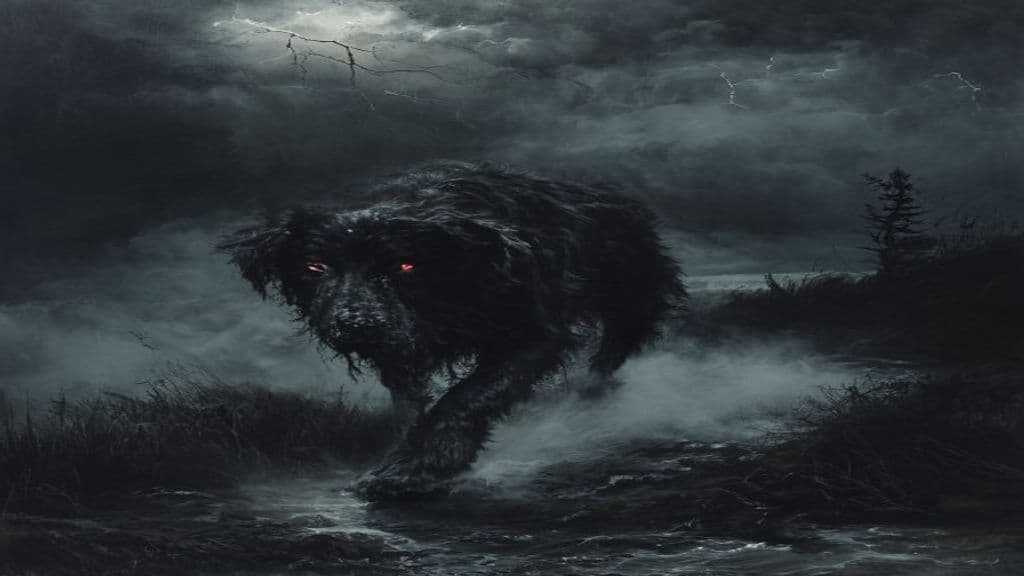
Black Shuck
A spectral black dog of East Anglian legend, with glowing red or green eyes. Its appearance is an omen of death. Its howl has been heard on clifftops during storms for centuries.
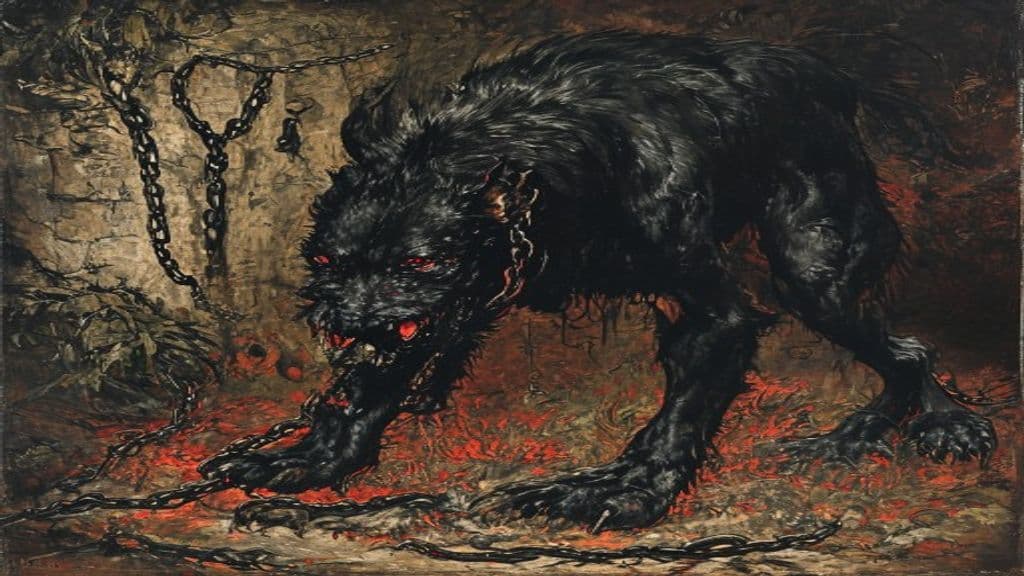
Hellhound
A class of mythic canine beings associated across many cultures with the boundary between the human world and the underworld or otherworld. Depending on tradition they function as guardians or attendants of the realm of the dead, members of spectral hunts, omens of death, or emissaries of diabolic forces.

La Llorona
The Weeping Woman of Mexican folklore — the ghost of a mother who drowned her children and now wanders rivers and lakes, weeping for them and taking other children she finds at night.
Cabeiro
Cabeiro (also spelled Kabeiro) is a figure in Greek mythology identified as a daughter of the shape‑shifting sea‑god Proteus and, by union with the forge‑god Hephaestus, the mother of the groups known as the Cabeiri and the Cabeirian nymphs. She appears in genealogical accounts linking marine and smithing divine lineages.
Caca
Caca is an ancient Roman female deity associated with the sacred hearth, attested in late sources as possessing a sacellum (shrine) in Rome where sacrifices were made through the agency of the Vestal priesthood. Later tradition and modern summaries report that her cult was succeeded or replaced by Vesta, and some secondary accounts link her mythically to Cacus.
Cacciaguida degli Elisei
A historically attested medieval Florentine ancestor whom Dante depicts in the Paradiso (Cantos XV–XVII) as a beatified soul in the Heaven of Mars; he functions as a paternal interlocutor who confirms Dante's lineage and imparts moral counsel and prophetic admonitions.
Cacodemon
A term originating in Ancient Greek (κακοδαίμων, kakodaimōn) denoting an "evil spirit" — the morally malign subset of daimōn — later reused in literature, psychiatry (cacodemonia), occult fragments, and popular culture where it appears as a videogame monster. Sources present the cacodemon both as a moralized spirit-type in classical-language summaries and as various modern imaginative creatures rather than a single fixed biological species.
Cactus Cat
A legendary 'fearsome critter' of American Southwestern frontier folklore: a bobcat-like feline covered in thorny spines, said to slash cacti to drink their fermented juices. It appears in tall-tale storytelling among miners, cowboys, and regional compendia rather than in documented ritual or indigenous cosmologies.
Cacus
Cacus is a monstrous, fire‑breathing giant of Roman myth who lived in a cave on the site of the future Rome (Aventine Hill/Forum Boarium). He stole cattle, preyed on humans, and was slain by the hero Heracles/Hercules; his death is etiologically linked to the founding of a local altar (the Ara Maxima) and to annual rites to Hercules in that district.
Cadmus
Cadmus is a legendary Phoenician prince and culture-hero in Greek myth, credited with founding Thebes, slaying a local dragon/guardian, marrying Harmonia, and—by some ancient sources—bringing a Phoenician script to Greece.
Cadoc
Cadoc (Medieval Latin: Cadocus; Welsh: Cadog or Catwg) is represented in medieval Welsh sources as a late 5th–6th century Christian saint, monastic founder and teacher centered on Llancarfan. His Vita records portents at his birth, miraculous signs (a holy well, a vanishing boar) and numerous foundations and dedications across Wales, Cornwall, Brittany and Scotland; his life-functions in the sources are hagiographical: miracle-worker, educator and local patron invoked for cures in some Breton sites.
Cador
Cador (Latin Cadorius; early forms Cado, Cadwy) is a legendary aristocratic figure of the Arthurian and early British pseudo‑historical tradition, portrayed in medieval sources as a duke/earl/king and a military commander allied with King Arthur. His historicity is uncertain and debated by scholars; details derive from Geoffrey of Monmouth, later medieval poets (Layamon, Mannyng) and later genealogical interpretations.
Caeculus
Caeculus is a Roman legendary founder figure, venerated as the eponymous founder of Praeneste (modern Palestrina) and described in tradition as a son of Vulcan. His birth story links domestic fire and the hearth to civic origins; he is depicted as surviving exposure, founding a community, and exhibiting unusual relations to fire.
Caelia
Caelia is a literary name used by early modern and later authors for two distinct female figures: a fairy-queen in Richard Johnson's romance Tom a Lincoln who rules an island of women, and an allegorical personification of a heavenly, maternal spirit in Edmund Spenser's The Faerie Queene who rules the House of Holiness and aids the Redcrosse Knight. The name also appears in early modern song broadsides as a beloved figure and exists independently as a Roman gens name.
Caelius Vibenna
Caelius Vibenna (Etruscan Caile Vipina) is presented in the supplied tradition as an Etruscan noble and legendary leader associated with a circle of companions; he appears in Etruscan tomb painting (notably the François Tomb at Vulci) and in later Roman antiquarian tradition as an ancestral or eponymous figure tied to the Caelian Hill of Rome. The corpus treats him as a human aristocratic/heroic figure rather than a supernatural being.
Community Record
- [1]Cadejo (Wikipedia). Wikipedia contributors. 'Cadejo.' Wikipedia, The Free Encyclopedia. https://en.wikipedia.org/wiki/Cadejowiki
- [2]Wikidata: Cadejo (Q5016347). Wikidata entry Q5016347 (Cadejo). http://www.wikidata.org/entity/Q5016347other
- [3]Archive listing: Eventos paranormales... (conference audio listing). Archive.org. 'Eventos paranormales, parálisis del sueño, desdoblamiento astral interno, exorcismos, obsesión psíquica...' (conference listing). https://archive.org/details/julio-10-eventos-paranormalesother
- [4]Archive listing: Turn around (conference audio listing). Archive.org. 'Turn around' (conference listing including 'seres paranormales'). https://archive.org/details/acidplanet-audio-01430052other