
Capheira is presented in the surviving summaries of Greek myth as an Okeanid — a daughter of the Titan Oceanus (often given as daughter of Oceanus, possibly by Tethys in broader Oceanid genealogy) — who resided on the island of Rhodes. In the mythic narrative preserved in concise secondary summaries, the infant Poseidon was entrusted by Rhea to local guardians; Capheira, together with the Telchines (legendary Rhodian craftsmen and early island inhabitants), was committed to the care and protection of the babe and jointly participated in his upbringing. This placement ties Capheira to both the primordial watery generation (the Oceanids) and to localized Rhodian traditions that situate minor divinities and legendary artisans as custodians in origin myths.
No specific ancient descriptive or iconographic details for Capheira are preserved in the supplied materials. She is designated generically as an Okeanid/Oceanid nymph, which in Greek mythic typology implies a female nature-spirit associated with bodies of water or coastal localities and commonly imagined as youthful, beautiful, and water-linked in broad literary and artistic conventions. Beyond this generic implication, the provided sources offer no surviving attributes (dress, height, iconography) specific to Capheira.
The sources consistently ascribe to Capheira the role of nurse and protector of the infant Poseidon; she is described as having been entrusted by Rhea to care for the god in his infancy and to have acted in concert with the Telchines in that guardianship. No further personal powers, magical competencies, hostile behaviors, or independent feats are attested for Capheira in the supplied corpus; her function is narrowly attested as a custodial, caregiving presence within the mythic household economy.
Weaknesses
- othernot attested in sources
Wards
- othernot attested in sources

Poseidon
Poseidon is a principal deity of the ancient Greek pantheon, counted among the Twelve Olympians; he presides over the sea, storms, earthquakes and horses and functions as protector of seafarers and guardian of cities and colonies.
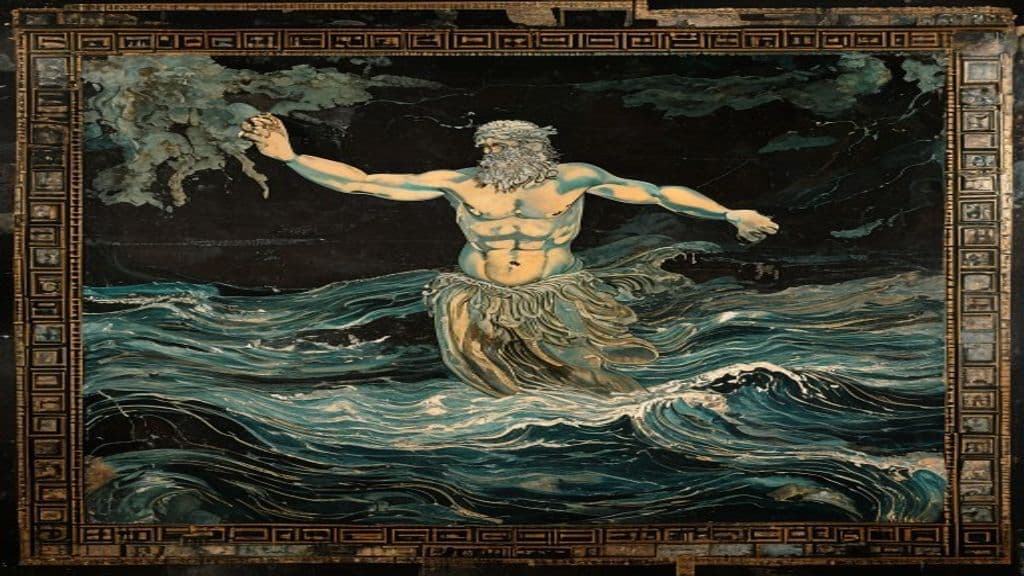
Oceanus
Oceanus (Greek: Ὠκεανός) is a primordial Titan in ancient Greek cosmology who personifies the great river that encircles the world and is named as father of the river gods (potamoi) and the Oceanids. He functions as a cosmological boundary-stream and genealogical progenitor in multiple Greek traditions and appears in literary theogonies and Greco-Roman art.
Abas
Abas (Ancient Greek: Ἄβας, gen.: Ἄβαντος) is not a single mythic being but a recurring personal name borne by multiple mortals and minor mythic figures in Greek epic and genealogical traditions — kings, founders, seers, warriors, attendants, a centaur, and a youth transformed by a goddess. The name is glossed in the sources as 'guileless' or 'good-hearted' and appears across Argive, Theban, Trojan, Euboean, and other local cycles.
Aceso
Aceso (Ancient Greek: Ἀκεσώ, Akesó) is an ancient Greek goddess who personifies the process of healing and convalescence. She is attested as a daughter of Asclepius and Epione and was worshipped in healing centers such as Athens and Epidauros, appearing in sculptural reliefs alongside her family.
Acheilus
Acheilus (also spelled Akheilos/Achilleus in some sources) is a minor figure of Greek myth described as a mortal son of Zeus who was transformed into a shark and thereafter called a 'shark-formed sea daimon.' Surviving summaries frame his story as a hubris metamorphosis: boasting about his beauty led a goddess to change him into a marine monster.
Achelois
Achelois (Ancient Greek: Ἀχελωίς, 'she who drives away pain') is an attributive name or epithet used in ancient Greek mythic contexts rather than a single, consistently characterized being. The term appears applied to several different figures — a surname of the Sirens, a general name for certain water-nymphs (Acheloides), and as the name of a daughter of Pierus — and functions within Greek naming practice as a descriptive label rather than a fixed ontological office.
Achelous
Achelous is the personified river-divinity of the Achelous River in ancient Greek religion and mythology. Regarded among the potamoi (river-gods), he is portrayed as a shape-changing elemental deity associated with springs, naiads, and the production of abundance (the horn/cornucopia motif); he appears in myths chiefly as suitor to Deianeira and as Heracles' opponent.
Achilles (son of Zeus)
A minor figure in Greek myth named Akhilleus (Ancient Greek: Ἀχιλλεύς), presented in some traditions as a son of Zeus and the Lamia who was famed for irresistible beauty, won a beauty contest judged by Pan, and was transformed into ugliness by Aphrodite. This Akhilleus is distinct from the Homeric hero of the Trojan War.
Achiroe
Achiroe (variants Anchirrhoë, Anchinoë/Ankhinoe) is a minor Greek mythological figure: a Naiad associated with the river Nile, daughter of the river-god Nilus, who becomes the wife of the Egyptian king Belus and mother of mythic progenitors such as Aegyptus and Danaus (with some accounts also naming Cepheus and Phineus). She functions primarily as a genealogical link between river-divinity and royal lineages rather than as an active agent in surviving myths.
Acontes
Acontes (Ancient Greek: Ἀκόντην) is an Arcadian prince in Greek mythology, counted among the fifty sons of the impious King Lycaon. He appears in the Lycaon narrative as a participant in a sacrilegious meal prepared for Zeus (disguised as a peasant) and is destroyed by the god's lightning as punishment.
Actaea
Actaea is a named sea‑nymph in Greek mythic lists, identified in the provided sources as the personification or eponym of the seashore. She appears primarily in onomastic and catalogue contexts (lists of nymphs/Nereids) and has no surviving independent narrative or cultic rites attested in the cited material.
Acte (Akte)
Acte (Ancient Greek Akte, sometimes rendered Acme) is a divine personification in Greek myth: one of the Horae who embodies a particular hour of the day — specifically the hour of eating and pleasure, a designated afternoon work-hour — and functions chiefly as a temporal marker rather than an active mythic agent.
Actia
Actia (Ancient Greek: Ἄκτια) is attested in the supplied sources not as a supernatural being but as (a) the ancient festival and epithet of Apollo Actius associated with Actium and Nicopolis, and (b) a modern taxonomic and commercial name (genus of flies; company and product names). No folkloric or mythic entity named Actia is documented in the provided materials.
Adikia
Adikia (Ancient Greek: Ἀδικία) is the personification and embodiment of injustice and wrongdoing in ancient Greek religious and visual culture, typically portrayed as the opposite and vanquished counterpart of the goddess Dike (Justice). She appears chiefly in archaic vase-paintings and emblematic visual programs where Justice punishes or restrains her.
Community Record
- [1]Capheira - Wikipedia. Wikipedia contributors, 'Capheira,' Wikipedia, The Free Encyclopedia.wiki
- [2]CAPHEIRA (Kapheira) - Rhodian Oceanid Nymph of Greek Mythology. Theoi Project, 'Kapheira (Capheira),' summary entry.other
- [3]Capheira | Facts, Information, and Mythology. Pantheon.org, 'Capheira' summary article.other
- [4]Who Were the Telchines? The Malevolent Wizards of Greek Mythology | TheCollector. TheCollector, article on the Telchines (contextual source for Rhodian tradition and Telchines' role).other
- [5]Wikidata: Capheira. Wikidata entry for 'Capheira' (includes modern homonym information).wiki