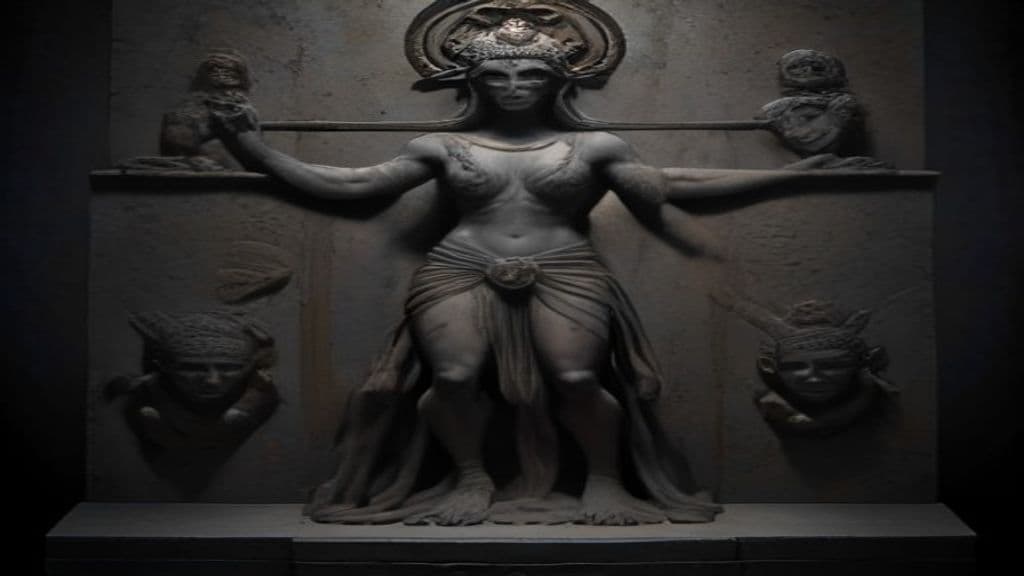
The name attested in Etruscan sources appears to be an adaptation of Greek Charon adopted into Etruscan religious vocabulary; sources note the name was "imported from Greek Charon" and then adapted (spelling variants Xarun/Xaru reflect Etruscan phonological developments). The surviving record does not preserve an independent native Etruscan etymology or a native-origin narrative for Charun; instead the figure emerges in Etruscan funerary iconography as an underworld attendant associated with the realm ruled by deities such as Aita/Mantus and Mania.
Charun is shown in Etruscan tomb reliefs and funerary objects with grotesque, monstrous features. Common iconographic traits recorded in the sources include a large hammer or mallet (frequently held or planted), pointed ears, snakes entwined around his arms, and a discolored (bluish, pale-cream or greyish) skin tone interpreted as signifying decay. Variants show enormous wings, snake-like hair, a vulture-like hooked nose, large tusks, heavy brow ridges, and sometimes pronounced lips, bright or "fiery" eyes, and a beard in certain renderings. Some scenes depict Charun mounted on horseback or also carrying a sword, but such attributes are attested in particular images rather than as universal features.
In the surviving evidence Charun's primary role is as an escort or guide of the dead — a psychopomp who, often together with Vanth and other underworld assistants (for example Tuchulcha), accompanies souls to their destination in the afterlife. Iconography also portrays Charun in menacing or violent poses: the hammer is shown in violent scenes (for example swinging at a figure's head on the sarcophagus of Laris Pulenas and threatening a male figure on an Orbetello stamnos). Scholars offer multiple interpretations of the hammer's meaning — emblematic funerary symbol, apotropaic instrument defending the deceased (striking serpents attacking the dead), or an instrument ensuring death — and these readings vary by image. Sources emphasize that Charun functions as an attendant rather than as the sovereign punisher of souls, and that Etruscan underworld contexts are generally morally neutral rather than punitive in a Christian sense.
Weaknesses
- otherno explicit weaknesses in sources
Wards
- symbolapotropaic funerary depiction of Charun
Aita
Aita is an Etruscan chthonic epithet of the older god Śuri (Suri), functioning as an underworld lord in late Etruscan iconography and funerary contexts. Appearing from about the 4th century BC, Aita shows strong influence from the Greek Hades and is depicted rarely in tomb paintings and grave goods.
Apollo of Veii (Aplu)
A life-size late Archaic Etruscan terracotta cult statue of the deity Aplu (Etruscan Apollo) created for the acroterial program of the Portonaccio sanctuary at Veii, ca. 510–500 BCE; intended as an architectural cult image and narrative participant in a roofline group depicting Apollo and Heracles.
Apulu
Apulu (Etruscan: 𐌀𐌐𐌖𐌋𐌖; syncopated Aplu) is an epithet/aspect of the Etruscan fire god Śuri combining solar/sky and chthonic/volcanic functions. Attested in inscriptions, major sculpture (notably the Apollo of Veii) and small votive objects, Apulu is associated with sun and light, thunder and lightning, healing and plague, and the protection of divination.
Begoe
Begoe is a scarcely attested named figure in Etruscan religious tradition, recorded in a 19th‑century retelling as able to slay an ox by whispering a sacred name. Modern references sometimes list Begoe as a variant spelling of the better‑attested Etruscan figure Vegoia/Vegoe, but evidence is fragmentary.
Calu
Calu is an Etruscan theonym/epithet denoting the chthonic, dark aspect of the fire-underworld god Śuri; the name was also used as a synonym for the underworld itself. Iconography and cultic language associate Calu with darkness and lupine (wolf) attributes and link the epithet to central-Italian wolf-ritual phenomena.
Culsu
Culsu is an attested name listed among Etruscan deities and legendary figures in modern compilations. Available sources provide only nominal attestation (the name and a modern label of 'goddess'); no independent ancient narratives, functions, iconography, or rituals are recorded in the supplied materials.
Fufluns
Fufluns is an Etruscan deity of plant life, wine, health, happiness, and growth, often equated with Greek Dionysos and Roman Liber. He is named as the son of Semla and Tinia, worshipped at Populonia (Fufluna/Pupluna), and is mentioned twice among the 16 gods on the Liver of Piacenza, where he appears as the ninth of the sixteen.
Hercle
Hercle is an Etruscan divine hero—an immortal of the Etruscan pantheon, presented as son of Tinia and Uni—portrayed with Heracles-type attributes but invested with distinct local roles as a liminal protector, master of animals, and an oracular cult figure in Etruria.
Persipnei
Persipnei (also Phersipnai, later Ferspnai) is the Etruscan queen of the underworld, consort to the underworld ruler Aita and the principal female sovereign in Etruscan netherworld iconography. She is an Etruscan analogue of the Greek Persephone and Roman Proserpina and appears chiefly in tomb frescoes.
Phersipnai
Phersipnai (also attested as Persipnei) was the Etruscan queen of the underworld, described in the sources as the consort of the underworld ruler Aita and functionally equivalent to the Greek Persephone and Roman Proserpina. The available references state that the Etruscan name was borrowed from Greek and place her among the ruling figures of the Etruscan chthonic realm.
Tinia
Tinia (also Tin, Tinh, Tins, Tina) is the chief sky god of the Etruscan religion, associated with thunderbolts, divination, and the guarantying of boundaries. He occupies a role analogous to Roman Jupiter and Greek Zeus and appears in Etruscan votive inscriptions and on the Piacenza Liver used for haruspicy.
Turms
Turms is an Etruscan divine figure who functions primarily as a messenger between humans and gods, an attendant or minister to higher deities (notably Tinia), a god associated with trade, and a psychopomp who conducts souls to the afterlife. He is attested mainly in Etruscan iconography on mirrors, sarcophagi, and decorated objects and is often equated functionally with Greek Hermes and Roman Mercury while bearing a distinctively Etruscan name.
Community Record
- [1]Charun. Wikipedia entry 'Charun' (summarized material on origins, appearance, functions, and funerary examples).wiki
- [2]Charun (Wikidata). Wikidata item Q1067918 (concise statement that Charun is one of the psychopompoi of the underworld).other
- [3]Paleoglot blog: 'Charun Number Six'. Paleoglot blog post noting multiplicity of Charun names in scholarship (used for confirmation of multiple attestations; treated as uncertain provenance by compiler).other
- [4]Larissa Bonfante & Judith Swaddling (as cited in Wikipedia). Bonfante & Swaddling: 'Many scenes feature the two purely Etruscan underworld demons, Vanth and Charu, whose job is not to punish the dead but rather to escort them to their final destination.' (as quoted in the sourced summary).academic
- [5]Nancy de Grummond (as cited in Wikipedia). Nancy de Grummond's discussion of the hammer: noting sarcophagus reliefs with Charuns swinging hammers, and interpretations including protective action against serpents and other contextual readings (as summarized in the provided material).academic
- [6]Miscellaneous archival items examined in research notes. Additional archive records referenced in the research notes were reviewed but did not alter core factual claims about Charun's Etruscan funerary role.other