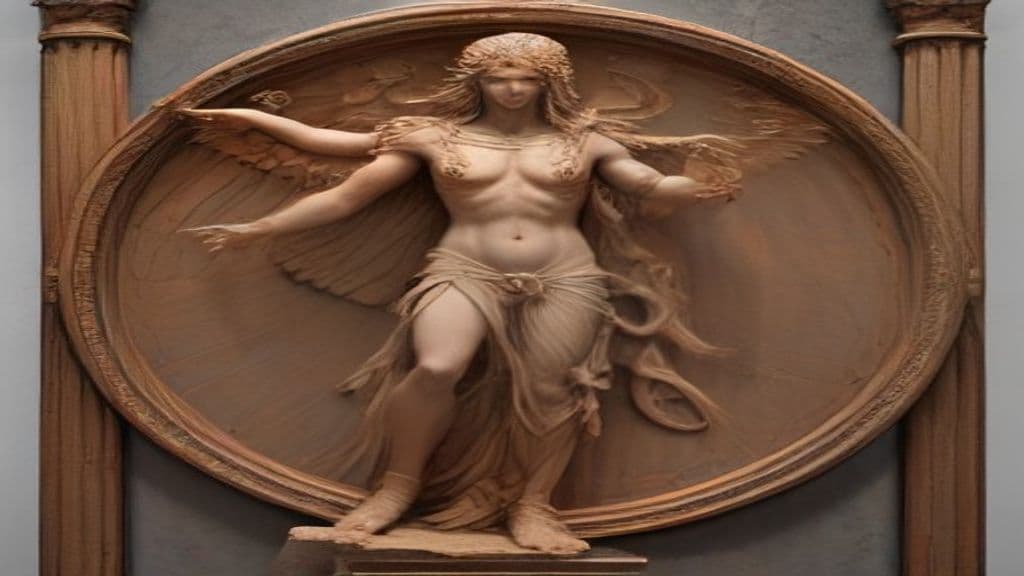
The sources do not provide a mythic origin story for Turms. Linguistically the name is recorded in the Etruscan alphabet as 𐌕𐌖𐌓𐌌𐌑 (transliterated Turmś) and is described as distinctively Etruscan in origin; beyond this onomastic note, no narrative account of his birth or origin is attested in the provided material.
Iconography depicts Turms with attributes parallel to Greek Hermes and Roman Mercury: a caduceus (staff entwined by serpents), a petasos (often shown winged), and winged sandals. He appears in Etruscan art on mirrors, sarcophagi, and in narrative scenes (for example, the Judgement of Paris and mythic episodes featuring Hercle/Perseus), and in underworld contexts where he may be labeled (e.g., Turmś Aitaś).
Attested functions include acting as a messenger between gods and humans, serving as an attendant or minister (ministerium) to greater deities such as Tinia, acting as a psychopomp conducting souls into the afterlife (including depictions alongside underworld figures like Charun and Cerberus and a labeled scene bringing the shade of Tiresias to Odysseus), and an association with trade and commerce analogous to Roman Mercury. These roles are drawn from Etruscan iconography and scholarly interpretation of inscriptions and scenes.
Aita
Aita is an Etruscan chthonic epithet of the older god Śuri (Suri), functioning as an underworld lord in late Etruscan iconography and funerary contexts. Appearing from about the 4th century BC, Aita shows strong influence from the Greek Hades and is depicted rarely in tomb paintings and grave goods.
Apollo of Veii (Aplu)
A life-size late Archaic Etruscan terracotta cult statue of the deity Aplu (Etruscan Apollo) created for the acroterial program of the Portonaccio sanctuary at Veii, ca. 510–500 BCE; intended as an architectural cult image and narrative participant in a roofline group depicting Apollo and Heracles.
Apulu
Apulu (Etruscan: 𐌀𐌐𐌖𐌋𐌖; syncopated Aplu) is an epithet/aspect of the Etruscan fire god Śuri combining solar/sky and chthonic/volcanic functions. Attested in inscriptions, major sculpture (notably the Apollo of Veii) and small votive objects, Apulu is associated with sun and light, thunder and lightning, healing and plague, and the protection of divination.
Begoe
Begoe is a scarcely attested named figure in Etruscan religious tradition, recorded in a 19th‑century retelling as able to slay an ox by whispering a sacred name. Modern references sometimes list Begoe as a variant spelling of the better‑attested Etruscan figure Vegoia/Vegoe, but evidence is fragmentary.
Calu
Calu is an Etruscan theonym/epithet denoting the chthonic, dark aspect of the fire-underworld god Śuri; the name was also used as a synonym for the underworld itself. Iconography and cultic language associate Calu with darkness and lupine (wolf) attributes and link the epithet to central-Italian wolf-ritual phenomena.
Charun
An Etruscan chthonic attendant and psychopomp depicted in funerary art; Charun escorts the dead to the underworld and appears in grotesque, monstrous form often bearing a hammer. He is typically an underworld functionary rather than the sovereign ruler of the dead.
Culsu
Culsu is an attested name listed among Etruscan deities and legendary figures in modern compilations. Available sources provide only nominal attestation (the name and a modern label of 'goddess'); no independent ancient narratives, functions, iconography, or rituals are recorded in the supplied materials.
Fufluns
Fufluns is an Etruscan deity of plant life, wine, health, happiness, and growth, often equated with Greek Dionysos and Roman Liber. He is named as the son of Semla and Tinia, worshipped at Populonia (Fufluna/Pupluna), and is mentioned twice among the 16 gods on the Liver of Piacenza, where he appears as the ninth of the sixteen.
Hercle
Hercle is an Etruscan divine hero—an immortal of the Etruscan pantheon, presented as son of Tinia and Uni—portrayed with Heracles-type attributes but invested with distinct local roles as a liminal protector, master of animals, and an oracular cult figure in Etruria.
Persipnei
Persipnei (also Phersipnai, later Ferspnai) is the Etruscan queen of the underworld, consort to the underworld ruler Aita and the principal female sovereign in Etruscan netherworld iconography. She is an Etruscan analogue of the Greek Persephone and Roman Proserpina and appears chiefly in tomb frescoes.
Phersipnai
Phersipnai (also attested as Persipnei) was the Etruscan queen of the underworld, described in the sources as the consort of the underworld ruler Aita and functionally equivalent to the Greek Persephone and Roman Proserpina. The available references state that the Etruscan name was borrowed from Greek and place her among the ruling figures of the Etruscan chthonic realm.
Tinia
Tinia (also Tin, Tinh, Tins, Tina) is the chief sky god of the Etruscan religion, associated with thunderbolts, divination, and the guarantying of boundaries. He occupies a role analogous to Roman Jupiter and Greek Zeus and appears in Etruscan votive inscriptions and on the Piacenza Liver used for haruspicy.
Community Record
- [1]Turms. Wikipedia contributors, 'Turms,' Wikipedia, The Free Encyclopedia, https://en.wikipedia.org/wiki/Turmswiki
- [2]Turmstraße (Wikidata entry referenced in notes). Wikidata entry Q870591 (Turmstraße), http://www.wikidata.org/entity/Q870591other
- [3]Der Turm (1954) [archival item referenced in notes]. Archive.org, Der Turm (1954), https://archive.org/details/der_turm_1954other
- [4]GitHubDaily archive (referenced in notes). Archive.org, GitHubDaily archive, https://archive.org/details/github.com-GitHubDaily-GitHubDaily_-_2022-06-11_15-12-58other