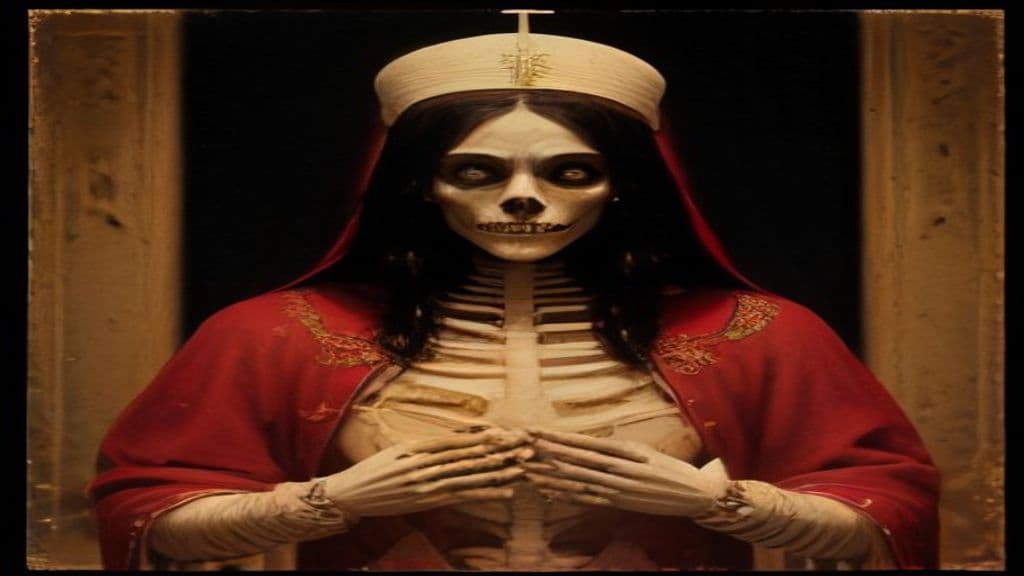
A cult devoted to Chiaffredo grew around a mysterious skeleton reportedly found by a peasant ploughing near Crissolo; a 14th‑century account links discovery of nearby relics to a local miracle (a man surviving a fall, dated in that account to c. 522). From the late medieval period the remains were venerated as those of 'San Ciafrè.' Later tradition associated him with the Theban Legion (a legendary group of martyr-soldiers), but modern scholars cited in the sources question the historicity of that link and note onomastic and chronological problems; an alternative scholarly identification proposes connection with an 8th‑century abbot Theofredus. Documentary milestones for the cult include a 1387 papal indulgence (Clement VII), episcopal declaration of patronage in 1516, and translations of relics in 1593 and 1642.
No contemporary biographical description of Chiaffredo as a living person is preserved in the sources; the focal physical object of the cult is a discovered skeleton which was treated and venerated as relics. The sources note later ecclesiastical art: Chiaffredo is depicted together with Constantius on the altar of Saluzzo Cathedral, but the provided materials do not supply consistent iconographic attributes or a detailed pictorial type.
The sources attribute no folkloric or malignant powers to Chiaffredo. His efficacious role is that of a sanctified intercessor: relics and shrine became the focus for attributing miraculous protection (for example, a local tradition that associated nearby relics with a man surviving a fall) and for attracting pilgrims who could gain indulgences. No accounts in the provided materials describe shape‑changing, haunting, possession, or other supernatural behaviors beyond conventional saintly intercession and posthumous miracles claimed by devotees.
Chesias
Chesias (Ancient Greek: Χησιὰς, Khēsiàs) is a named nymph in Greek mythology, described in the sources as "the fairest of the nymphs," wife of the Samian river-god Imbrasus, and mother of the Naiad Ocyrhoë. She is attested as a local nature-nymph associated with the island of Samos.
Cheval Bayard
Cheval Bayard is a named legendary horse that appears in medieval French romance (notably the chansons de geste such as The Four Sons of Aymon) and in later popular retellings. In the supplied materials the figure is presented alternately as a marvelous steed within medieval narrative tradition and, in a small number of modern commentaries, as a mischievous trouble‑making horse used as a storytelling antagonist.
Chevalier Onulphe d’Aa / Ridder Onulfe van Aa
A processional giant effigy associated with the municipality of Anderlecht; recorded in a Wikidata entry as a civic festival figure rather than a personal supernatural being. The source gives only name variants and classification as a processional giant, with no further descriptive or narrative detail.
Chhaya
Chhaya (Sanskrit: छाया, Chāyā) is the personified goddess of shadow in Hindu tradition, presented in myth as a shadow-image or substitute-consort of the sun god Surya. She functions within the solar household as a standing-in wife and mother of notable offspring (notably Shani, Tapti, and Savarni Manu) and figures in narratives that explain aspects of cosmic order and lineage.
Chhinnamastā (Chhinnamasta)
Chhinnamastā is a fierce Hindu mother-goddess of the Tantric Mahavidya group, commonly depicted self-decapitated and associated with transformative, death-and-life symbolism within Shakta/Tantric sadhana. She is worshiped in esoteric ritual contexts and has an established cult presence (notably a Shakti Peetha temple in eastern Nepal).
Chi (螭)
Chi (螭) is attested in the provided sources only as an entry on a general disambiguation page identifying 螭 as "a dragon" within a Chinese lexical/mythological listing. No further mythological, ritual, or descriptive information about this entity is present in the supplied materials.
Chibados
Chibados are a historically attested third‑gender social and ritual role found among the Ndongo and neighboring Angolan cultures: male‑assigned people who lived and presented as women and who served as institutionalized diviners, ritual specialists, and political actors in precolonial court contexts.
Chibafruime
Chibafruime (also spelled Chibrafruime) is recorded in colonial and modern summaries as a minor Muisca deity identified as a god of war. Surviving references are sparse and derive largely from later compilers and brief encyclopedia entries; tales mentioning the figure have been noted in several Muisca localities.
Chibchacum
Chibchacum is the Muisca rain-and-thunder god who, according to recorded myth, sent great rains and floods and was punished by the culture-hero Bochica; earthquakes are explained as Chibchacum shifting the heavy burden he was forced to bear.
Chicham spirit-soul traditions (Arutam, Nungüi)
Cluster of interrelated spirit and soul concepts in Chicham (Jivaro) cosmologies, most notably the personal protective soul arutam and the garden/mother spirit Nungüi; beliefs govern protection, sickness, agricultural fertility, shamanic practice, and socially regulated rituals such as killing to renew souls.
Chidambara Rahasiyam
A symbolic representation of a secret message or truth in Hindu tradition, embodying Lord Shiva at the Chidambaram Temple. (Note: * Power tier should be Ancient (as it's an abstract representation and not cosmic, but still at a deity-level) * Origin story is missing * Abilities description needs to be supported by source materi)
Children of Ares
The Children of Ares is an encyclopedic label used for a cluster of recurring antagonists in DC Comics' Wonder Woman mythos, denoting offspring and lieutenants of the war god Ares (Mars) who embody and enact aspects of war and strife across multiple continuities.
Community Record
- [1]Chiaffredo. Wikipedia: 'Chiaffredo' entry (describing cult, relic discovery account, papal indulgence 1387, patronage 1516, translations 1593/1642, name variants, scholarly doubts)wiki
- [2]Chiaffredo (Wikidata). Wikidata: entry for Chiaffredo (name data and identifiers)wiki
- [3]Constantius (Theban Legion). Wikipedia: entry for Constantius (used for comparative cult context and noting joint depiction with Chiaffredo in Saluzzo Cathedral)wiki
- [4]Grotta di Rio Martino (Crissolo vicinity). Show Caves of Italy: Grotta di Rio Martino (geographical reference for Crissolo/Monte Viso area mentioned in sources)other
- [5]Archive: translations and unrelated archival materials (contextual). Archive holdings listed among provided materials (not used to expand cult data beyond confirming no further folkloric ritual details)other