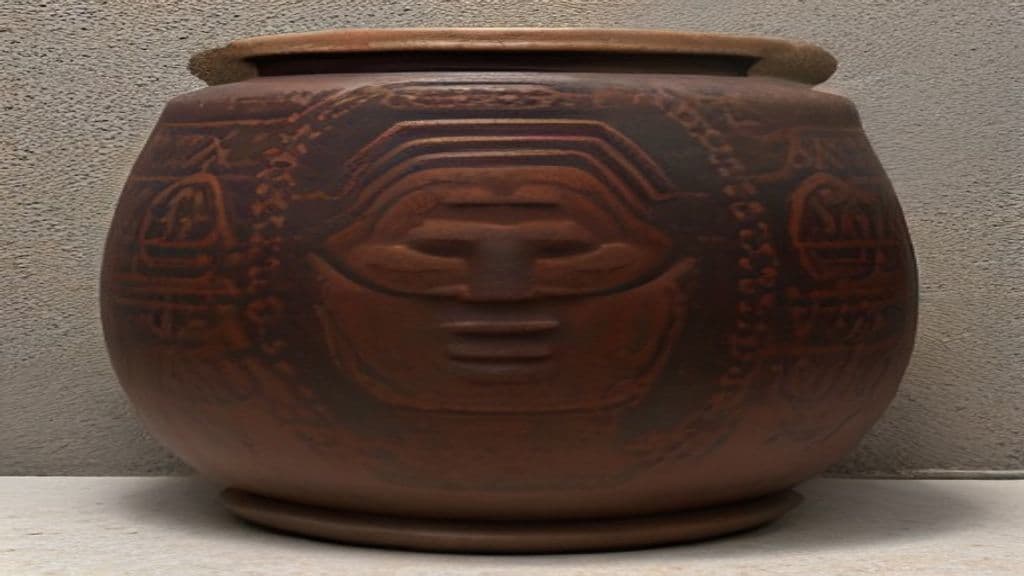
Archaeological and historical summaries in the supplied sources place the emergence of the Chimú cultural-political formation around ca. 900 CE, succeeding the earlier Moche culture. Over several centuries the Chimú expanded along the Pacific littoral of what is now northern Peru, consolidating a kingdom (termed Chimor) that by its height encompassed roughly 1,000 kilometres of coastline. The polity persisted until it was conquered by the Inca emperor Topa Inca Yupanqui around 1470 CE, approximately fifty years before sustained Spanish contact in the region (Sources: Wikipedia Chimor; museum and regional summaries).
Because 'Chimú' denotes a people and polity rather than an individual supernatural form, appearance descriptions in the sources focus on material culture and architecture: fine ceramics and iconography (vessels depicting fishermen and maritime scenes), distinctive metalwork (including silver armor examples in museum collections), textiles, and large-scale urban adobe architecture exemplified by the capital region of Chan Chan with coastal ports such as Huanchaco. Photographic and museum collections document these artifacts and their motifs (museum collection notes; photographic sources; vessel captions) (Sources: Museum of Cultural History, earthasweknowit, archive.org images).
As a socio-political entity the Chimú exhibited organizational and technological capacities: centralized craft production (ceramics, metalwork, textiles), maritime orientation and control of extensive coastal resources and ports (Huanchaco served as the main port of Chan Chan), and political reach over a broad coastal territory. Archaeological excavations associated with Chimú control have also produced evidence of ritual practices, including human sacrifice (multiple child and neonate burials with fractures and cutting marks reported from Huanchaco and other sites), indicating organized ritual behaviors though the supplied sources do not record ritual protocols or priestly roles (Sources: Wikipedia Chimor; museum and excavation reports as summarized in the History Blog posts and museum notes).
Children of Ares
The Children of Ares is an encyclopedic label used for a cluster of recurring antagonists in DC Comics' Wonder Woman mythos, denoting offspring and lieutenants of the war god Ares (Mars) who embody and enact aspects of war and strife across multiple continuities.
Children of Heracles
A group of mortal descendants of the hero Heracles (Hērakleidai) represented in Euripides' tragedy Children of Heracles (performed 430 BCE). In the play they appear as suppliants persecuted by Eurystheus whose fate raises civic, religious, and moral questions rather than as a class of supernatural beings.
Children of Ilúvatar
In J. R. R. Tolkien’s legendarium, the Children of Ilúvatar are the two principal kinds of sentient, created beings—Elves and Men—brought into being by the supreme creator Ilúvatar (Eru) and occupying a central place within Tolkien’s cosmology.
Chimera
The Chimera (Ancient Greek Χίμαιρα) is a monstrous hybrid from Greek myth—traditionally a fire‑breathing composite described with a lion forepart, a goat in the middle, and a serpent hind—portrayed as a destructive beast from Lycia that ravaged cattle and countryside and was slain by the hero Bellerophon. In later tradition its image also appears in visionary or allegorical contexts as an omen.
Chimimōryō
A traditional East Asian class of nature‑bound spirits and monsters associated with mountains, rivers, forests, swamps, trees, and rocks. Originating in ancient Chinese chronicles, the compound term unites two paired spirit-types (chimei and wangliang/mōryō) and was later adopted into Japanese reference works as a catch‑all category for various yōkai, oni‑like beings, and nature deities.
Chiminigagua
Chiminigagua is the supreme creative principle in Muisca (Chibcha) cosmology of the Colombian Altiplano; described in sources as the primordial source of light who brought the visible world into being and from whom the Sun, Moon and other lesser deities derive. The deity is presented more as a transcendent, often bodiless origin than as a regularly culted, anthropomorphic patron; veneration in practice was channeled through solar, lunar and fertility cults and major sanctuaries.
Chin
Chin is a named male numinous figure attested in colonial-era Spanish descriptions of certain Maya groups (notably Verapaz and reports from the Itzá) as having demonstrated sexual intercourse with other male deities and humans; his actions are cited etiologically in those sources as a precedent for regulated same-sex practices in some Maya communities. The surviving extracts do not present Chin with a full cult biography, ritual prescriptions, or iconographic identification in primary indigenous texts.
Chindi (Navajo)
In Navajo tradition, a chindi is the negative energy or miasma left behind after a person dies. (Note: 1. Power tier should be revised as Primordial, since it's described as "everything that was negative about the person's life" and its effects are not limited to a specific region. 2. Sensory cues shou)
Chinese dragon (long / loong)
A central legendary zoomorphic being in Chinese myth and culture (Chinese: long / loong), the dragon embodies auspicious cosmic and ancestral power, especially mastery over water and weather, and functions as an imperial and communal emblem across material culture, ritual performance, and state iconography.
Chinese ghosts
Spirits of deceased persons in Chinese folk belief, integrated with ancestor-worship and syncretic Buddhist ideas; often conceived as potentially malevolent if neglected or provoked, while some deceased become honored ancestral spirits through proper ritual care.
Chinese gods and immortals (shenxian)
A heterogeneous corpus of deities (shen) and immortals (xian) in Chinese religious and mythic thought, understood as manifestations or localizations of the cosmic principle (Tian/Tao/qì). They include celestial gods, local tutelaries, deified culture-heroes, and Taoist immortals formed and sustained by temples, ancestral ritual, and popular cult.
Chinese guardian lions (shī, 石獅)
Stone or metal sculptural guardian lions (Chinese: shī, often 石獅 shíshī "stone lion") placed in male–female pairs at thresholds to protect buildings and occupants. Originating in Chinese Buddhist and imperial symbolism, they function as apotropaic architectural emblems believed to ward off harmful spiritual influences and hostile humans when correctly placed.
Community Record
- [1]Chimor (Wikipedia). Wikipedia, Chimorwiki
- [2]Wikidata: Chimú culture. Wikidata entry for Chimú cultureother
- [3]Collar — Chimu (archive.org). Archive.org collection item describing Chimú artifactsother
- [4]Native American civilizations -- South America Chimu (HistClo). HistClo summary of Chimú chronology and cultureother
- [5]Museum of Cultural History: Moche- and Chimú ceramics. Museum of Cultural History collection notes on Moche and Chimú ceramicsother
- [6]Photos of Chimú artifacts. Photographic documentation of Chimú material cultureother
- [7]76 more child sacrifice victims found at Chimú site – The History Blog. News report summarizing archaeological finds of sacrificed children at a Chimú-associated siteother
- [8]Bones of sacrificed Chimú children found in Peru – The History Blog. News report summarizing archaeological evidence of child sacrifice at Huanchacoother
- [9]Great South American Native American Civilizations: Chronological Development (HistClo). Regional chronological overview placing Chimú in Andean sequenceother
- [10]Chimú Silver Armor - Photo. Photograph of Chimú metalwork in a museum collectionother