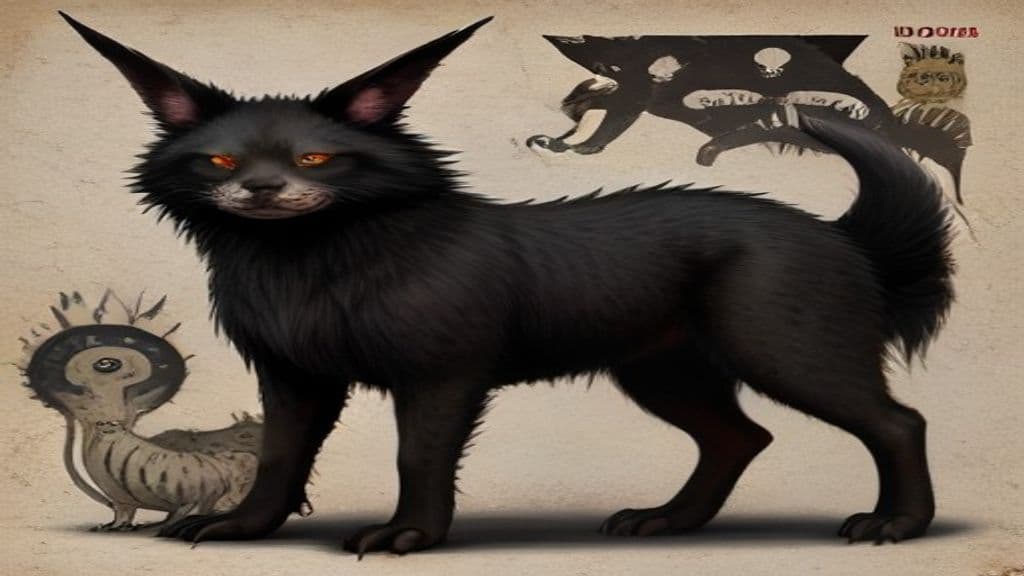
The name chupacabra (Spanish chupacabra / chupacabras, literally 'goat-sucker') was coined in the media context in 1995 and is attributed in source summaries to Puerto Rican comedian Silverio Pérez; it rapidly became the label applied to a cluster of livestock mutilation and alleged blood‑draining incidents beginning in Puerto Rico and later reported across the Americas. The creature's 'origin' in popular consciousness stems from press reports, eyewitness accounts, and subsequent media amplification rather than from a pre‑existing traditional myth cycle.
Descriptions vary widely across reports. In Puerto Rico and parts of Hispanic America the creature is often described in press summaries as a heavy, reptilian, alien‑like animal, sometimes said to be roughly the size of a small bear with a row of spines from neck to tail; in accounts from the Southwestern United States it is frequently portrayed as more dog‑like. The literature emphasizes the variability of descriptions and notes many reported carcasses were later identified as known animals (e.g., coyotes with sarcoptic mange, dogs, foxes), suggesting that appearance reports include misidentifications and folkloric embellishment.
Core attributed behavior in reports is attacks on livestock — especially goats — with alleged vampiric sucking or drinking of blood; early Puerto Rican accounts described animals 'bled dry' with small circular or puncture wounds (e.g., three puncture wounds reported in a 1995 case). These vampiric claims are anecdotal in the sources; where physical evidence was examined, biologists and authorities commonly attributed deaths and mutilations to ordinary predators (dogs, coyotes, foxes) and disease (severe mange) rather than to a unique blood‑draining cryptid. Thus the chupacabra functions primarily as an explanatory label applied to a variety of animal‑kill events.
Chud
The Chud (Russian: Чудь) are an ancient, mythic people in Russian and several Finno‑Ugric oral traditions. Presented as a pre‑modern population, they appear in legends as a displaced, assimilated, or subterranean society whose disappearance and former condition help explain features of landscape and cosmology in regional folklore.
Chudail (Churel)
A female revenant figure in North Indian and broader South Asian popular imagination: a vengeful female spirit said to return after traumatic or unjust death to haunt, possess, or exact revenge on the living. The figure functions in folklore and cinema as a locus for anxieties about gendered violence and transgressive femininity.
Chuhaister
Chuhaister (Ukrainian: Чугайстер) is a forest tutelary figure specific to the Ukrainian Carpathians. Portrayed both as an individual-like personage and as a limited-number type (accounts speak of one, or three, four, or seven Chuhaisters), he is an ambivalent forest man who hunts other wild spirits (notably mavkas), is associated with wind and storm phenomena, and interacts with humans—often as a solitary guardian of deep woods and high mountain wilds.
Chukwu
Chukwu is the supreme creative reality in traditional Igbo religion (Odinani), the source of all existence from which personal chi and lesser alusi derive. Chukwu functions as the ultimate authority, creator, and sustaining principle whose will is mediated in practice through intermediaries such as chi, alusi, diviners and the Arochukwu oracle.
Chullachaqui
A legendary forest being of the Peruvian and Brazilian Amazon described as a small forest creature or 'demon' notable for having one or both feet deformed; traditionally invoked in lore about people becoming lost or frightened in the jungle.
Chuma (Chuma-kik)
No reliable evidence in the provided sources identifies a supernatural entity called 'Chuma' or 'Chuma-kik' in Armenian tradition. The available materials mention the string 'Chuma' in unrelated contexts (personal names, place names, a Slavic word for plague) but supply no folkloric data linking it to Armenian spirits or monsters.
Chur (pseudo-deity)
Chur (Чур) is a term attested in Russian linguistic and folkloric usage that 19th‑century scholars reconstructed as a boundary patron or household protector. Its status as an actual worshipped god is disputed; surviving evidence is primarily formulaic speech, lexicographic entries, and a few literary citations rather than clear ritual or iconographic attestations.
Churail
The term "churail" appears in contemporary Pakistani media and Urdu-language fiction titles; the supplied sources document modern uses of the word (a 2020 Pakistani web series titled Churails and Urdu fiction collections using "churail" in their titles) but do not provide folkloric descriptions, origins, or ritual practices for a supernatural being by that name.
Church Grim
A site-bound guardian spirit in English, Scottish and Nordic/Scandinavian folklore that watches over an individual Christian church and its churchyard, defending the consecrated ground from profanation and hostile spirits. Forms and origin accounts vary by region, including a large black dog in English tradition, the bound spirit of an animal (often a lamb) in Scandinavian accounts, and in some Scottish strands the spirit of the most recently buried person acting as a temporary watcher.
Churel (Chudail)
A South Asian female revenant or vengeful ghost associated with women who die cruelly or unpurified; often said to target male relatives and sometimes described as latching onto trees, producing a tree‑attached tree‑spirit variant in local tales.
Chut
Household spirit in Belarusian mythology associated with domestic spaces and activities, responsible for bringing prosperity and success through offerings, but capable of cruel revenge if neglected. (Note: 1. Power tier: Lowered to Lesser, as it seems more consistent with "regional" or local influence rather than deity-level abilities. 2. Appearance: A note should be added that no physical description i)
Chuvash dragon (Verechelen / Vĕreśĕlen)
A serpentine supernatural being from Chuvash legend, described in sources as a large snake-like creature that can have wings, breathe fire, shapeshift, and in some variants possess multiple heads. The creatures are embedded in Volga-Bulgar regional legend and appear in place-based tales tied to sites such as Bilär and Alabuğa.
Community Record
- [1]Chupacabra (Wikipedia). Wikipedia, article 'Chupacabra'.wiki
- [2]La leyenda del Chupacabras (film). Wikipedia, article 'La leyenda del Chupacabras'.wiki
- [3]Chupacabras (cycling race). Wikipedia, article 'Chupacabras (cycling race)'.wiki
- [4]Winged Chupacabras! (blog anecdote). David Weatherly, 'Winged Chupacabras!' blog post recounting Puerto Rico police officers hearing 'the beating of powerful wings' and a 'powerful, rotten odor.'folk
- [5]Was the Nightjar an Early Chupacabra?. Benjamin Radford, skeptical examination linking some reports to known animals.other
- [6]Roswell 1960: 'Military Insider' Claims He Saw Humanoids And Chupacabras. Online tabloid-style report including sensational claims linking chupacabras to humanoid/alien narratives.other
- [7]El Chupacabra Breeds with Dog in California. Tabloid/online claim alleging hybridization or breeding with a dog.other
- [8]From the Archives: Scott Corrales – Chupacabras and Other Mysteries | Radio Misterioso. Radio/archival discussion of chupacabra reports and related mysteries.folk
- [9]Travus T. Hipp Morning News & Commentary (July 26, 2010). Archive.org radio/news commentary using 'chupacabras' in political/pop-cultural rhetoric about border anxieties.other
- [10]Funny or Die Video 4928: Amante De Pollo (archive). Archive record showing cultural/media use of the chupacabra figure in comedy and popular media.other
- [11]Chupacabra — Wikidata. Wikidata entry Q61633659 for Chupacabra.other
- [12]Illegal Dancing & Chupacabra (archive item). Archive.org item referencing 'Chupacabra' in a media/program context.other
- [13]Metal&Madness - Cryptids (archive item). Archive.org item relating to cryptid discussion including the chupacabra in pop‑culture programming.other