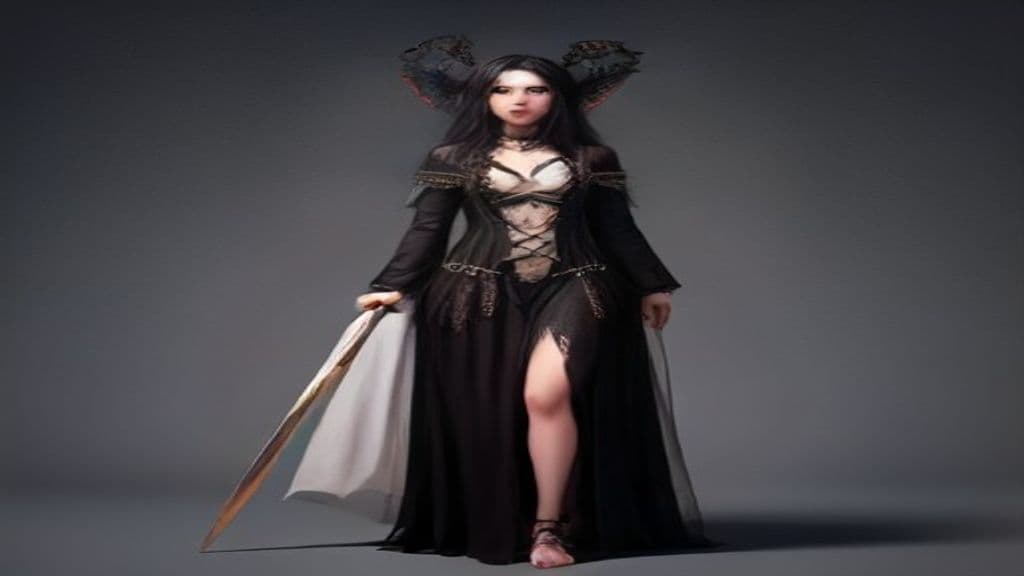
Cigfa is presented in the medieval Welsh narrative tradition as the daughter of Gwyn Glohoyw (lineaged as "Cigfa, daughter of Gwyn Glohoyw, son of Gloyw Walltlydan, son of Casnar Wledig") and as the wife of Pryderi of Dyfed. The sources portray her as a mortal member of Pryderi's household rather than a supernatural being. She appears in the sequence of events in which Pryderi departs for Ireland and later when Dyfed is struck by enchantment; during the afflicted years she remains with Manawydan, who promises to protect her while Pryderi and Rhiannon are absent. Scholarly commentary records her as a later-added or minor domestic figure in the tale in some interpretations, but the primary manuscripts consistently present her as Pryderi's wife and a participant in the Third Branch narrative.
Medieval and modern summaries of the Mabinogi provide no physical description of Cigfa: the extant passages and translations consulted do not specify height, hair, dress, or other distinguishing bodily features. Rather than being depicted by bodily detail, Cigfa is represented through her social position and manners within the royal household (a wife of Pryderi and companion to Manawydan) and through narrative references to her lineage. The sources therefore frame her appearance primarily in terms of status and relational role rather than described physical traits.
The sources assign no supernatural powers, magic, or extraordinary abilities to Cigfa. She is portrayed as a mortal wife and companion whose narrative function is social and relational: remaining with Manawydan during the blighting of Dyfed, sharing the household hardship, and thus serving to illustrate Manawydan's virtues—particularly chastity, perseverance, and protective duty—by the way he conducts himself toward and in care of her. Cigfa does not perform enchantments nor is she described as the recipient of exclusive ritual attention in the surviving summaries and translations.
Blodeuwedd
In the Fourth Branch of the Mabinogi, Blodeuwedd is a woman fashioned by the magicians Math and Gwydion from flowers to be the wife of Lleu Llaw Gyffes; she later betrays him, is transformed into an owl as punishment, and functions etiologically to explain owl nocturnality and enmity with other birds.
Chōchinbi
Chōchinbi (提灯火, "paper-lantern fire") are regionally reported Japanese atmospheric spirit-lights treated as a variety of onibi. Tales describe them as lantern-like floating flames seen near footpaths, rice fields, riverbanks, and graveyards, sometimes vanishing when approached and sometimes associated with animal yōkai or resentful human spirits.
Chūjō-hime
Chūjō-hime is a legendary aristocratic woman in Japanese Pure Land devotional tradition who becomes a nun and exemplary holy woman credited in later hagiography with the miraculous weaving of the Taima Mandala; she functions as a model of filial piety, female salvation, and as a focal figure for relics, embroideries, and etoki preaching.
Ciacco
Ciacco is a named damned soul who appears in Dante Alighieri's Divine Comedy (Inferno, Canto VI) among the gluttonous; he converses with Dante and, within the poem, offers a prophetic speech about Florentine political strife. The figure is later reused in medieval and Renaissance literature (notably Boccaccio's Decameron) as a stock gluttonous character.
Ciampolo
Ciampolo is a damned human soul appearing in Dante Alighieri's Inferno (Canto XXII), placed among the grafters in the fifth ditch of the eighth circle (Malebolge). He is depicted as hauled from boiling pitch by the Malebranche devils, speaks to Dante and Virgil identifying fellow sinners, and ultimately deceives the devils to return to the pitch.
Cicones
The Cicones (Greek Κίκονες, Latinized Cicones or Ciconians) are a Homeric Thracian tribe associated with the town of Ismarus (Ismara) on the south coast of Thrace. In epic sources they appear as a martial human people who repel Odysseus' raiders after the sack of Ismarus (Odyssey Book IX) and are listed among allies in the Iliad; they are treated as a human ethnic/political group rather than as supernatural beings.
Cigau
The Cigau is a name used locally in Sumatra for a reported mid-sized feline cryptid, described in contemporary popular and cryptozoology sources as a golden, short-tailed cat seen near Bangko and Mount Kerinci. Sources treat it as a disputed physical animal rather than a figure of indigenous cosmology.
Ciguapa
The ciguapa is a nocturnal humanoid figure from Dominican and neighboring Caribbean folklore, most often depicted as a wild, preternatural woman of the mountain forests and rivers. Tales present her variously as a seductive siren-like being who lures men, a mischievous nature spirit, a jealous and sorrowful literary figure, or—in some variants—a violent or cannibalistic creature; she functions in oral and literary traditions as a cautionary forest figure and a marker in shifting cultural narratives.
Cihuateteo
In Aztec tradition, the Cihuateteo (Cihuātēteoh; sing. Cihuātēotl) are the spirits of women who died in childbirth. They occupy an honored cosmic role—guiding the sun toward the west—and, on five calendar days, were believed to descend to the earth as dangerous nocturnal spirits who must be propitiated.
Cikavac
Cikavac is a creature of Serbian folklore described as a winged bird kept by an owner through a specific acquisition ritual; in tradition it brings honey and milk taken from others to its owner, fulfills wishes, and enables understanding of animal speech.
Cilix
Cilix is a figure from Greek myth presented as a Phoenician prince and eponymous founder whose settlement in Asia Minor explains the place-name Cilicia. In modern usage the name is also applied to a genus of insects and to an impact structure on Jupiter's moon Europa, but those are scientific reuses of the name.
Cimbres Marian apparition (Nossa Senhora das Graças)
A series of reported Marian apparitions near the village of Cimbres, Pesqueira, Pernambuco, Brazil, in 1936–1937 in which two adolescent seers claimed to receive warnings, injunctions to penance and prayer, and devotional prescriptions; the events are associated with a miraculous spring at a rocky inselberg and later diocesan recognition of their supernatural character.
Community Record
- [1]Cigfa (Wikipedia). Wikipedia, entry 'Cigfa'wiki
- [2]Manawydan, the son of Llyr: The Third Medieval Welsh Tale of the Mabinogi. Translation/summary of the Third Branch (Manawydan fab Llyr)literary
- [3]Cigfa (ancienttexts / Mary Jones site). Summary entry on Cigfaliterary
- [4]The legend of Pryderi (archive). Collected edition/summary concerning Pryderi and related talesliterary
- [5]Cigfa (ancienttexts). Summary and notes on Cigfa and related materialsliterary