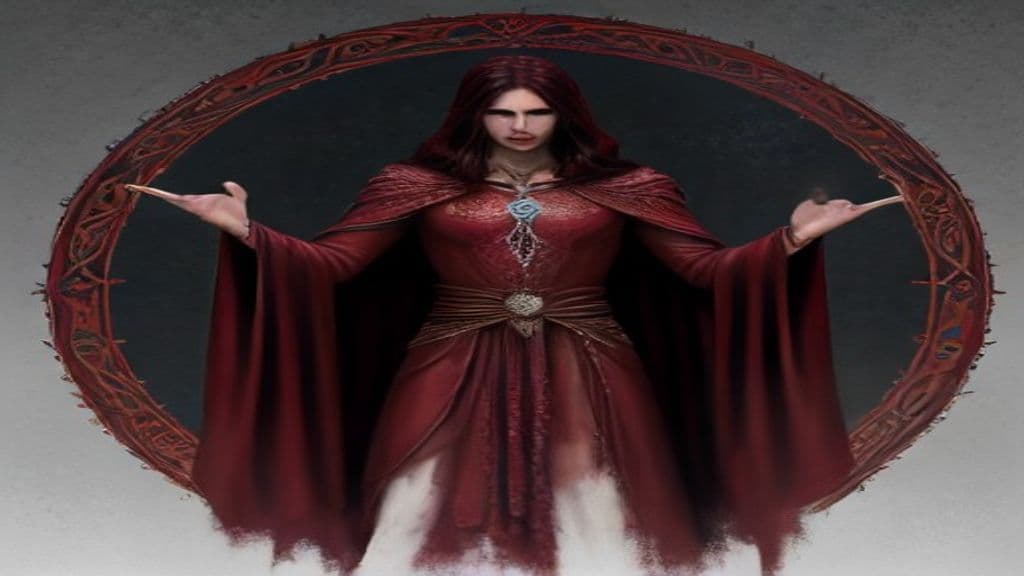
Corum is a prince of the Vadhagh, an older long-lived race in Michael Moorcock's fiction whose advanced knowledge lets them perceive and, in limited ways, shift through other dimensional planes. During an age when rising human societies (the Mabden) clash with older races, Corum's people are devastated by human violence. Early in his story Corum is mutilated—losing his left hand and right eye to human barbarians—an event that precipitates his quest. He later receives two magical replacements from the near-immortal sorcerer Shool (the Hand of Kwll and the Eye of Rhynn). Corum functions as one incarnation of the Eternal Champion: a single soul reborn across the multiverse that intervenes to preserve the Cosmic Balance between Law and Chaos and can encounter other incarnations such as Elric, Erekosë, and Dorian Hawkmoon.
Corum is presented as a Vadhagh prince, often called the Prince in the Scarlet Robe. Early in his narrative he loses his left hand and right eye; at one stage he bears the six-fingered Hand of Kwll and the Eye of Rhynn as replacements for his mutilated members. After later losing those artifacts he uses a silver prosthetic hand and a plain eyepatch. Epithets in the sources include 'Corum of the Silver Hand,' reflecting the prosthetic material in later descriptions.
As a Vadhagh, Corum shares his people's capacity to perceive and, in some circumstances, shift into other dimensional planes—abilities described in the fiction as a blend of advanced knowledge and willful power rather than ordinary human sorcery. The Eye of Rhynn is an artifact that lets Corum perceive an undead netherworld where the last beings he killed reside; he often covers or limits use of this eye to avoid sensory overload. The Hand of Kwll is a six-fingered artifact hand that can summon those last beings from that netherworld when used in conjunction with the Eye. Corum is morally reluctant to rely on these artifacts because they involve methods and dark forces that conflict with his ethics. More broadly, Corum's metaphysical role is as an incarnation of the Eternal Champion, a multiversal agent whose purpose is to act to restore or maintain balance between Law and Chaos.
Weaknesses
- conditionformative mutilation (loss of left hand and right eye) — narrative vulnerability that motivates later events
- othermoral reluctance — ethical cost deters full use of powerful artifacts (Hand of Kwll and Eye of Rhynn)
Wards
- ritualsummoned-drowned-crew defense (narrative example of sorcerous warding)
- conditionshifting out of phase (Vadhagh ability used defensively to avoid pursuers)
Cornucopia (Roman Tradition)
In Roman tradition, the Cornucopia is a symbol of abundance and nourishment, often depicted as a horn-shaped container overflowing with produce. (Note: 1. Power tier should be Primordial does not seem correct as Cornucopia is described as a symbol, not an entity with cosmic powers. 2. Origin story should mention Roman tradition or clarify that it ori)
Corocotta
Corocotta is a name attested in two related registers: a Cantabrian legendary/historical human figure remembered as a guerrilla leader or bandit active during the late 1st century BC, and a classical natural-history term for an exotic canid/felid‑like beast (often equated with the spotted hyena) described in Greco‑Roman literature. The two usages overlap by name but represent distinct traditions—local oral memory of resistance and wider Roman wonder‑literature about exotic animals.
Corona Australis
A constellation in the Southern Celestial Hemisphere associated with various cultural interpretations. (Note: 1. Power tier should be "Primordial" as Corona Australis is an astronomical object and not a deity-level entity. 2. Abilities are not mentioned in the source material; delete this section entirely. 3.)
Coronis
Coronis (Ancient Greek Κορωνίς, romanized Koronis) is a name borne by several women in Greek myth; most prominently a Thessalian princess who was a lover of the god Apollo and the mother of Asclepius. Her story in surviving accounts concerns her pregnancy by Apollo, reports of her unfaithfulness, and her death in narratives that also explain the survival and birth of Asclepius.
Coronus
Coronus (Ancient Greek: Κόρωνος, Koronos) is a personal name in Greek mythic genealogies applied to one or more mortal/heroic figures associated with the Thessalian Lapiths. He is attested as a king of the Lapiths and as an ancestor (notably father of Leonteus) in epic and mythographic lists; some sources list a Coronus among various Argonaut rosters, a variant attribution rather than a unanimous identification.
Corson
Corson is attested in the supplied sources only as 'one of the four principal kings that have power on the seventy-two demons.' No further descriptive, cultural, ritual, or iconographic information is provided in those sources.
Corviconodon
Corviconodon is referenced in the supplied corpus as a taxonomic name candidate interpreted within a paleontological framework (Eutriconodonta/Triconodonta). The provided sources do not document Corviconodon as a supernatural being, mythic figure, or part of ritual tradition; instead they discuss related eutriconodont genera, dental morphology, and taxonomic practice for Mesozoic mammals.
Corvus Glaive
Corvus Glaive is a fictional alien supervillain from the Marvel Comics universe and its multimedia adaptations, serving as a principal lieutenant and martial leader within the Black Order under Thanos. He is characterized as a lithe, cruel warrior whose namesake glaive is described in sources as conferring immortality and can be summoned to his hand at will.
Corybas
Corybas (Κόρυβας, Korubas) is a mythological eponymous figure tied to the Cybelene/Phrygian cult world and to the ecstatic ritual performers called the Corybantes (Korybantes). Attested as a son of Iasion and the goddess Cybele, the name also denotes the collective ritual daimones or dancing priests associated with the Korybantic dance and Samothracian mysteries.
Corycia
Corycia (Ancient Greek: Κωρυκία, Kōrykia; also Corycis) is a local naiad — a freshwater nymph — associated with the springs and the Corycian (Korykian) Cave on Mount Parnassus near Delphi in Phocis. She is presented in classical summaries as an eponymous resident spirit of that sacred spring-site and is connected in genealogy and cultic geography to Delphic water-nymphs and river-gods.
Corymbasus
Corymbasus (Greek Κορύμβασος / Korymbasos) is a named martial figure in the Dionysiac epic tradition—notably Nonnus’ Dionysiaca—attested as a mortal warrior and, in one passage, as “king of the Aithiopians (Ethiopians).” He is repeatedly recorded in mythographic summaries as the slayer of several minor named combatants during the mythic Indian War of Dionysus.
Corynaeus
Corynaeus is the proper name of one or more mortal followers of Aeneas appearing as minor agents in Virgil's Aeneid: a ritual performer conducting a lustration after Misenus' burial (Book VI) and combatants mentioned in battlefield scenes (Books IX and XII). Scholarly sources note textual ambiguity about whether these mentions denote a single individual or multiple men sharing the same name.
Community Record
- [1]Corum Jhaelen Irsei (Wikipedia). Wikipedia, 'Corum Jhaelen Irsei'wiki
- [2]Wikidata: Corum Jhaelen Irsei. Wikidata entry for Corum Jhaelen Irseiwiki
- [3]Eternal Champions - Corum Jhaelen Irsei (surbrook.devermore.net). Eternal Champions - Corum Jhaelen Irsei summaryother
- [4]Character summary: Corum (pvv.ntnu.no). Character notes and synopsisother
- [5]The Swords Trilogy (Wikipedia). Wikipedia, 'The Swords Trilogy' (context for Corum narratives)wiki
- [6]Source Material: 'The Knight of the Swords' by Michael Moorcock (summary). Summary of 'The Knight of the Swords' (source novel)literary
- [7]Source Material: 'The Queen of the Swords' by Michael Moorcock (summary). Summary of 'The Queen of the Swords' (source novel)literary