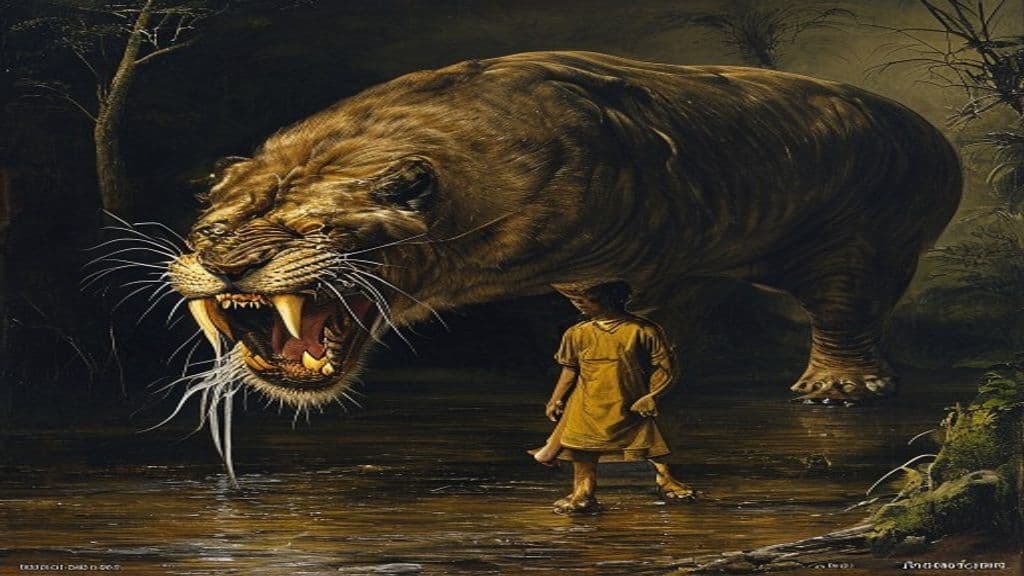
The cited accounts do not provide a mythic origin. Colonial-era observers (Bronson, Hobley) report that local informants treated a large lake reptile as an important presence in the lake and that some groups offered burnt sacrifices to a lake reptile called Luquata; no native-language origin narrative or cosmological genealogy is supplied in the available sources.
The primary physical description comes from John Alfred Jordan as recorded by Edgar Beecher Bronson: roughly fourteen or fifteen feet long (4.3–4.6 m); head as large as a lioness but shaped and marked like a leopard; two long white fangs projecting from the upper jaw; back broad like a hippopotamus and covered in scales described as armadillo-like but patterned and colored like a leopard; a broad fin-like tail used with slow swishes. Jordan also reported large clawed footprints in soft mud, described as as wide as a hippo's but clawed like a reptile's.
Reported or inferred capabilities in the eyewitness narrative include strong aquatic locomotion (able to hold itself level in a swift current using a broad fin-like tail), amphibious hauling-out and terrestrial movement (inferred from large clawed tracks at the waterline), dangerous dentition and claws capable of grievous harm to humans (per Jordan's description), and apparent resilience or evasion (a .303 rifle shot reportedly did not stop the animal and it escaped into the water). These are reported behaviors from colonial-era eyewitness and secondhand reports rather than experimentally demonstrated abilities.
Weaknesses
None recorded.
Wards
- ritualBurnt offerings to Luquata
Dii Consentes
A canonical Roman grouping of twelve principal deities (six male, six female) honored collectively as a harmonized council of major gods. Attested in Roman literary and antiquarian sources and represented in public statuary and a dedicated portico, the Dii Consentes function as an ordered roster of the chief divine personages rather than a singular mythic agent.
Dilong (地龍)
Dilong (地龍; dìlóng, "earth dragon") is a category-name in Chinese dragon taxonomy denoting dragons associated with the earth/ground. The term is polyvalent in sources: it designates an earth-associated dragon-type in cosmological and omen literature, and by analogy names earthly animals (notably the earthworm) used in materia medica.
Dimoetes
Dimoetes (Ancient Greek: Διμοίτης, sometimes spelled Thymoetes in manuscripts) is a mortal figure in Greek mythic narrative, known from a Hellenistic-era love-tragedy compilation. His story, preserved in Parthenius' Sorrows of Love (attributed to earlier author Phylarchus), presents him as a tragic lover whose obsessive attachment to a corpse ends in his suicide.
Dinadan
Dinadan is a fictional human knight of Arthurian romance, a member of King Arthur's Round Table best known as a pragmatic, comic, and cynical foil—especially to Tristan—appearing in the Old French Prose Tristan, later continuations, and Thomas Malory's Le Morte d'Arthur. He is portrayed as a competent but reluctant warrior, a teller of satirical commentary on chivalry and courtly love, and is killed in Malory during the internal collapse of Arthur's court.
Dinah Soar
Dinah Soar is a fictional superpowered humanoid pterosaur appearing in American Marvel Comics, a founding member of the Great Lakes Avengers who possesses high-speed flight, a hypersonic/inaudible voice, and an empathic calming rapport. She was introduced in 1989 and is portrayed as born in the Savage Land with her precise lineage unrevealed.
Dingir
Dingir (Sumerian DIĜIR, 𒀭) is a Sumerian cuneiform sign and word that functions as an ideogram for sky/heaven and as a logogram/determinative for divinity (god/goddess). It is a written/symbolic category in Sumerian and later Mesopotamian orthographies rather than an agentive supernatural being.
Diné Bahaneʼ (Navajo Creation Story)
A Navajo creation story that forms the basis of their spiritual beliefs, traditional way of life, and ceremonies. (Note: 1. Power tier should be revised to Primordial is accurate, but it's not explicitly stated that Diné Bahaneʼ has primordial powers; instead, it shapes the Navajo worldview. 2. Appearance should be incl)
Diocorystes
Diocorystes (Ancient Greek: Διοκορυστὴς) is a minor figure in Greek mythic genealogy, one of the fifty sons of King Aegyptus who were each married to a daughter of Danaus (the Danaids). He is recorded as the husband of the Danaid Hippodamia and as being slain on his wedding night along with most of his brothers.
Diodorus (son of Sufax)
A legendary Berber/Numidian ancestral king named in modern summaries of North African mytho-historical traditions. He is presented in the cited materials as son of Sufax and as a legendary ruler linked genealogically to Numidian dynasties and to Hellenic mythic figures.
Diogeneia
Diogeneia (Ancient Greek: Διογένεια) is a personal name borne by multiple mortal women in Greek myth and later reused in civic and modern contexts. In ancient sources the name identifies distinct genealogical figures (daughters, wives, mothers) rather than a single supernatural being; a later civic festival and modern events and groups also bear the name.
Diogenia
Diogenia is an Attic naiad attested in classical genealogical sources as a daughter of the river-god Cephisus who, by marriage to Phrasimus, became mother of Praxithea and thereby linked river-divinity to the royal house of Erechtheus in Athenian legendary history.
Diomedes
Diomedes (Ancient Greek: Διομήδης) is a hero of Greek myth, foremost among Achaean warriors in the Trojan War, later a king of Argos and a legendary founder of cities in Italy; some traditions report he received cult after death. The name also appears for other historical and modern persons and places but within the supplied sources refers primarily to the mortal heroic figure(s) of classical tradition.
Community Record
- [1]Dingonek (Wikipedia). Wikipedia article 'Dingonek' summarizing Bronson's recounting of Jordan's sighting and Hobley's reports.wiki
- [2]In Closed Territory (Edgar Beecher Bronson) — summary as cited on Wikipedia. Bronson's In Closed Territory as quoted/summary in the Wikipedia article; contains John Alfred Jordan's eyewitness description and Bronson's report of Hobley's account concerning sacrificial offerings to Luquata.literary
- [3]Charles William Hobley reports (1913) as cited. Hobley's 1913 article and field reports are cited in the Wikipedia summary as corroborative references for local ritual offerings and similar sightings; details are relayed in Bronson's account and the Wikipedia entry.academic
- [4]Wikidata: Dingonek. Wikidata entry classifying Dingonek as a cryptid and linking to primary summaries.wiki
- [5]Dingonek | A Book of Creatures. Modern secondary compendium summarizing and expanding on Bronson/Jordan material; used cautiously for noting later popular treatments and conflations.folk
- [6]Strange Ark: The Dingonek. Secondary popular account summarizing colonial-era descriptions and later cryptid associations.folk