
Dilong is not presented in the sources as a single individualized mythic progenitor but as a lexical and conceptual category within Chinese dragon (long 龍) classification mapped onto the cosmic opposition di 地 (earth/land) versus tian 天 (heaven/sky). The earliest attested literary occurrence in the provided material appears in a mid-seventh-century historical narrative: the History of the Southern Dynasties biography of Wang Sengbian records witnesses seeing paired dragons ascend and a dilong leaving Liang territory, an action read as a portent in 550 CE. Over time the lexical unit 地龍 was extended by analogy to name earthly creatures — most notably the earthworm (qiuyin 蚯蚓), recorded in herbal literature (e.g., Bencao Gangmu) under alternate names including dilong/tulong — and later recycled into modern scientific nomenclature (for example, the dinosaur genus name Dilong and use as the Chinese name for other fossil taxa).
The supplied sources do not provide a fixed, detailed visual description unique to a mythic Dilong. In mythic taxonomy it is treated as a variety of long (龍, "dragon") and so inherits the generic dragon imagery of Chinese tradition (serpentine, scaled long forms capable of movement between realms), but is characteristically described in contrast as more earthbound than the tianlong (天龍, "heavenly dragon"). Sources explicitly note Dilong's domainal affiliation rather than a standardized morphology; concrete morphological details (size, limbs, scales, horned head, etc.) are not given in the excerpts. Separately, where 地龍 names an animal the appearance is that of the ordinary earthworm (qiuyin 蚯蚓); in materia medica the worm form (specifically the red earthworm Lumbricus rubellus in modern summaries) is the relevant physical referent.
Sources attribute to Dilong primarily a domainal/cosmological function: it is an earth-associated dragon type paired conceptually with tianlong (heavenly dragon). No distinct catalogue of supernatural powers is recorded in the provided material beyond this domainal affiliation and the implication that, unlike many Chinese dragons described as able to ascend or fly, a dilong is comparatively earthbound. A medicinal-literary belief recorded in the Bencao Gangmu (as noted by Li Shizhen) links earthworms called dilong with meteorological influence: the myth that earthworms (like dragons) can create yinqing (陰晴, "cloudy and clear; unsettled weather"). Beyond the weather-affecting attribution attached to the worm sense, the sources do not record other specific abilities (healing powers beyond medicinal use, control of rivers, speech, or agency toward humans) for a mythic Dilong.
Weaknesses
- otherno specific weaknesses recorded in sources
Wards
- otherno specific wards recorded in sources
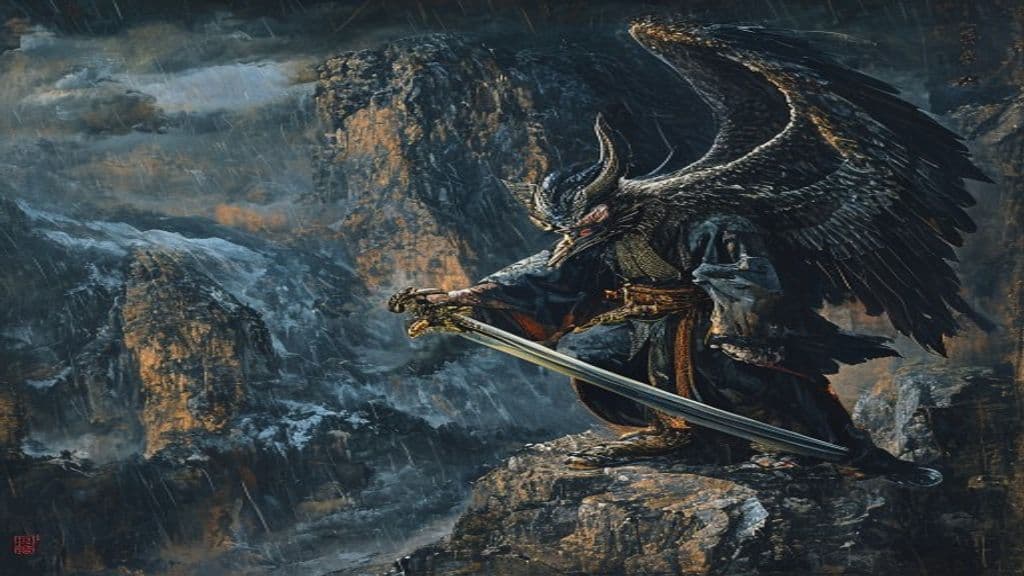
Tengu
Proud, warrior-like mountain spirits of Japan, associated with martial arts, pride, and the wild mountains. Neither fully good nor evil — they test and train warriors and monks, but punish the arrogant.
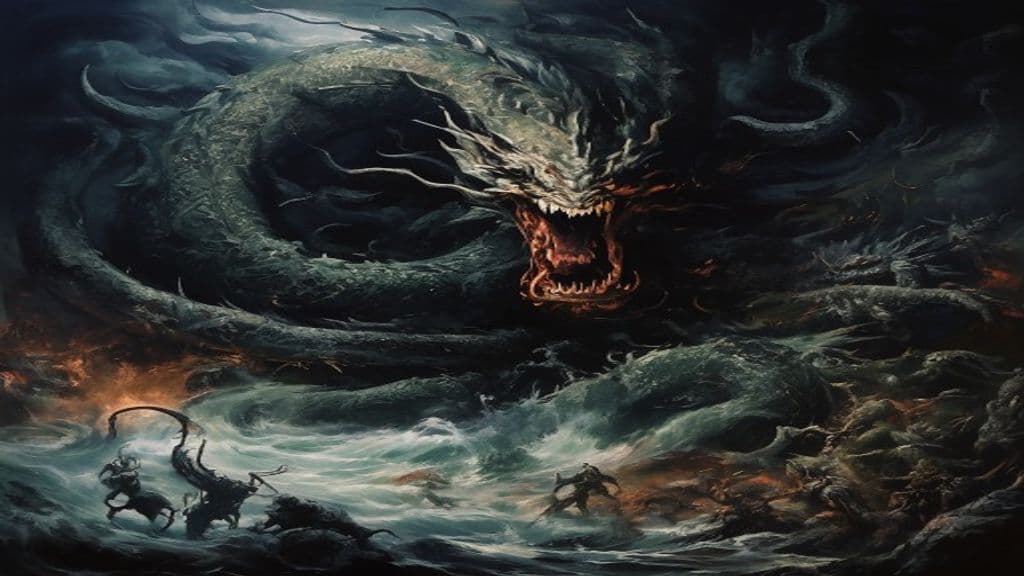
Tiamat
The primordial salt-sea dragon of Babylonian creation myth — the chaos-mother from whose slain body the universe was built, and whose blood became the first humans.

Dragon (Long)
Long (龍, "dragon") is a pervasive cultural and artistic motif that appears in Taoist sacred-geographical contexts, Chinese literature, and modern exhibitions; the provided sources treat it as part of the broader mythic imagery present around Taoist sites and ritual scenes rather than as a single, consistently described doctrinal entity.
Ao Guang (Dragon King of the East Sea)
Ao Guang is the Dragon King (Dragon God) who presides over the East Sea (Dōng Hǎi) in Chinese mythology, literature, and folk-religion. He is presented in sources as a regional aquatic deity associated with water and weather and appears as a named supernatural figure in classical vernacular novels such as Journey to the West and Fengshen Yanyi.
Ao Kuang
Ao Kuang (also attested as Ao Guang) is the Dragon King of the East Sea in Chinese mythology and folk religion, one of a quartet of sea-dragon sovereigns associated in folklore with the cardinal seas. He appears in classical literature and later popular media as a ruler of maritime waters whose favor or displeasure is connected to tides, rain, floods and storms.
Asian dragon (long / loong)
The Chinese or Asian dragon (Chinese: long or loong) is a legendary creature in Chinese mythology, folklore, and culture, widely represented as an auspicious, potent being most commonly associated with control over water and weather. It appears across myth, art, and modern public performance rather than as a single folkloric apparition with standardized ritual responses.
Bixi
Bixi (Bi Xi) is a named figure in Chinese mythological lists—traditionally counted among the nine sons of the dragon—and is the canonical form for tortoise-bodied, dragon-crowned stone mounts that bear commemorative stelae. The form functions primarily as an architectural and commemorative sculptural motif used in funerary complexes, imperial mausoleums, and public commemorations from at least the late Han dynasty through the Ming and Qing.
Chang'e
Chang'e (嫦娥), originally attested as Heng'e and linked to the older name Chang Xi, is the female lunar immortal of Chinese myth who resides in the Moon Palace (廣寒宮). Best known from the elixir-of-immortality tale in which she ascends to the Moon and is accompanied there by the Jade Rabbit, she functions across religious and literary contexts as a lunar goddess/immortal and a poetic symbol of solitude and longing.
Chinese dragon (long / loong)
A central legendary zoomorphic being in Chinese myth and culture (Chinese: long / loong), the dragon embodies auspicious cosmic and ancestral power, especially mastery over water and weather, and functions as an imperial and communal emblem across material culture, ritual performance, and state iconography.
Chiwen
Chiwen (蚩吻 / 鴟吻 / 鴟尾 / 螭首) is a Chinese mythic dragon‑child figure and an associated class of roof ornament placed at the ends of roof ridges. As one of the traditional Nine Sons of the Dragon, Chiwen is represented in architecture as a dragon‑head/fish‑body finial that symbolically 'swallows' ill influences and functions as a protective architectural device (waterspout, finial) to guard buildings against fire, floods and other hazards.
Eight Pillars (八柱, bāzhù)
The Eight Pillars (Chinese: 八柱, bāzhù) are a cosmological feature in Chinese mythology consisting of eight mountain-pillars located in the eight cardinal directions that function as supports/axes of the world, conduits between Earth and Heaven, and loci for paradises and supernatural inhabitants.
Feng Meng
Feng Meng (also spelled Beng Meng) is a figure from Chinese mythology described as the apprentice of the divine archer Houyi (Yi) who, driven by envy of his master's skill, murdered Houyi with a club made from a peach tree.
Four Holy Beasts
A set of four sacred animals in Chinese and broader East Asian cultural and astronomical tradition, mapped to the four cardinal directions and used as auspicious, protective, and cosmological symbols in literature, architecture, and material culture.
Fox spirit
A widespread class of mythical beings associated with foxes (often represented by red-fox imagery in many traditions) characterized by cunning, shapeshifting, trickery, and ambiguous moral roles; prominently attested in East Asian folklore and present in modern literature and media as romantic, vengeful, or matchmaking figures.
Fuxi
Fuxi (伏羲 / Fu Hsi) is a primordial culture-hero in Chinese myth credited in traditional accounts with establishing social institutions (marriage, family), teaching technologies (hunting, fishing, cooking, music), and originating systems of knowledge such as divination and the eight trigrams (ba gua). Frequently paired with Nüwa, he occupies a foundational role in prehistoric cosmology and ritual memory rather than a narrowly historical figure.
Community Record
- [1]Dilong. Wikipedia: Dilongwiki
- [2]Wikidata: Dilong. Wikidata entry Q27439other
- [3]Bencao Gangmu (compendium references summarized). Bencao Gangmu entry for qiuyin (earthworm) as cited in secondary summaries (Li Shizhen notes earthworm alternate names dilong/tulong and the weather myth)literary
- [4]History of the Southern Dynasties (Wang Sengbian biography). Mid-7th century History of the Southern Dynasties account (biography of Wang Sengbian) recording paired dragons ascending and a dilong leaving Liang territory as a portent (550 CE)literary