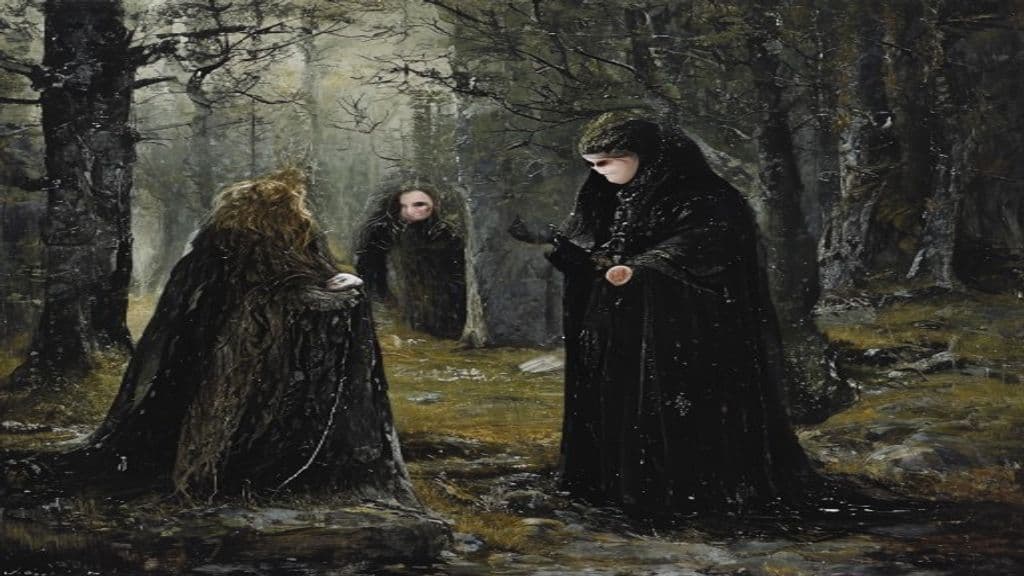
The term dís in Old Norse (dís, pl. dísir) covers a spectrum from ordinary woman/'lady' to divine or semi‑divine female being. Scholarly syntheses and saga references present the dísir variously as fertility goddesses, guardian spirits of clans or places, and as the souls of dead women; this multiplicity suggests that the belief likely reflects overlapping traditions of goddess worship, ancestor veneration, and fate‑linked female powers (sources: Wikipedia summary of dís, Simek commentary as cited in the supplied materials, saga references such as Atlamál). Comparative linguistics links dís/ Old Norse dís to West Germanic forms (Old High German itis, Old Saxon idis, Anglo‑Saxon ides), a parallel noted in the literature but not treated as a simple equivalence in the sources provided.
Surviving textual references do not give a consistent physical description of the dísir; they are usually referred to collectively and characterized by function and affiliation (with valkyries, norns, and fylgjur) rather than by fixed bodily features. Some scholarship and poetic terminology imply that dísir could appear in forms similar to valkyries or other female fate‑beings, but explicit sensory descriptions are not preserved in the cited excerpts (sources: Wikipedia synthesis; Simek as cited).
Dísir are associated with Fate and may influence life outcomes, fertility, clan welfare, and success in battle. They function as protective spirits of kin or place (landdísir in Icelandic tradition), objects of sacrifice (dísablót), and in some texts are described as 'dead women' or as close to the souls of the dead (Atlamál citation per Simek). In saga and poetic contexts they are grouped with valkyries and norns, indicating roles in battle‑magic, destiny, and guardianship; they can be benevolent or antagonistic toward mortals (sources: Wikipedia summary; Heimskringla; Víga‑Glúms saga; Hervarar saga; Simek commentary cited in the supplied materials).
Weaknesses
None recorded.
Wards
- ritualdísablót

Baldr
Baldr (Old Norse Baldr; Old English Bældæġ; Old High German Balder/Palter) is a god in Germanic mythology. In the Norse branch he is named as a son of Odin and Frigg and as a member of the Aesir, attested alongside brothers such as Thor and Váli in the supplied sources.
Black Shuck
A spectral black dog of East Anglian legend, with glowing red or green eyes. Its appearance is an omen of death. Its howl has been heard on clifftops during storms for centuries.
Deutsche Mythology
A collection of mythological narratives representing the collective myths, legends, and beliefs of ancient Germanic cultures. (Note: 1. Power tier: Primordial (Deutsche Mythology as a collective mythological narratives does not have supernatural abilities and behaviors attributed to it; rather, it contains those of individual Germa)
Domar (Dómarr)
Domar (Old Norse Dómarr, 'Judge') is a legendary Swedish king of the Yngling dynasty attested in medieval Scandinavian genealogical sources. He is presented as a mytho-historical ancestral ruler whose long and peaceful reign follows the sacrificial death of his father Domalde and whose own death was marked by cremation at Fyrisvellir and erection of a memorial stone at Uppsala.
Dragon (Long)
Long (龍, "dragon") is a pervasive cultural and artistic motif that appears in Taoist sacred-geographical contexts, Chinese literature, and modern exhibitions; the provided sources treat it as part of the broader mythic imagery present around Taoist sites and ritual scenes rather than as a single, consistently described doctrinal entity.
Draugr
In Nordic folklore the draugr (plural draugar; anglicized draug) is an archaic term for a malevolent revenant — a dead person who returns and remains active in the world of the living. Accounts emphasize variability: traits, behaviours, and descriptions change between stories and across regions, especially in early medieval Icelandic sagas and surviving Norwegian folklore.
Eystein Halfdansson
Eystein Halfdansson (Old Norse: Eysteinn Hálfdansson) is presented in Norse king-list and saga tradition as a semi-legendary Norwegian petty king of the House of Yngling who ruled Romerike and acquired Vestfold by marriage. He is depicted as a dynastic ruler and Viking raider whose death is attributed in Snorri's Ynglinga saga to a magical act performed by King Skjöld of Varna.
Fenrir
The monstrous wolf son of Loki, bound by the gods with a magical ribbon until Ragnarök — when he will break free and swallow Odin, and the world.
Fylgja
A supernatural accompanying spirit in Old Norse tradition tied to a person's or family's fate and fortune. The fylgja appears most often as a female human figure or as an animal, commonly in dreams, and functions as an omen-bearing presence connected to destiny rather than an agent that alters fate.
Huldra
A seductive forest spirit of Scandinavian folklore — beautiful from the front but with a cow's tail or hollow back — who lures men into the wilderness, sometimes to their ruin.
Jörmungandr
In Norse mythology, Jörmungandr is an unfathomably large sea-serpent, the Midgard Serpent or World Serpent, that dwells in the world sea and encircles Midgard, biting its own tail; Jörmungandr releasing his tail is described as one of the signs of the beginning of Ragnarök. The name has been reused in modern astronomy for near-Earth asteroid 471926 Jormungandr (provisional 2013 KN6), discovered 28 May 2013.
Jötunn (Jotun / Giant)
A jötunn (Old Norse jǫtunn; plural jötnar) is a class of powerful non-human beings in Norse/Germanic myth that exist alongside gods, dwarfs, elves, and humans. They commonly dwell across boundaries (e.g., Jötunheimr) and appear ambivalently as adversaries, kin, spouses, and participants in cosmological narratives.
Community Record
- [1]Dís — Wikipedia. Wikipedia article 'Dís' summarizing saga and scholarly references including Heimskringla, Víga‑Glúms saga, Hervarar saga, and Simekwiki
- [2]Heimskringla (Saga of St. Olaf) — dísablót at Gamla Uppsala (month of Gói) — cited in Wikipedia. Heimskringla account as referenced in the 'Dís' article: dísablót celebrated at Gamla Uppsala in Gói with Dísaþing and fairliterary
- [3]Víga-Glúms saga — dísablót at Winter Nights. Víga‑Glúms saga reference to dísablót held at Winter Nights (as summarized in the 'Dís' article)literary
- [4]Hervarar saga — dísablót performed in autumn; hörgr reddened with sacrifices. Hervarar saga account referenced in the 'Dís' article describing a dísablót performed by a royal daughter and sacrifices reddening a hörgrliterary
- [5]Simek commentary (as cited in the supplied material). Summary citing Simek: dísir associated with valkyrie‑like guardians of the dead; called 'dead women' in Atlamál 28; landdísir as dead women/guardians of placeacademic
- [6]Friggasweb — 'Matrons and Disir: The Heathen Tribal Mothers' (supplemental discussion referenced). Modern discussion referenced in the supplied materials linking dísir to continental matron traditions (used only as supplemental commentary in the provided corpus)other
- [7]The Elder and Younger Eddas (Project Gutenberg) — corpus context for valkyries, norns, fylgjur comparisons. Eddic material and saga corpus used in comparative discussion of female fate‑beings; cited in the 'Dís' summaryliterary