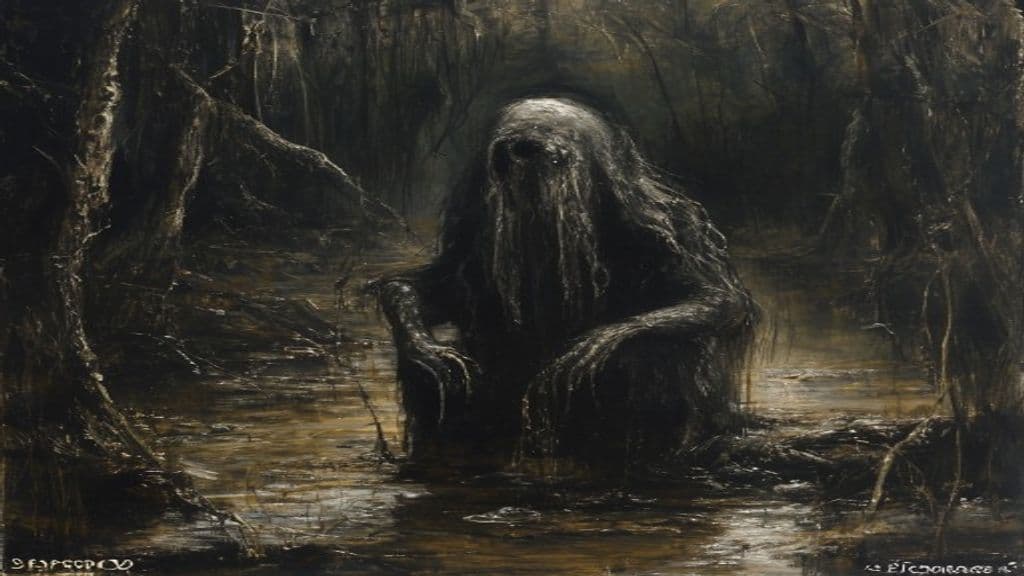
In Slavic mythology, the Dziwożona is a type of supernatural entity associated with swamps. The term 'Dziwożona' does not translate directly into English, but its classification as a swamp demon indicates that it occupies a place in the cosmology of Slavic mythology where nature spirits and malevolent entities coexist.
No specific physical description is provided for the Dziwożona.
Dziwożonas are described as malicious and dangerous, suggesting they may interact with humans in a negative way, possibly by causing harm or death. The fact that certain individuals were thought to become Dziwożonas after death implies that these entities have some connection to the cycle of life and death.
Bauk (Slavic mythology)
A mythical creature from Serbian mythology that inhabits dark places, waiting to grab and devour its victims. (Note: 1. Power tier should be Lesser (local spirit), as it's described as hiding in dark places, not possessing deity-level powers. 2. The appearance description matches the source material, but note that ")
Bies
Bies (Slavic: Polish Bies; Russian бес [ˈbʲɛs]; Slovene/Montenegrin bes; Bosnian/Croatian bijes) is a term from Slavic linguistic and mythic contexts for an evil spirit that, especially after Christianization, was commonly equated with the Christian devil or demons. The lexical field of the word also survives in several South and West Slavic languages with the meaning 'rage' or 'fury', reflecting a conceptual overlap between malign spirit agency and overwhelming affective states.
Chut
Household spirit in Belarusian mythology associated with domestic spaces and activities, responsible for bringing prosperity and success through offerings, but capable of cruel revenge if neglected. (Note: 1. Power tier: Lowered to Lesser, as it seems more consistent with "regional" or local influence rather than deity-level abilities. 2. Appearance: A note should be added that no physical description i)
Cooperating God and Devil (Slavic creation myth)
In Slavic creation myths, the God and Devil cooperate to create the world, exemplifying a dualistic motif where opposing forces work together for balance. (Note: 1. Power tier: Incorrect, the source material does not specify that the God and Devil have primordial power. 2. Origin story: Needs rewording to reflect that there are multiple versions of Slavic crea)
Ded Moroz (Grandfather Frost)
Benevolent gift-giving figure in Slavic mythology, similar to Father Christmas and Santa Claus. (Note: 1. Power tier: Should be Ancient (deity-level) given the description in Source 1 that Ded Moroz is a "legendary figure" with roots in Slavic mythology. 2. Summary: Inaccurate, as it compares Ded Moroz)
Dobrynya Nikitich
A Slavic bogatyr (heroic warrior) based on a historical warlord, reflecting medieval ideals of chivalry and nobility. (Note: - Power tier: Primordial (no supernatural abilities are mentioned, but he is a bogatyr, which implies a higher power tier) - Sensory cues: not present in source material - Weaknesses: not present in s)
Drioma
A Slavic spirit associated with the evening and night hours, known for interacting with children and adults. (Note: 1. Power tier should be Ancient, not Primordial, as Drioma's abilities are described as entering houses through cracks and fissures, but no cosmic or universal-level powers mentioned. 2. Add sensory c)
Dukljan
Adversary of God in Slavic mythology, embodying qualities and actions of Roman emperor Diocletian. (Note: 1. Power tier should be Lower (consistent with his role as an adversary, not a cosmic being). 2. Summary needs to include that Dukljan is in Serbian mythology, not Slavic. 3. Appearance, Abilities, Se)
First Humans in Slavic Mythology
Central concept in the narrative of human creation, reflecting a worldview that values ancestry and tradition. (Note: 1. Power tier should be changed to Lesser or Minor Spirit (there's no indication that they have primordial power). 2. Summary is accurate but could be more specific about what makes them central to th)
Interpretatio Slavica
A cultural practice among Slavic peoples to identify and equate their deities with those of neighboring cultures and Christian saints. (Note: - Power tier should be Ancient (deity-level), as it's a cultural practice rather than a supernatural being. - Sensory cues, weaknesses, and wards are not applicable to this entity, as it's an abstract)
Kyi, Shchek and Khoryv
Semi-legendary brothers who allegedly founded the city of Kiev in Kievan Rus', their historical significance overshadowing any potential mythological importance. (Note: 1. The power tier should be Primordial, as they are considered the founders of the city of Kiev, a major cultural and historical hub. 2. Add "Their names likely represent real individuals or ancestral)
Leđan (Slavic tradition)
An ancient and magical city from Croatian mythology and folklore. (Note: 1. Power tier: downgrade to Greater (since Leđan is described as an "ancient" city, but its magical nature and lack of explicit abilities suggest it may be less powerful than Ancient). 2. Appearance: )
Community Record
- [1]Wikipediawiki