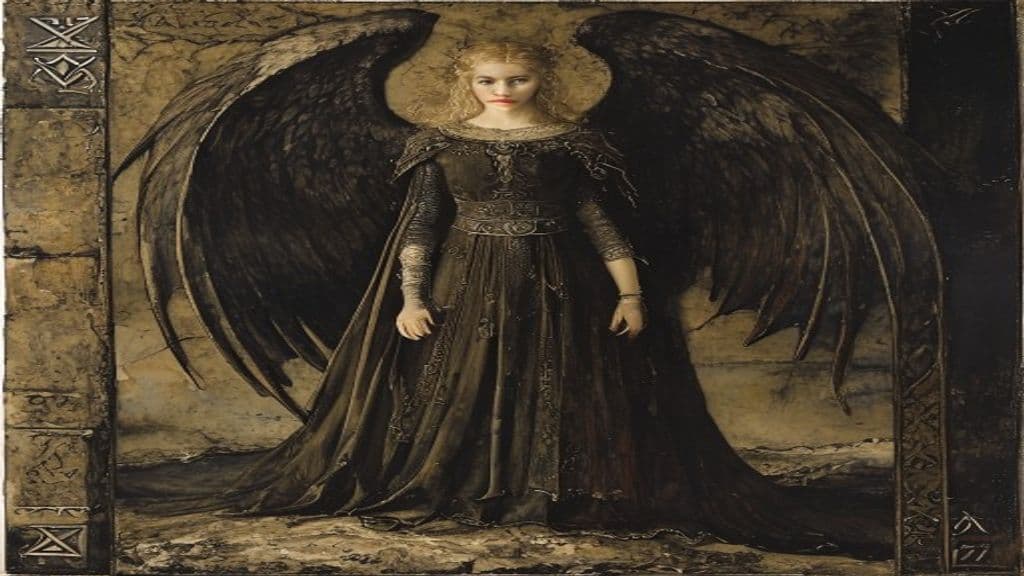
Eir attests in Old Norse texts preserved in medieval Iceland. In the Prose Edda (Gylfaginning ch. 35) Snorri lists Eir among the ásynjur and comments that she is "an extremely good physician." In Skáldskaparmál (Prose Edda ch. 75) her name appears in a list of valkyrie names. In the Poetic Edda (Fjölsvinnsmál) she is one of the maidens attending Menglöð who "sit on the hill Lyfjaberg" (the "hill of healing"); there Svipdagr asks whether the maidens will give aid if blót (offerings) are made to them and the answer is affirmative. Modern scholars (e.g., Simek, Orchard, Lindow, Davidson) note the uncertain identity-unity of these occurrences and debate whether they describe a single goddess-figure, a valkyrie, or attendant/guardian spirits sharing a name.
No surviving medieval source provides a descriptive physical appearance or iconography for Eir. Her presence in texts is functional and classificatory—listed among ásynjur, in a valkyrie-name list, and as one of Menglöð's maidens—rather than pictorially described; therefore no specific dress, attributes, or bodily features are attested in the cited materials.
Primary attested ability is healing: Snorri explicitly calls Eir "an extremely good physician" (Gylfaginning ch. 35). In Fjölsvinnsmál she is one of the maidens associated with a healing place (Lyfjaberg) and, by context and scholarly commentary (Hilda Ellis Davidson), belongs to a group of guardian maidens who "shelter and save" those who make offerings. Her name is used in skaldic kennings as a poetic synonym for woman, indicating cultural association with valued female qualities. Some scholars note theoretical links between valkyrie functions (life-and-death agency) and healing, but such links are interpretive rather than explicit in the primary attestations.
Weaknesses
- othernone attested
Wards
- ritualmake offerings (blót) to the maidens of Lyfjaberg
Andvari
Andvari is a dwarf from Old Norse sources (attested in the 12th century) who lives beneath a waterfall, hoards gold, owns a magical ring called Andvaranaut, can change into a pike, and curses the gold when it is stolen—events that set in motion tragic outcomes in Norse heroic narrative.
Angrboða
Angrboða is a jötunn (giantess) in Norse myth attested briefly in the Poetic Edda and Prose Edda as the partner of Loki and the mother of three world‑shaping offspring: Fenrir, Jörmungandr, and Hel. Surviving medieval attestations are sparse; most descriptions of her beyond genealogy derive from modern retellings and popular culture.
Ask and Embla
In Norse myth Ask (Askr) and Embla (Embla) are the first human man and woman, fashioned from wood/trees by the gods at the beginning of the cosmos and endowed with the gifts that make them human; they serve as the progenitors of humankind in the Norse cosmological narrative.
Atter
In Norse tradition, Atter refers to various forms of poison, corruption, or noxious influence that can manifest physically or morally. (Note: * Power tier should be Primordial only for its ability to cause cosmic-scale harm (e.g., societal consumption). However, most of its described abilities fall under Greater or Lesser powers, implying A)
Aurboða
Aurboða is a jötunn (giantess) in Norse mythology attested as the wife of the jötunn Gymir and mother of the jötunn Gerðr; the name also appears separately as one of the nine maidens in the poem Fjölsvinnsmál. Her name is debated etymologically as either 'gravel-bidder' (aurr + boða) or, in an alternative reading, 'gold-bidder' (aur + boða).
Auðumbla
Auðumbla is the primeval cow of Old Norse cosmogony attested in the Prose Edda: she nourishes the primordial jötunn Ymir with rivers of milk and by licking salty rime-stones reveals Búri, an ancestor of the gods. Her name and role link fertility, nourishment, and the emergence of key lineages in the Norse origin narrative.
Baldr
Baldr (Old Norse Baldr; Old English Bældæġ; Old High German Balder/Palter) is a god in Germanic mythology. In the Norse branch he is named as a son of Odin and Frigg and as a member of the Aesir, attested alongside brothers such as Thor and Váli in the supplied sources.
Barri
Barri (also attested Barrey/Barey) is a mythic place-name in Old Norse tradition, named in Skírnismál and Snorri Sturluson’s Gylfaginning as the rendezvous-site where Freyr and Gerðr will meet nine nights after prior events. The term is etymologically ambiguous between a grove/wood and an island or a grain-field, and scholars debate whether its semantic field evokes woodland or agricultural fertility.
Baugi
Baugi is a jötunn (giant) in Old Norse myth who appears as a secondary actor in the mead of poetry narrative preserved in Skáldskaparmál and the þulur. He is presented as the brother of Suttungr, provides and uses an auger named Rati to bore into the mountain Hnitbjörg, and figures in Odin's (Bölverk’s) bargain and deception to obtain the mead of poetry.
Beli
Beli is a jötunn (giant) in Old Norse myth known chiefly as an adversary slain by the god Freyr. Attestations are fragmentary: he appears in Eddic and skaldic references as the named foe of Freyr and as an element in kennings, and scholars treat the fuller myth as largely lost.
Bergelmir
Bergelmir is a jötunn in Norse mythology, attested as a descendant of the primordial giant Aurgelmir (Ymir) and portrayed as the survivor who preserves the frost-jötunn line after the primeval flood caused by Ymir's death. He appears in two primary Old Norse contexts: the poem Vafþrúðnismál (where he is implied to be an infant laid in a lúðr) and Snorri Sturluson's Gylfaginning (where he and his wife escape on a lúðr).
Beyla
Beyla is a minor attendant of the Vanir god Freyr attested only in the Poetic Edda poem Lokasenna (prose introduction and stanzas 55 and 66). Surviving texts give her no independent cult or clear domain; modern scholars have proposed she may be an agricultural personification based on name-interpretation and association with Freyr.
Community Record
- [1]Eir (Wikipedia summary from provided notes). Wikipedia: Eir (summary of primary attestations and scholarship)wiki
- [2]Poetic Edda: Fjölsvinnsmál (attestation of maidens on Lyfjaberg). Poetic Edda, Fjölsvinnsmál (listed among maidens attending Menglöð on Lyfjaberg)literary
- [3]Prose Edda: Gylfaginning ch. 35 (listing among ásynjur; 'extremely good physician'). Prose Edda, Gylfaginning ch. 35 (Snorri's enumeration of ásynjur; Eir described as an excellent physician)literary
- [4]Prose Edda: Skáldskaparmál ch. 75 (valkyrie-name list). Prose Edda, Skáldskaparmál ch. 75 (Eir appears in a list of valkyrie names)literary
- [5]Skaldic poetry and Bergen runic inscription (~1300). Skaldic verses and a Bergen runic-stick inscription c.1300 show use of Eir as a personal/name element and in kennings for womenliterary
- [6]Hilda Ellis Davidson (scholarly commentary). Hilda Ellis Davidson: commentary on healing goddesses and interpretation of Menglöð's maidens as guardian spirits who 'shelter and save' those who make offeringsacademic
- [7]Andy Orchard; John Lindow; Rudolf Simek; Henry Adams Bellows (scholarly notes summarized). Modern scholarly observations: Orchard on valkyrie/etymology and theoretical links; Lindow skeptical of a distinct goddess; Simek suggests valkyrie origin; Bellows compares Eir to Hygieia—these are interpretive scholarly positions summarized in the provided material.academic