
Enmesharra appears in Mesopotamian theogonies and god-lists as a member of an older generation of gods who preceded the main active pantheon. His name (Sumerian Enmešarra) literally marks him as 'lord of all me' (me = divine powers/ordinances). In myths and lists he functions as a primordial or ancestral figure whose prerogatives were displaced or reassigned to younger gods (for example, narratives that place him prior to Enlil or that recount his defeat and the redistribution of a quality called zi-mu-ú to Shamash). Scholarly commentary treats Enmesharra primarily as a theological/theogonic construct recorded in lists and mythic confrontation tales rather than as a focus of broad popular cult, though his name does appear in ritual corpora such as a temple-foundation prayer that refers to him as a lord of the underworld.
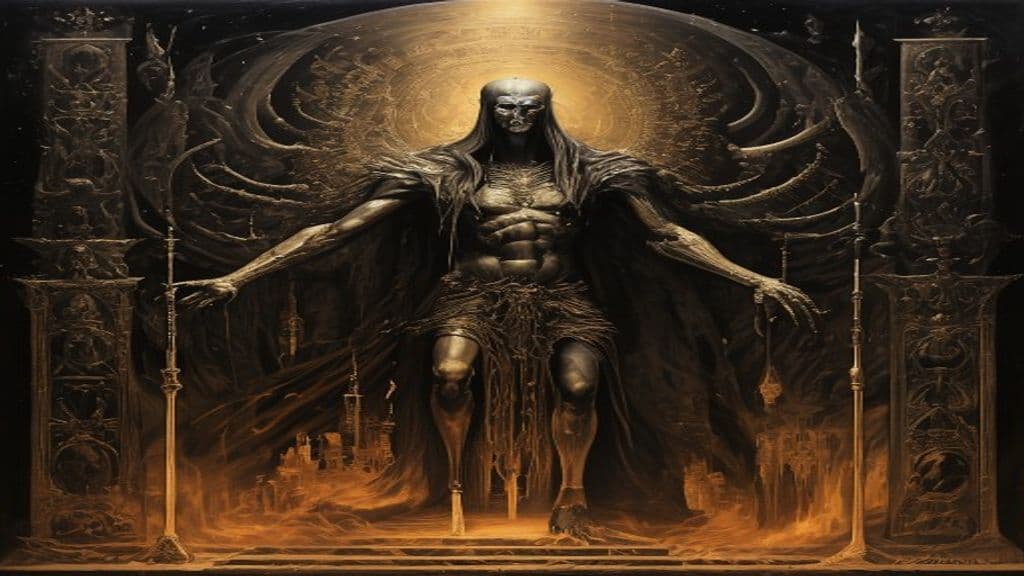
Surviving textual sources provide no standardized anthropomorphic portrait. Some texts describe him as a deceased or subterranean presence—one passage speaks of him as 'burned and existing in the form of a ghost'—so he is often conceptualized as an underworld or ancestral deity. A number of scholars have tentatively proposed identifications with certain cylinder-seal motifs (e.g., ray-shoulder figures or a 'birdman' type), but these iconographic attributions are interpretative and contested and are not securely attested in the texts summarized here.
Enmesharra's role in the texts is primarily theogonic: his name and placement in lists mark him as a former possessor or guardian of the me (the suite of divine powers and social-cosmic ordinances). Myths present him as having once exercised rulership or prerogatives later contested or reassigned to younger gods (scholars note analogies to motifs like the theft or transfer of prerogatives; one text implies past rulership of the universe). Narrative episodes record his defeat, being 'laid to rest,' or the reassignment of an epithet/quality (zi-mu-ú, 'splendour') to the sun-god Shamash after his defeat. The surviving material does not portray routine interactions with ordinary humans or present a catalog of active powers used against people; his function is chiefly cosmological and ancestral within mythic history.
Weaknesses
- otherdefeat in mythic confrontation (e.g., as narrated in 'Enmesharra's Defeat' and related texts) leading to being laid to rest and reassignment of attributes
Wards
None recorded.
Nergal
Nergal is a major Mesopotamian deity associated with war, disease, inflicted death, and rulership of the underworld. Principal cult center at Kutha (temple E‑Meslam), he appears in hymns and myths (e.g., the Epic of Erra, "Nergal and Ereshkigal") and is sometimes equated with or called Erra or Meslamtaea.
Bhoot (bhoota)
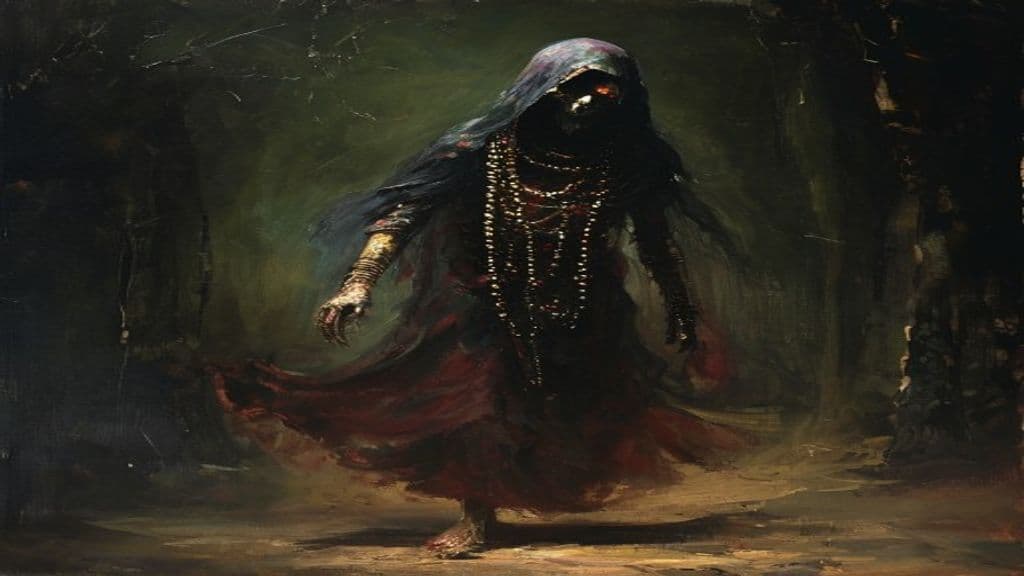
A bhoot (also bhoota, bhoot, bhut) is the culturally specific term across parts of the Indian subcontinent for a perturbed, restless spirit generally understood to be the ghost of a deceased person. Sources describe bhoots as arising when a person's death or post-death circumstances prevent them from moving on — for example violent death, unresolved affairs, or failures in funerary rites — and the term appears frequently in modern South Asian media and discussions.

Anzû (Imdugud)
Anzû, also called dZû or Imdugud, is a large storm-associated bird-figure in Sumerian/Akkadian/Babylonian myth. Portrayed as a hybrid (commonly a massive bird with a lion's head or as a half-human storm-bird), Anzû is credited in mythic narratives with seizing the Tablet of Destinies and thereby challenging the authority of chief gods such as Enlil.
Community Record
- [1]Enmesharra - Wikipedia. Wikipedia contributors. "Enmesharra." Wikipedia, The Free Encyclopedia.wiki
- [2]Enmesarra - Wikidata. Wikidata entry Q1343297: Enmesarra.other
- [3]Enmesharra - Gensopedia. Gensopedia entry: Enmesharra (includes non-scholarly variants noted in source materials).other
- [4]Lugaldukuga - Wikipedia (comparative context). Wikipedia contributors. "Lugaldukuga." Wikipedia, The Free Encyclopedia. (used as ancillary comparative material cited in source set)wiki