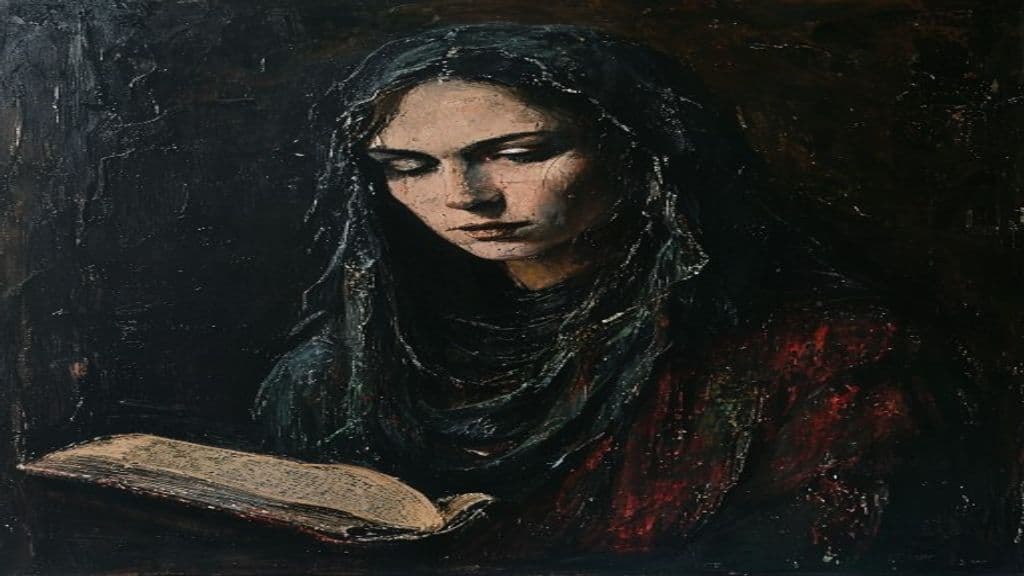
No physical description is provided in the source material.
The Eteriani's 'abilities' are more accurately described as its themes and motifs, such as love, heroism, and chivalry.
A Man Was Going Down the Road
Georgian tradition, possibly a reference to a novel title by Otar Chiladze (1973), lacking clear information on its supernatural nature or abilities. (Note: * Power tier should be set to Primordial, as there's no information on its supernatural nature or abilities; it simply appears to be a novel title without further context. * Summary: The summary is ac)
Al (Georgian Tradition)
In Georgian tradition, Al is a supernatural entity that interferes with human reproduction, acting as a demon of childbirth. (Note: - Power tier should be "Ancient" (Al is a demon of childbirth, but not cosmic-level) - Abilities need to specify that Als can cause spontaneous abortions, stillbirths, and infant mortality, as stated )
Arvoitus (Finnish Riddle Entity)
A supernatural entity embodying the concept of a riddle or puzzle, often used in Finnish folklore to test one's wisdom and knowledge. (Note: 1. Power tier: Minor Spirit (Arvoitus does not interact directly with humans but presents itself as a puzzle, suggesting it's more of a subtle, local entity rather than a powerful regional one.) 2. Ap)
Estries
Supernatural being in Jewish folklore that preys on infants, associated with blood consumption. (Note: - Power tier should be revised to Ancient (deity-level) as Estries' focus on a specific community and their vampiric nature suggests a significant level of power. - The article should include the prov)
Esu (Eshu, Elegbara)
Esu (also attested as Eshu, Elegbara, Elegua/Elegguá, Exu) is a named Orisha — a deity — in the Yoruba traditional religious system and its diasporic continuations. The provided source identifies Esu principally as an Orisha associated with roads and notes the figure's presence across Ifa/Orisha practice and several Afro-diasporic religions.
Etana
Etana is a legendary early king of Kish in Mesopotamian tradition who, according to epic texts and the Sumerian King List, aided an eagle and was conveyed to the heaven of the god Anu to seek a 'plant of birth' enabling him to sire an heir. He functions as a culture-hero whose narrative situates kingship, divine favor, and animal intermediaries within Mesopotamian cosmology.
Eteocles
Eteocles is a mytho-historical Theban king of the Greek tradition, son of Oedipus, who becomes central to the dynastic feud with his brother Polynices that culminates in the war of the Seven against Thebes and the mutual killing of the two brothers.
Eteocretans
The Eteocretans are referred to in classical and modern sources as an indigenous, pre-Greek people of the island of Crete; the name also denotes the pre-Greek language attested in a few alphabetic inscriptions from Crete. In the cited accounts they are treated as an early settler population in a legendary‑historical sequence rather than as a supernatural being.
Eternal Champion
A recurring archetypal hero created by Michael Moorcock who appears as many incarnations across a fictional Multiverse to maintain a metaphysical Balance between the forces of Law and Chaos. The Eternal Champion is described as different facets or incarnations of a single semi‑conscious archetype rather than a single individual.
Ethiopian pegasus
A legendary monstrous animal attested in classical and medieval bestiary summaries: a breed of winged, two-horned horse said to come from Aithiopia (ancient 'Ethiopia') and reportedly located on an island in the Red Sea off the coast of Eritrea. It appears in the corpus of Greco‑Roman natural‑history marvels (Pliny is cited in secondary summaries) and later bestiary compilations rather than as a spirit or deity.
Ethniu
Ethniu (also Ethne, Ethliu, Eithne, Ethnea, etc.) is a figure of Irish myth, presented as the daughter of the Fomorian leader Balor and the mother of the hero Lugh. Her story centers on imprisonment to avert a prophecy and the clandestine conception and rescue of her child, motifs that link her to dynastic and prophetic conflicts in the mythic cycles.
Etinṣib Ziwa
Etinṣib Ziwa (also Ītinṣib Ziwa) is an uthra — a divine being or 'messenger of the light' — attested in the Mandaean Book of John (Chapter 3) where he initiates a battle with the figure Nbaṭ and fights with members of Yushamin's lineage.
Community Record
- [1]