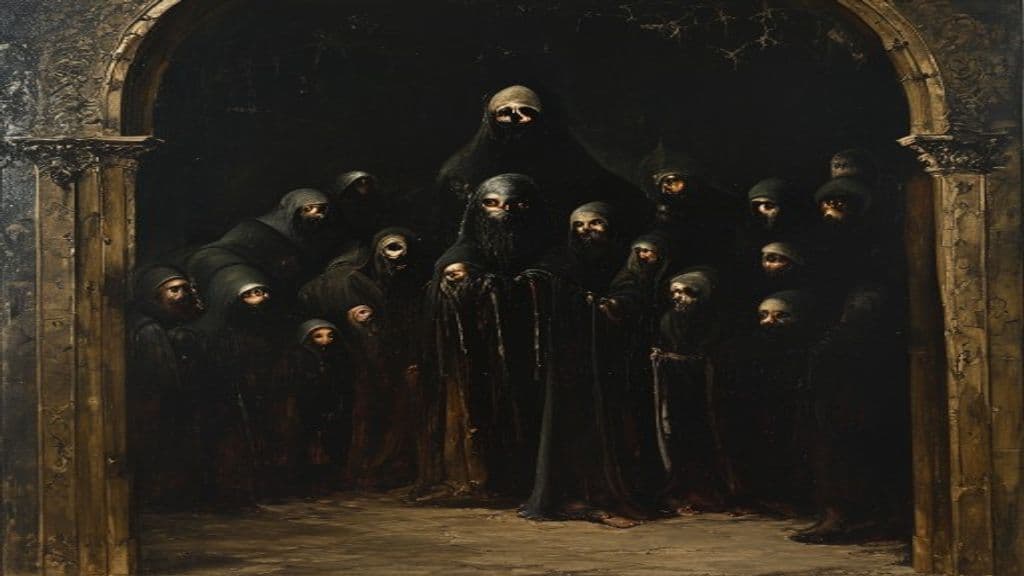
No physical description is provided in the source material, leaving their appearance uncertain.
Estries prey specifically on Jewish babies, implying a particular focus on vulnerable individuals within the community and associated with blood consumption.
Weaknesses
- unknown
Wards
- unknown
Golem (Jewish tradition)
An animated anthropomorphic being formed from inanimate earth (typically clay or mud) and brought to life by a human practitioner through the ritual use of Hebrew letters or divine names. In Jewish narrative and mystical contexts the golem functions as servant or protector created by rabbis, Baal Shem figures, or Kabbalists, but stories repeatedly warn that it can grow uncontrollable and must be deactivated by altering its animating inscription.
Senoy, Sansenoy and Semangelof
A triad of named spirit-agents in Jewish folkloric summaries attested as protecting women during and shortly after childbirth and safeguarding newborn infants from attacks attributed to the night demon Lilith. Secondary and modern sources sometimes label them as angels or "medicinal angels," but primary ritual, linguistic, and iconographic data are not preserved in the supplied materials.
Esfandiyār
Esfandiyār is a legendary human prince and warrior in the Iranian epic tradition (the Shahnameh). Presented as a Kayanian crown prince and a divinely supported champion who aids the cause of Zarathustra, his career includes seven labors, receipt of heavenly armor and a binding chain, and a fatal duel with the hero Rostam that functions as a moral and providential pivot in the epic.
Eskandar (Alexander the Great) — Shahnameh tradition
In Ferdowsi’s Shahnameh Eskandar (Sikandar/Alexander) is a legendary royal-hero integrated into the Iranian royal sequence: a world-conquering monarch who also undertakes spiritual journeys and erects a barrier against apocalyptic forces. The episodes function as a narrative and cosmological bridge from the poem’s mythic Kayanian age to a more historical time-frame.
Espanoi (Shahnameh) — unresolved
The supplied sources do not support the existence of a supernatural or mythological entity named "Espanoi" in the Shahnameh. The term appears in the materials only as the English ethnonym "Spaniards" and as a bracketed label in an archival item title; no Shahnameh or Persian-folklore descriptions, attributes, or rituals for an "Espanoi" are present in the provided research notes.
Esterka
Esterka is a legendary medieval Jewish woman in Polish tradition, famed as the beloved, mistress, or in some accounts wife of King Casimir III (Kazimierz) the Great (reigned 1333–1370). In chronicles and later literature she functions as a bridge between royal/political history and Jewish communal memory in Poland, credited with influencing royal policy toward Jews and memorialized in place‑names and artistic works.
Esther
Esther is the eponymous human heroine of the Book of Esther in the Hebrew Bible (Megillat Ester). Presented as a Jewish woman who becomes queen in the Persian royal court, her strategic concealment of identity, intercession with King Ahasuerus, and the communal fast she requests are narrated as securing the survival of the Jewish people in that story and underpin the festival of Purim.
Esu (Eshu, Elegbara)
Esu (also attested as Eshu, Elegbara, Elegua/Elegguá, Exu) is a named Orisha — a deity — in the Yoruba traditional religious system and its diasporic continuations. The provided source identifies Esu principally as an Orisha associated with roads and notes the figure's presence across Ifa/Orisha practice and several Afro-diasporic religions.
Etana
Etana is a legendary early king of Kish in Mesopotamian tradition who, according to epic texts and the Sumerian King List, aided an eagle and was conveyed to the heaven of the god Anu to seek a 'plant of birth' enabling him to sire an heir. He functions as a culture-hero whose narrative situates kingship, divine favor, and animal intermediaries within Mesopotamian cosmology.
Eteocles
Eteocles is a mytho-historical Theban king of the Greek tradition, son of Oedipus, who becomes central to the dynastic feud with his brother Polynices that culminates in the war of the Seven against Thebes and the mutual killing of the two brothers.
Eteocretans
The Eteocretans are referred to in classical and modern sources as an indigenous, pre-Greek people of the island of Crete; the name also denotes the pre-Greek language attested in a few alphabetic inscriptions from Crete. In the cited accounts they are treated as an early settler population in a legendary‑historical sequence rather than as a supernatural being.
Eteriani
A Georgian folk epic romance and cultural phenomenon, featuring themes of love, heroism, and chivalry in its oral prose and poetry. (Note: 1. The summary is accurate. 2. Power tier should be Ancient (deity-level) rather than Primordial (cosmic), as Eteriani is a cultural phenomenon tied to human history and not a cosmic entity. 3. Sensor)
Community Record
- [1]Wikipediawiki