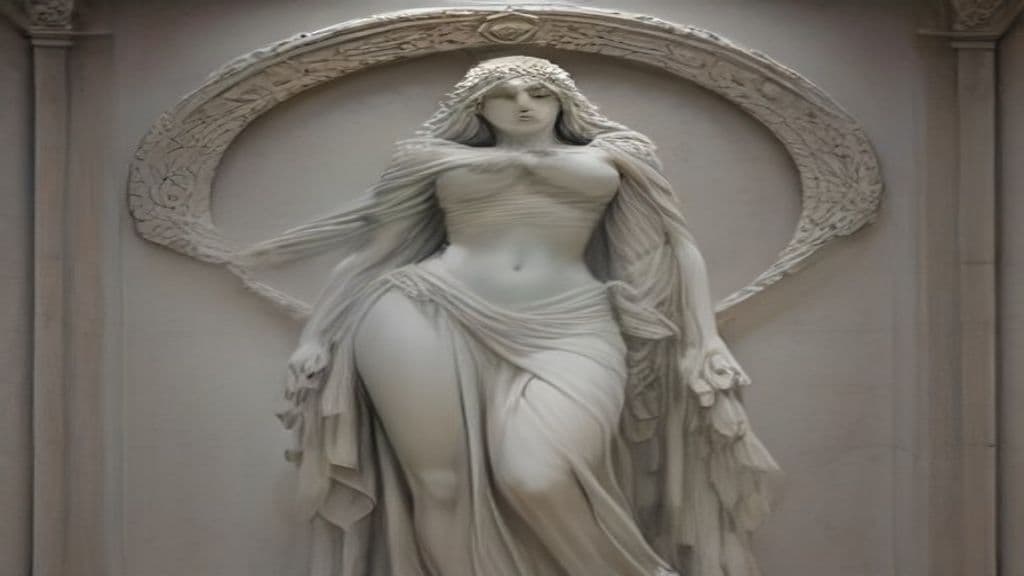
The name Eurymede appears in multiple, variant genealogical strands rather than a single origin narrative. In one strand she is named as the mother of the hero Bellerophon by Glaucus (sources that collect mythographic traditions, summarized in classical compilations and modern references). In alternate tradition(s) cited in later retellings and local lore she is identified with the name-form Eurynome and presented as a daughter of King Nisus of Megara, placing her in a Megarian royal household and thereby providing a local account of Bellerophon's parentage. In a separate genealogical tradition she is listed among the daughters of King Oeneus of Calydon and Althaea and thus counts as one of the sisters of Meleager (the Meleagrides); in that narrative the sisters grieve Meleager's death and are transformed into birds by Artemis. The supplied sources present these strands as alternate, locally rooted versions of genealogical relationships rather than as cumulative biographical episodes.
No physical description is supplied in the sources; Eurymede is attested only as a named mortal woman within genealogical lists and narrative mentions. Like many named women in Greek genealogies, she is identified relationally (mother, daughter, sister, princess) rather than by bodily attributes or costume.
The sources attribute no supernatural powers or characteristic abilities to Eurymede herself. Her narrative function is genealogical: as mother of Bellerophon in some accounts, and as one of Oeneus's daughters (one of the Meleagrides) in others. In the Meleagrides tradition she shares in a collective metamorphosis—being among the sisters turned into birds—which is enacted by the goddess Artemis; the transformation is divine action rather than an innate ability of Eurymede.
Alke
Alke (Ancient Greek: Ἀλκή) is the anthropomorphic personification of prowess, courage, and battle-strength in archaic and classical Greek poetic tradition. She is attested as a named figure depicted on Athena's aegis in Homeric epic and the name also appears in later mythographic lists as a number of distinct proper-name figures.
Argeia (Argia / Argea)
Argeia (Ancient Greek Ἀργεία; variants Argia, Argea) is primarily attested as a mortal name in Greek mythic genealogies — notably a daughter of Adrastus of Argos, wife of Polynices and mother of Thersander, Adrastus, and Timeas. The lexical form Argeia is also used in modern scientific taxonomy as a genus of parasitic isopods and as a species epithet (e.g., Chimarra argeia) in entomology.
Batea of Troad
Batea (Ancient Greek: Βάτεια) is a mythic female ancestor and eponym in early Greek accounts tied to the foundation myths of the Trojans/Dardanians. Presented as a member of the Teucrian royal house and consort of Dardanus, she is credited with giving her name to a hill in the Troad and to the town Bateia and functions mainly to link genealogical descent and territorial claims.
Boeotus (son of Poseidon)
Boeotus is a mythic eponymous ancestor in Greek tradition credited with giving his name to the region and people of Boeotia. He appears in genealogical accounts as a son of Poseidon (often with Arne) or in variant traditions as son of Itonus and the nymph Melanippe, functioning chiefly as a founding ancestor rather than an active cultic or supernatural agent.
Chaetus
Chaetus (Ancient Greek: Χαῖτος) is a mortal figure in Greek mythic genealogies identified as one of the sons of King Aegyptus. He is best known as one of the Aegyptid princes who married a daughter of Danaus (Asteria) and was slain on his wedding night along with most of his brothers.
Chlorus
Chlorus is a mythic genealogical figure attested in brief classical/compilatory sources of Greek tradition. He appears as a link in a lineage (son of Pelasgus, father of Haemon, ancestor of Thessalus) used etiologically to connect eponyms such as Haemonia and Thessaly to named progenitors.
Demonice of Aetolia
Demonice (Ancient Greek: Δημονίκη, also attested as Δημοδίκη / Demodoce) is a mythic Aetolian princess in Greek genealogical tradition. She is presented as a mortal daughter of King Agenor of Pleuron who consorted with the god Ares and bore sons whose names serve as eponyms for local rivers, cities, and peoples of Aetolia and neighbouring regions.
Dioxippe (Heliades)
Dioxippe (Ancient Greek: Διωξίππη) is a named figure in Greek myth most commonly attested as one of the Heliades — daughters of Helios and the Oceanid Clymene — appearing in mythographic name-lists. The same personal name 'Dioxippe' also occurs for several unrelated female figures in Greek tradition (a Danaid, an Amazon, a wife of Agenor) and even as the name of one of Actaeon’s dogs in various sources.
Epicaste
Epicaste (Ancient Greek Ἐπικάστη, Epikaste) is a personal name attested for multiple mortal women in ancient Greek mythic genealogies and epic references. The name functions as a narrative identifier across several local traditions (Thebes, Calydon, Elis, Argos, Pylos/Ithaca) rather than denoting a single supernatural being or class of spirit.
Euneus
Euneus is a mythic dynastic and heroic figure of ancient Greek tradition, son of Jason and Hypsipyle and later king of Lemnos. He appears in epic and mythographic accounts as a local ruler who provisioned Greek fleets, ransomed a Trojan prisoner, and served as ancestor-eponym for a Lemnian clan of cithara-players.
Eusorus
Eusorus (Ancient Greek Εύσωρος, Eusōros/Eusorus) is an otherwise-unknown named ancestor attested in Greek epic and mythographic genealogies. He functions as a paternal or grandpaternal figure used to anchor the origins of better-known figures such as Aenete, Cyzicus, and Acamas; no myths, deeds, cult, or physical descriptions are recorded for him in the cited sources.
Lampetia
Lampetia is a figure in ancient Greek myth, described as a daughter/attendant of the sun-god Helios who, with her sister Phaethusa, guards Helios's sacred herd on the island Thrinacia. She functions as a divine herdswoman and reporter of transgressions against divine property in Homeric narrative and appears in variant genealogies in later mythography.
Community Record
- [1]Eurymede — Wikipedia. Wikipedia, entry 'Eurymede' (summary of ancient name-forms and attested characters)wiki
- [2]Βελλεροφόντης (Bellerophon) — lyrical theatre drama (Modern Greek verse). Archive.org, lyric theatre drama 'Bellerophon' (notes a local tradition naming Eurynome/Eurymede daughter of Nisus of Megara)literary
- [3]LP0077 - III ARGONAUTS - Introduction to the Argonauts / The Library of Apollodorus (excerpt). Archive.org, material related to Apollodorus and mythographic compilations that record variant genealogies (used as reference for genealogical variants)literary
- [4]Wikidata: Eurynome. Wikidata entry for Eurynome (variant name-form linked to some accounts of Eurymede/Eurynome)other