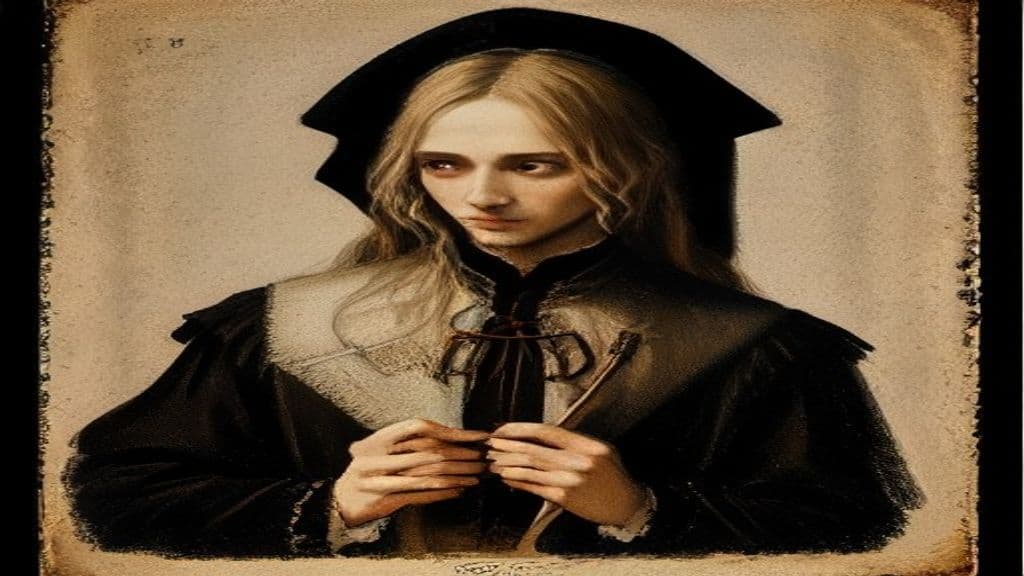
The core legend assembles around a probable historical itinerant scholar Johann Georg Faust (c. 1480–c. 1540) and first appears in print as the chapbook Historia von D. Johann Fausten (1587). In the narrative complex Faust is an erudite scholar dissatisfied with the limits of conventional learning who solicits infernal aid and makes a pact at a crossroads exchanging his soul for a term of service that grants knowledge and pleasures. Over centuries the tale circulated in popular chapbooks, puppet plays, and dramatic adaptations (notably Christopher Marlowe’s Doctor Faustus and Goethe’s Faust), and scholars note analogues and possible name-relatives (e.g., Johann Fust, Faustus in Historia Brittonum) and cognate European motifs such as the Polish Pan Twardowski and the Theophilus legend; the precise historical origins and strands remain debated in the sources.
Sources portray Faust primarily by social and intellectual markers rather than a fixed physical description: he is an erudite, learned scholar (studying theology and medicine) who is highly successful yet dissatisfied. Early chapbooks emphasize his turning away from sacred learning (“laid the Holy Scriptures behind the door… refused to be called doctor of theology, but preferred to be styled doctor of medicine”). Literary and theatrical depictions (Marlowe, Goethe, illustrated chapbooks, films and stage adaptations) provide varied visual representations tied to each medium’s conventions, but the tradition contains no single canonical bodily description beyond the scholarly persona; his story is regularly accompanied by an infernal representative (commonly Mephistopheles) who provides the supernatural powers.
Faust is a human who obtains supernatural powers by bargaining with an infernal representative (the Devil/Mephistopheles). The granted abilities are deployed to obtain forbidden or extensive knowledge and to secure worldly pleasures; narratives cite magical powers used to explore arcane knowledge and to effect seduction and worldly advantage (Goethe’s drama depicts Mephistopheles aiding Faust in seducing Gretchen, with tragic consequences). Different textual traditions diverge on consequences: early popular versions depict Faust as irrevocably damned and carried off to Hell at the bargain’s end, while Goethe’s reworking presents the possibility of salvation through ‘constant striving’ and the intercession of pure-hearted figures.
Weaknesses
- conditionsubject to theological judgment (variant outcomes: irrevocable damnation in early chapbooks; possible salvation in Goethe through striving and intercession)
Wards
- othernone documented in provided sources
Demogorgon
A name that emerged in Latin medieval commentary and was later taken up in Renaissance and early modern literature and demonology as a powerful, primordial subterranean or infernal figure associated with fate and accountability. Modern popular culture reuses the name for monsters, but those visualizations are distinct from the medieval and Renaissance textual tradition.
Devil horse
A polyvalent folkloric and cultural label applied to horses or horse-shaped phenomena interpreted as malevolent, uncanny, or diabolically influenced in disparate literary, toponymic, and cinematic sources. The term appears in place-name folklore, fiction, film titles, and as an epithet attached to ordinary horses, but the sources do not present a single, coherent supernatural taxonomy for a discrete species called "Devil horse."
Lavinia
Lavinia is a figure from Roman literary and legendary tradition, presented primarily as the daughter of King Latinus and the wife of Aeneas whose marriage and omen-centered story link Trojan and Latin lineages and give the eponym for the town Lavinium. The name also survives as a female given name and as the title/protagonist in later literary works.
Undine (Ondine)
An elemental water spirit from Paracelsian occult cosmology later developed into a literary water-nymph archetype. Undines are humanoid, almost always presented as female, inhabit watery places, lack an immortal human soul by default, and—according to Paracelsus and later literature—may acquire a human soul through marriage with a human.
Fatimah
Fatimah (also spelled Fatima) in the provided sources is presented as a female personal name and as the historical figure Fatima bint Muhammad (Fatima al‑Zahra), daughter of the Islamic prophet Muhammad, wife of Ali, and mother of Hasan and Husayn. The corpus contains biographical and onomastic information only and does not treat Fatimah as a supernatural entity.
Faun
A faun is a Roman mythic being combining human and goat-like features, originally conceived as rustic local spirits (genii) of the countryside and later visually conflated with Greek satyrs and the god Pan; they are associated with pastoral fertility, revelry, and an ambivalent role toward travelers in wild places.
Fauna
Fauna is a Roman feminine divine figure associated with the countryside, fertility, and animal life; she is presented as the feminine counterpart or personified form related to the male rural deity Faunus and connected to the same pastoral/woodland complex as the fauns.
Faunus
Faunus is an ancient Roman rustic deity and tutelary nature god of forests, plains, and fields, protector of agriculture and cattle. He functions as an oracular and fertility power, head of a plurality of lesser fauni (place-spirits), and was celebrated in festivals such as the Faunalia and associated with the Lupercalia rites.
Feathered Serpent
A composite avian-serpent supernatural figure attested across multiple Mesoamerican cultures (Olmec, Teotihuacan, Maya, Toltec, Aztec, Kʼicheʼ). Associated in sources with cosmological roles such as creation, wind and rain, knowledge, Venus, and calendric/origin mythic functions, and widely represented in monumental architecture and iconography.
Feilian
Feilian is a named Chinese wind-being originating in southern (Chu) tradition and attested in early Chu poetry (Chu ci). In later commentarial and historiographic traditions the figure became identified with or subsumed under the Zhou/Taoist wind-deity Fengbo; Feilian is represented variously as a chimeric winged beast, a local wind-power, and in some accounts as a historical or mytho-historical personage linked to late Shang narratives.
Feirefiz
Feirefiz is a human knight-character in Wolfram von Eschenbach’s medieval Arthurian poem Parzival. Son of Gahmuret and the Moorish queen Belacane, he appears as Parzival’s half-brother and equals him in knightly skill; within Wolfram’s narrative he is a non-Christian noble who must undergo baptism to participate fully in the Grail community.
Feldgeister
Feldgeister are a class of German agricultural spirits or 'field spirits' associated with cereal crops, harvest processes and weather. The category groups many named local types (animal, human, and hybrid forms) implicated both in fertility of fields and in hazards such as child-stealing, illness, spoilage and storm phenomena.
Community Record
- [1]Faust. Faust — Wikipedia article (summary and bibliographic information, including note on 1587 Historia von D. Johann Fausten and discussion of variants such as Goethe and Marlowe).wiki
- [2]Faust | Project Gutenberg (Goethe's Faust — Part I). Goethe, Johann Wolfgang von. Faust — Part I (Project Gutenberg edition referenced in source list for textual treatment and outcomes in Goethe’s reworking).literary
- [3]Faust | Project Gutenberg (Faust editions). Editions/illustrated Project Gutenberg copy referenced among sources documenting print history and visual adaptations.literary
- [4]Wikidata: Faust. Wikidata entry for Faust (identifier and structured metadata referenced in source list).other
- [5]Archive item referencing Faust tradition. Archive materials listed among provided sources (used as part of the supplied source corpus).other