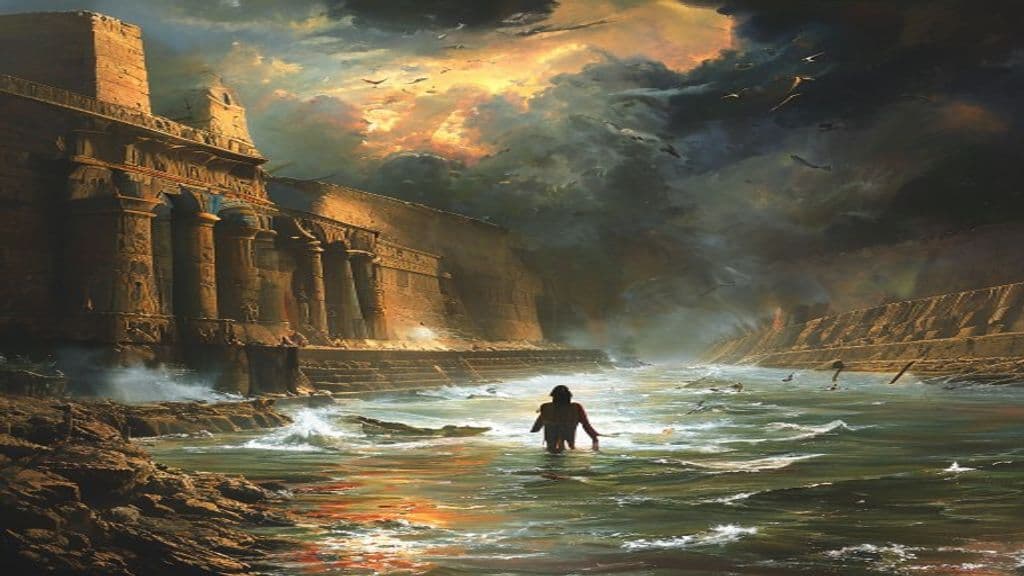
The Flooding of the Nile brings silt and nutrient-rich water to the land, making it fertile for agriculture.
The Dreaming
A foundational religio-cultural worldview in Australian Aboriginal traditions designating an 'Everywhen' in which ancestral figures inhabited, created, and continue to give meaning to land, life, law and social identity. It is expressed locally under many indigenous terms and is best understood as an ongoing cosmological order rather than a single anthropomorphic being.
The Ennead
A group of nine deities in Egyptian mythology, representing a complex web of relationships and generations within the divine family, worshipped at Heliopolis. (Note: - Power tier should be Ancient (deity-level) rather than Primordial (cosmic), as the Ennead consists of deities with specific powers and attributes. - The article should specify that Horus is not alwa)
The Exodus
A foundational myth in Jewish tradition describing the liberation of the Israelites from ancient Egypt, considered a transformative event of divine intervention. (Note: - Power tier should be Primordial is incorrect; the Exodus is not an entity with abilities or behaviors, so it doesn't fit any of the power tiers. - Appearance should be mentioned as "Not depicted" si)
The Fall of Man (Jewish Tradition)
A transformative event in Jewish tradition where Adam and Eve disobey God's command, introducing guilt, shame, and expulsion from the Garden of Eden. (Note: - Power tier: Primordial -> Ancient (The Fall is a transformative event for humanity, but it doesn't have cosmic implications) - Weaknesses: Remove this section or rephrase as "Contradictions" since G)
The Ferryman (Greek Tradition)
A supernatural being in Greek tradition tasked with ferrying souls across a body of water after death, associated with Aesop's fables. (Note: - Power tier should be Greater, as ferrying souls across a body of water doesn't imply cosmic-level abilities. - The origin story is unclear; consider rephrasing or adding that no specific origin stor)
The Fifth World (Navajo tradition)
A concept representing the current era of human existence within a cyclical creation myth, as part of Navajo traditions. (Note: - Power tier should be Ancient (deity-level), as it's a concept within a cultural tradition, not a Primordial power. - Abilities need to reflect that it doesn't possess active powers or behaviors; per)
The Game of the Gods
A pivotal moment in Norse mythology, marking a turning point in creation and destruction, associated with the golden age of the Æsir and their survival after Ragnarök. (Note: 1. The power_tier should be Primordial (correct), but consider adding "with unknown implications" as it's not clear how this entity interacts with reality. 2. Remove or rephrase the claim that it has )
The Gaze of Orpheus
A primordial force resulting from Orpheus' actions in the underworld, enforcing conditions set by Hades and Persephone. (Note: 1. The origin story doesn't specifically mention Hades and Persephone setting conditions; it was a consequence of Orpheus' actions. 2. Power tier correction: As the Gaze is more of a force or conseque)
The Gray Man
A polyvalent label applied to multiple distinct figures: a local ghost of Pawleys Island, a figure in Scottish folklore called Fear liath, and numerous modern fictional or cultural uses. The sources provided do not present a single unified supernatural being but rather several separate referents sharing the same name.
The Great Race
A cosmic event in Lakota creation stories where humans and buffalo competed to establish supremacy, resulting in humans emerging victorious through cunning and strategy. (Note: 1. The power tier should be Primordial instead of Ancient. 2. Add sensory cues: dreams, omens, visions 3. Add weaknesses: loss of trust between humans and buffalo; spiritual disconnection from the nat)
The Great Renunciation
A pivotal event in Buddhist tradition, marking Gautama Buddha's transition from a life of luxury to one of asceticism. (Note: 1. Power tier: Minor Spirit is incorrect; The Great Renunciation is not an entity with powers or behaviors, so it should be classified as none or Primordial (since it's a pivotal event). 2. Sensory cu)
The Headmen
The Headmen are a team of supervillains appearing in American comic books published by Marvel Comics, created from earlier horror-story characters and first assembled as a team in The Defenders #21 (March 1975). They are human (or human-derived) antagonists who pursue schemes of scientific, political, and economic domination and are repeatedly opposed and defeated by superhero protagonists.
Community Record
- [1]