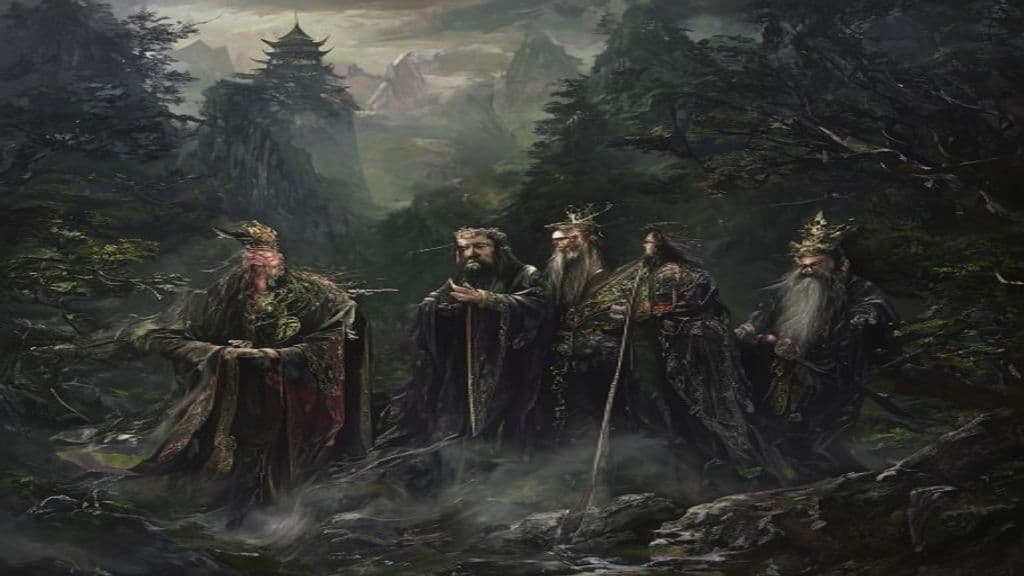
No specific physical description is provided for any of the Four Immortals in the source material.
Tản Viên Sơn Thánh has control over natural elements such as mountains and forests. Phù Đổng Thiên Vương possesses great strength and military prowess. Chử Đồng Tử likely has wisdom, knowledge, and spiritual powers. Princess Liễu Hạnh is a Mother Goddess and heavenly spirit.
Foruhal
The provided source material only links the name Foruhal to the corpus surrounding the Shahnameh (specifically a page referencing Davāzdah Rokh) but contains no description, role, or contextual information about Foruhal. No attributes, stories, or cultural placement are given in the supplied excerpt.
Fossegrim
A water spirit or troll in Scandinavian folklore, associated with music and enchantment. (Note: 1. Power tier: Lowered from Greater to Lesser, as it's described as a local spirit. 2. Origins story: Clarify that it's rooted in Scandinavian cultural values, but more specifically mention the Old No)
Founding of Rome
The collective process of gradual union and formation of settlements on hilltops in ancient Rome. (Note: - Power tier: Primordial (not Lesser, as it's a historical process rather than a supernatural entity) - Abilities: Remove "The exact nature of this process is unclear" and replace with something accur)
Foundling-Bird (Fundevogel)
Fundevogel (Foundling-Bird) is a proper-name character and origin-motif from the Brothers Grimm tale “Fundevogel,” describing a human boy found in a bird's nest and raised by a forester. Within the ATU 313A transformation‑chase context, the character participates in a sequence of metamorphoses used to evade pursuers rather than representing a distinct supernatural race.
Four Holy Beasts
A set of four sacred animals in Chinese and broader East Asian cultural and astronomical tradition, mapped to the four cardinal directions and used as auspicious, protective, and cosmological symbols in literature, architecture, and material culture.
Four Horsemen of the Apocalypse
Figures appearing in Revelation 6 (New Testament) traditionally dated to c. AD 95, summoned when the Lamb opens the first four of seven seals. Four riders on white, red, black, and pale horses function in the vision as divinely-commissioned agents who bring large-scale calamities (commonly rendered in later commentary as conquest, war, famine, and death).
Four Kumaras
A quartet of eternally youthful, mind-born sages created by Brahma who roam the cosmos as celibate rishis and exemplars of renunciation and devotion. Named Sanaka, Sanandana, Sanatana and Sanatkumara, they function as primordial teachers and mahajanas in Purāṇic and Bhagavata traditions.
Four Perils (Sì Xiōng)
The Four Perils (四凶; Sì Xiōng) are a set of four malevolent figures in ancient Chinese literature—Hundun, Qiongqi, Taowu, and Taotie—recorded variously as monstrous creatures inhabiting mythic mountains, moral exemplars of vice, or eponymous lineal ancestors used in historiographic critique. Accounts differ across sources, so each name functions simultaneously as a beast in mytho-geography and as a symbol of disorder or vice in moral-historical texts.
Four Symbols (Sì Xiàng)
A set of four mythological creatures in Chinese cosmology—Azure Dragon, Vermilion Bird, White Tiger, and Black Tortoise‑Snake—serving as celestial asterisms and directional guardians integrated into ritual, astrological, and state symbolism.
Fox spirit
A widespread class of mythical beings associated with foxes (often represented by red-fox imagery in many traditions) characterized by cunning, shapeshifting, trickery, and ambiguous moral roles; prominently attested in East Asian folklore and present in modern literature and media as romantic, vengeful, or matchmaking figures.
Foxfire
A natural bioluminescent glow produced by certain fungi on decaying wood, historically observed and variously mythologized as "fairy fire" or likened to will-o'-the-wisp; treated in the provided sources as a biological/phenomenal phenomenon rather than an intentional spirit.
Francesca da Rimini
Francesca da Rimini was a late 13th‑century Italian noblewoman whose adulterous affair with Paolo Malatesta and subsequent murder by her husband Giovanni Malatesta became a lasting literary and artistic theme; most famously she appears as a speaking soul among the lustful in Dante Alighieri's Inferno (Canto V).
Community Record
- [1]Four Immortalswiki