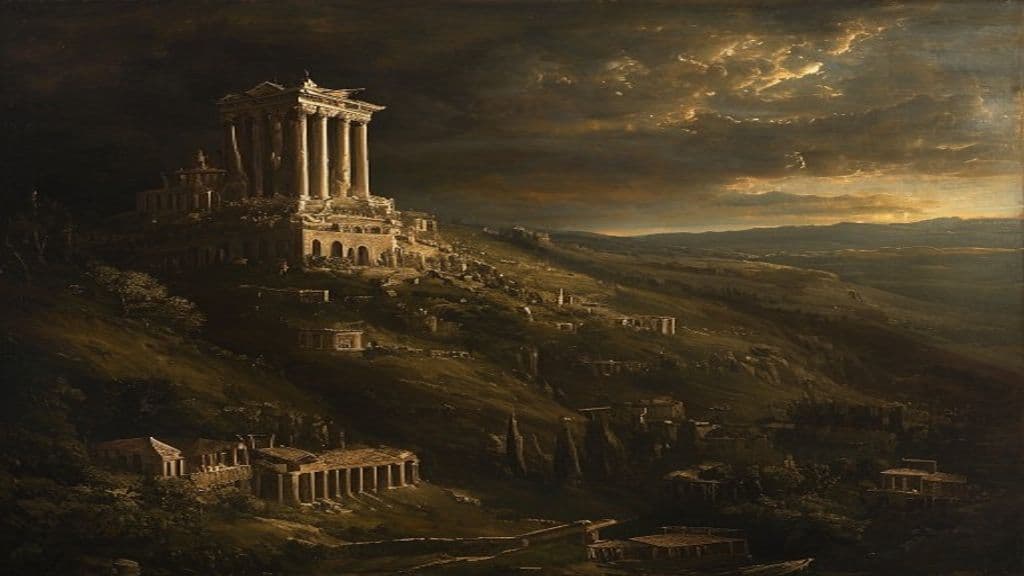
The founding of Rome is described as the gradual union of several hilltop villages influenced by external factors like city-state formation emerging from ancient Greece. This process began around 1600 BC and potentially earlier (c. 1700 BC).
No physical description of the entity is provided, as it is not considered a tangible being within this context.
The exact nature of this process is unclear, but it does not imply any supernatural abilities or behaviors.
Weaknesses
- historical eventsexternal influences
- social dynamicschanges in societal
Wards
- cultural significancepreservation of historical layout and structure
Acron (King of the Caeninenses)
Historical figure and leader of the Caeninenses, a neighboring tribe to the Romans. Rejected the proposal of intermarriage with Romulus. (Note: 1. Power tier: Acron is described as a king, but no source material indicates his abilities or powers are deity-level (Ancient) or cosmic (Primordial). Greater seems plausible. 2. Origin story: The dr)
Avernus
In Roman tradition, Avernus is a volcanic crater near Cumae (Cuma) in Italy associated with the underworld. (Note: 1. Power tier: Given that there are no reported interactions or abilities associated with Avernus as an entity, it should be classified as a Minor Spirit. 2. Appearance: There is no distinct physical )
Carmen (Roman Tradition)
A carmen is a type of supernatural entity or force in Roman tradition, used for expiation and execration through verbal incantations and rituals. (Note: - Power tier should be Primordial (cosmic-level entity as described in source material) - Add sensory cues, weaknesses, and wards based on the abilities of a carmen (e.g., incantations and rituals may)
Corona Australis
A constellation in the Southern Celestial Hemisphere associated with various cultural interpretations. (Note: 1. Power tier should be "Primordial" as Corona Australis is an astronomical object and not a deity-level entity. 2. Abilities are not mentioned in the source material; delete this section entirely. 3.)
Interpretatio Slavica
A cultural practice among Slavic peoples to identify and equate their deities with those of neighboring cultures and Christian saints. (Note: - Power tier should be Ancient (deity-level), as it's a cultural practice rather than a supernatural being. - Sensory cues, weaknesses, and wards are not applicable to this entity, as it's an abstract)
Remoria
A place within Roman tradition associated with the founding of Rome by Romulus and Remus. (Note: - Power tier: Reduce from Primordial to Ancient (as it's a geographical site associated with deity-level figures, but not a deity itself) - Summary: Update to reflect its connection to the founding of)
Fortuna
Fortuna is the Roman divine personification of fortune, chance, and the capricious turning of events. Worshiped in multiple local and functional aspects, she could bestow prosperity or withdraw it; her action was read both as arbitrary caprice and as connected to civic virtue.
Foruhal
The provided source material only links the name Foruhal to the corpus surrounding the Shahnameh (specifically a page referencing Davāzdah Rokh) but contains no description, role, or contextual information about Foruhal. No attributes, stories, or cultural placement are given in the supplied excerpt.
Fossegrim
A water spirit or troll in Scandinavian folklore, associated with music and enchantment. (Note: 1. Power tier: Lowered from Greater to Lesser, as it's described as a local spirit. 2. Origins story: Clarify that it's rooted in Scandinavian cultural values, but more specifically mention the Old No)
Foundling-Bird (Fundevogel)
Fundevogel (Foundling-Bird) is a proper-name character and origin-motif from the Brothers Grimm tale “Fundevogel,” describing a human boy found in a bird's nest and raised by a forester. Within the ATU 313A transformation‑chase context, the character participates in a sequence of metamorphoses used to evade pursuers rather than representing a distinct supernatural race.
Four Holy Beasts
A set of four sacred animals in Chinese and broader East Asian cultural and astronomical tradition, mapped to the four cardinal directions and used as auspicious, protective, and cosmological symbols in literature, architecture, and material culture.
Four Horsemen of the Apocalypse
Figures appearing in Revelation 6 (New Testament) traditionally dated to c. AD 95, summoned when the Lamb opens the first four of seven seals. Four riders on white, red, black, and pale horses function in the vision as divinely-commissioned agents who bring large-scale calamities (commonly rendered in later commentary as conquest, war, famine, and death).
Community Record
- [1]