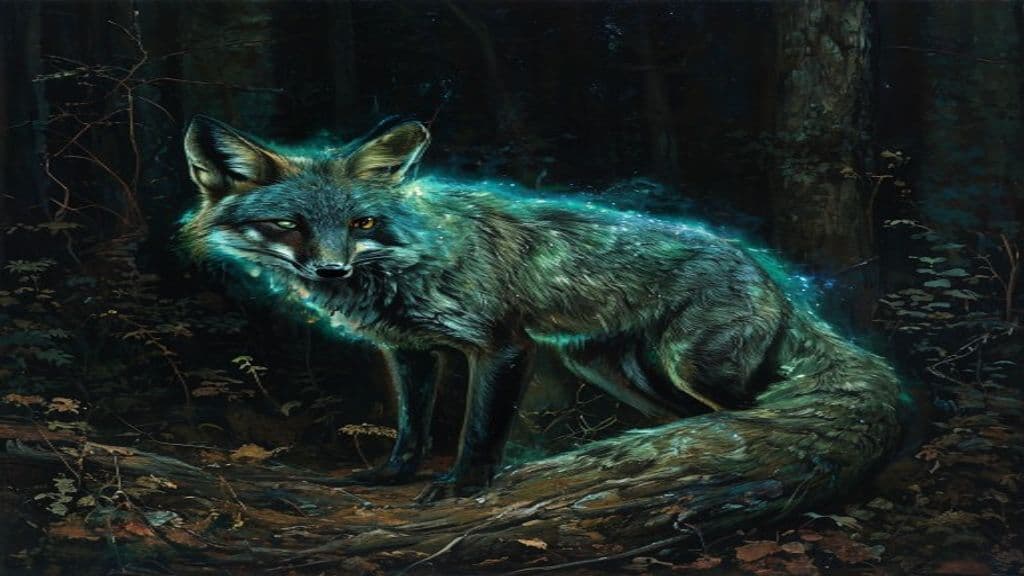
Foxfire appears in historical naturalist records from antiquity (Aristotle c. 382 B.C. is cited noting a cold light) and in later authors such as Pliny the Elder; for centuries observers recorded mysterious cold, bluish lights on decaying wood. The phenomenon moved from curiosity and folkloric comparison (often called "fairy fire" and linked in literature to will-o'-the-wisp traditions) toward scientific explanation when investigations in the 19th century identified bioluminescent fungi as the source (noted in a summarized history that includes an 1823 investigation). Over time the term also entered metaphor (for example, revontulet in Finnish literally meaning "foxfires" referring to aurora phenomena) and was experimented with for practical lighting uses in historical contexts.
Described as a bluish-green or greenish glow emitted from decaying wood and fungal fruiting bodies (sources cite species such as Panellus stipticus and Omphalotus spp.). Historical observers recorded the light as cold to the touch in contrast to thermal fire; intensity ranges from a faint forest glow to, in some reported cases, brightness sufficient to read by. Contemporary descriptions emphasize a beautiful green glow visible on logs, stumps, and wooden beams under appropriate environmental conditions.
Biochemically, the light is produced by an oxidative reaction in which a luciferase acts on a luciferin substrate, emitting visible light; the glow persists while the fungi are metabolically active. Scientific summaries in the sources present ecological hypotheses for the effect—such as attracting insects for spore dispersal or serving as a warning signal analogous to aposematism—but treat these as functional hypotheses rather than intentional actions by a sentient agent. The phenomenon is not described in the provided material as mobile, willful, or agentive.
Weaknesses
- conditioncold or metabolic inactivity (extreme cold or conditions that halt fungal metabolism diminish or extinguish the glow)
- conditiondesiccation or absence of suitable substrate (drying of decay or removal of colonized wood will stop the bioluminescence)
Wards
None recorded.
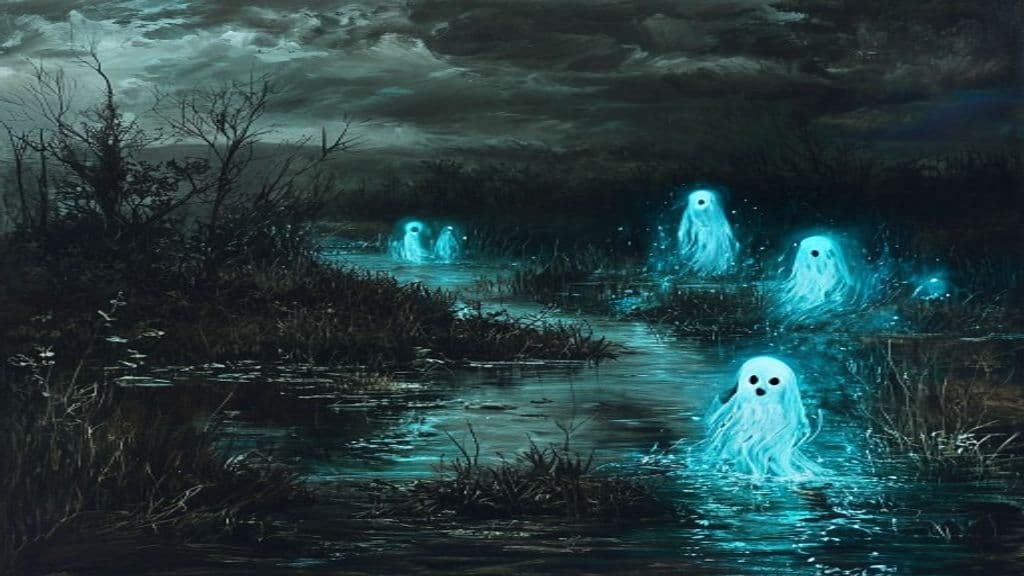
Barbary lion
The Barbary lion was a historical North African population of Panthera leo (also called the North African, Atlas, or Egyptian lion) that inhabited the Maghreb and Atlas Mountains. Treated in sources as a zoological and conservation subject rather than a supernatural being, it is extinct in the wild and survives only in captive lineages claimed to descend from historic North African animals.
Hippotion
Hippotion is a scientific genus of sphinx or hawk moths (family Sphingidae) erected by Jacob Hübner in 1819. The genus groups several species of moths found across multiple regions and is treated in entomological, natural-history, and pest-management sources rather than folkloric tradition.
Wainuia clarki
Wainuia clarki is a species of air‑breathing predatory land snail in the family Rhytididae, endemic to New Zealand. Sources describe it in biological and conservation terms; it is carnivorous and feeds mainly on earthworms.
Wolf
The wolf (Canis lupus) is a biological species of large canid native to Eurasia and North America, treated in the provided sources as an ecological actor rather than a supernatural being. It is an apex predator with complex social organization, a deep fossil record, and longstanding cultural significance reflected in language and human–wolf relations.
Four Kumaras
A quartet of eternally youthful, mind-born sages created by Brahma who roam the cosmos as celibate rishis and exemplars of renunciation and devotion. Named Sanaka, Sanandana, Sanatana and Sanatkumara, they function as primordial teachers and mahajanas in Purāṇic and Bhagavata traditions.
Four Perils (Sì Xiōng)
The Four Perils (四凶; Sì Xiōng) are a set of four malevolent figures in ancient Chinese literature—Hundun, Qiongqi, Taowu, and Taotie—recorded variously as monstrous creatures inhabiting mythic mountains, moral exemplars of vice, or eponymous lineal ancestors used in historiographic critique. Accounts differ across sources, so each name functions simultaneously as a beast in mytho-geography and as a symbol of disorder or vice in moral-historical texts.
Four Symbols (Sì Xiàng)
A set of four mythological creatures in Chinese cosmology—Azure Dragon, Vermilion Bird, White Tiger, and Black Tortoise‑Snake—serving as celestial asterisms and directional guardians integrated into ritual, astrological, and state symbolism.
Fox spirit
A widespread class of mythical beings associated with foxes (often represented by red-fox imagery in many traditions) characterized by cunning, shapeshifting, trickery, and ambiguous moral roles; prominently attested in East Asian folklore and present in modern literature and media as romantic, vengeful, or matchmaking figures.
Francesca da Rimini
Francesca da Rimini was a late 13th‑century Italian noblewoman whose adulterous affair with Paolo Malatesta and subsequent murder by her husband Giovanni Malatesta became a lasting literary and artistic theme; most famously she appears as a speaking soul among the lustful in Dante Alighieri's Inferno (Canto V).
Frank Tower
Frank Tower is a 20th‑century urban‑legend figure alleged to have survived multiple major ship sinkings (Titanic, Empress of Ireland, Lusitania). Sources treat the story as a tall tale circulated in novelty and popular‑culture outlets; documentary research finds no evidence that a single person named Frank Tower was aboard and survived all three disasters.
Frankenstein (the creature / creation)
A sapient humanoid created by Victor Frankenstein in Mary Shelley's 1818 novel by assembling human remains and animating them through an unorthodox scientific experiment. In the original text the family name 'Frankenstein' refers to the creator, but cultural usage often applies the name to the created being itself.
Frankish Paganism
A polytheistic tradition that evolved among the Franks until the 7th century, influenced by Germanic and Greco-Roman components. (Note: - Remove "Minor Spirit" power tier (inconsistent with polytheistic tradition and influence from Greco-Roman components) - Summary should include Frankish paganism's decline and eventual replacement by)
Community Record
- [1]Foxfire (Wikipedia). Wikipedia: "Foxfire" article (summary of bioluminescent fungi, etymology, history, species examples, and ecological hypotheses).wiki
- [2]Foxfire (Wikidata). Wikidata entry for Foxfire (identifier Q140052795) referenced in materials.other
- [3]Glowing Fungus Night Light (archive video metadata). Archive.org video metadata mentioning P. stipticus known as foxfire and its green glow.other
- [4]Foxfire magazine (Wikipedia). Wikipedia: Foxfire (magazine) — referenced among cultural uses of the word.wiki
- [5]Miscellaneous archive references. Additional archive items and cultural references listed in the provided notes (e.g., historical experiments and cultural usages).other