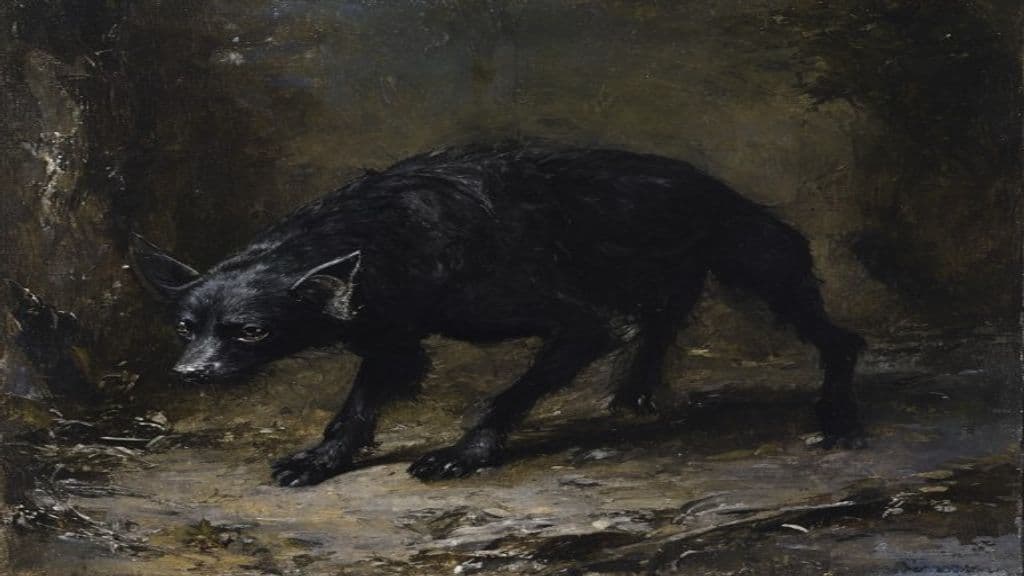
No native mythic origin narrative for the Freybug is recorded in the supplied sources. The earliest documentary mention cited is the appearance of the word “Fray‑bugs” in letters of Laurence Saunders (1555), followed by John Brand’s antiquarian treatment (Popular Antiquities), which suggested equivalence or close similarity to other English black‑dog apparitions such as the Barghest. Later popular writers (e.g., Carol Rose) drew on Brand. The surviving record therefore reflects lexical and antiquarian transmission rather than a preserved, detailed origin myth.
Sources describe the Freybug as a monstrous black dog roughly the size of a calf. Beyond size and general dark, canine form the supplied materials give no further consistent physical detail; the description is terse and aligns the Freybug with the generic black‑dog motif (large, dark, doglike apparition) rather than with a richly specified individual appearance.
The documented behaviour of the Freybug is principally that of a terrifying roadside apparition: it 'wandered country roads terrifying travelers.' The Oxford English Dictionary (as cited in the sources) defines 'Fray‑bug' as 'an object of fear; a bogy, spectre,' which frames the entity as a fright‑producing apparition. Antiquarian John Brand suggested the Fray‑bug was a Black Dog similar to the Barghest, placing it within the broader class of English black dogs that inspire dread; however, the supplied sources do not record specific supernatural feats (such as killing, speech, or shape‑changing) or any consistent portentous function for the Freybug itself, so any extension beyond its role as a frightening presence is uncertain.
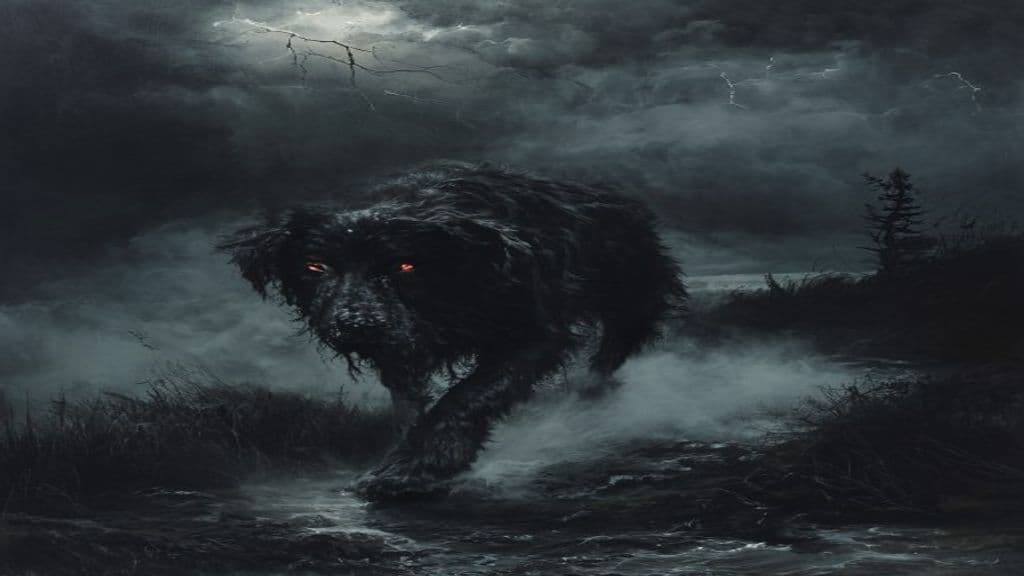
Black Shuck
A spectral black dog of East Anglian legend, with glowing red or green eyes. Its appearance is an omen of death. Its howl has been heard on clifftops during storms for centuries.
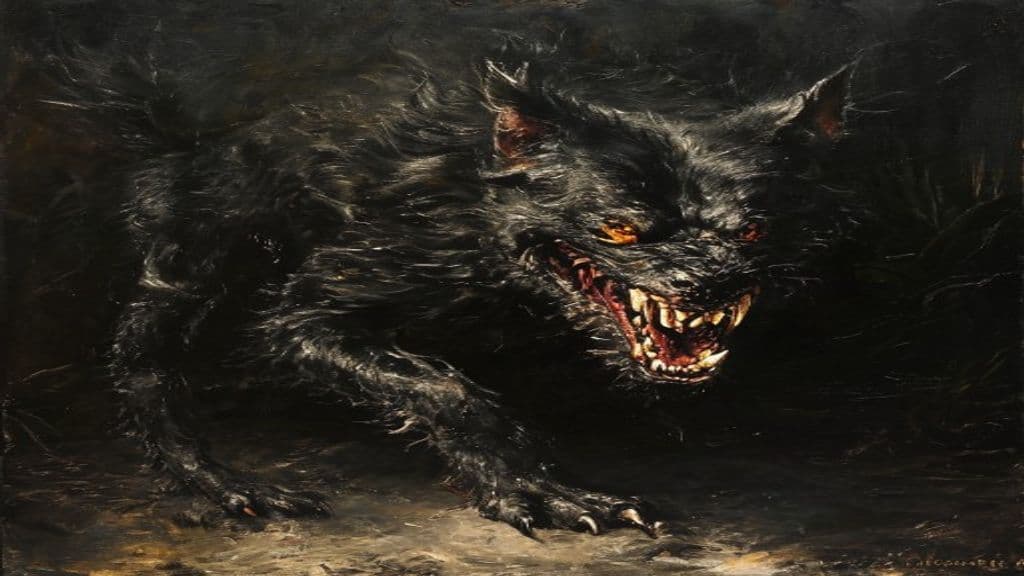
Barghest
A Northern English uncanny presence most often described as a monstrous black dog that serves as an omen of death; the term also covers variant local beings (ghosts or household elves) in some counties, making it a fluid category of liminal, threatening presences in regional folklore.
Billy Blind
Billy Blind is a named household spirit from English and Lowland Scottish ballad tradition who appears as an advising helper in Child ballads, providing information, revelation, and stratagems that enable protagonists to resolve enchantment, identity, and childbirth crises. Attestations are narrative (ballads) and later literary/television adaptations draw on his advising role.
Black Dog (folklore)
A class of supernatural canine apparition in British vernacular folklore, often associated with liminal places and regarded as an omen-bearing or guardian hound. Local named forms (Black Shuck, Barghest, Gurt Dog, Gallytrot) show a range from malign, death-portending hellhounds to benevolent guide-figures.
Blunderbore
Blunderbore is a stock giant of English and Cornish folklore, appearing as a corporeal monstrous antagonist in tales such as Jack the Giant Killer and regional variants like Tom the Tinkeard. He is depicted through his actions—kidnapping, highway obstruction, and violent strength—and is typically overcome by a human folk-hero who frees captives and reasserts social order.
Brown Man of the Muirs
A moorland guardian figure from Anglo-Scottish Border folklore. In a field account he appears as a solitary dwarf who reproves hunters and claims custodianship of upland animals; in later fairy-tale literature he appears as (or is related to) a tribe—the Brown Men of the Moors and Mountains—associated with stronger, more violent motifs and a compulsion-incantation.
Bugbear
A folkloric scare-figure historically invoked to frighten disobedient children, classed among boogeyman-type beings. Medieval descriptions in English sources portray it as a creepy, bear-like lurker in woods; modern popular culture and gaming have reimagined it as a large goblinoid monster.
Cap-o'-Rushes
Cap-o'-Rushes is the title and heroine of an English folktale collected by Joseph Jacobs. The story is classed among international folktale types (principally ATU 510B) and opens with the 'Love Like Salt' motif; it tells of a daughter who disguises herself in a garment of rushes, works as a kitchen maid, attends secret balls, causes recognition by hiding a ring in a dish, and engineers reconciliation by ordering a saltless wedding feast so her father remembers his earlier words.
Church Grim
A site-bound guardian spirit in English, Scottish and Nordic/Scandinavian folklore that watches over an individual Christian church and its churchyard, defending the consecrated ground from profanation and hostile spirits. Forms and origin accounts vary by region, including a large black dog in English tradition, the bound spirit of an animal (often a lamb) in Scandinavian accounts, and in some Scottish strands the spirit of the most recently buried person acting as a temporary watcher.
Dando's Dogs
Dando's Dogs are an English folkloric pack of spectral hounds tied to the tale of a sinful huntsman named Dando. They are classed among English 'black dog' apparitions and described as taking part in the Wild Hunt; tradition reports their sounds on early Sunday mornings as they pursue game or search for their master after his abduction.
Firedrake
A term in English tradition for dragon-shaped manifestations of fire observed in the sky; used both as an Old English poetic word for dragon (fyrdraca) and, from the Renaissance onward, to describe luminous aerial phenomena such as meteors or ignis fatuus. Sources treat firedrakes variously as mythic dragons, atmospheric luminous vapors, or morally charged apparitions (e.g., the Devil in dragon form).
Goblin
A class of small, often grotesque humanoid beings in European folk belief that range from household helpers to tricksters and violent figures. Goblins occupy liminal spaces—hearths, cellars, ruins and wild places—and their behavior toward humans depends on region, story, and reciprocal treatment.
Herne the Hunter
Herne the Hunter is a place-bound ghost of English folklore associated with Windsor Forest and the Great Park in Berkshire, tied to a specific oak known as Herne's Oak. Sources describe him as a horned, mounted spectral figure who rattles chains, torments cattle, and blasts or withers trees; many later details derive from 19th–20th century literary elaboration.
Jenny Greenteeth
A figure of northern‑English folklore personifying dangerous still and slow freshwater. Presented as a green‑skinned river‑hag who lures or seizes children and the elderly into ponds, rivers, and lakes; stories function primarily as cautionary warnings about aquatic hazards.
Community Record
- [1]Freybug (Wikipedia). Wikipedia entry 'Freybug' summarising Laurence Saunders (1555), OED definition, John Brand's Popular Antiquities, and later popularizers.wiki
- [2]Letters of Laurence Saunders (1555) — cited in antiquarian sources. Laurence Saunders' letters (1555) mention 'Fray‑bugs' (as reported in later antiquarian and encyclopedic summaries).other
- [3]Popular Antiquities of Great Britain — John Brand (reference). John Brand referenced Laurence Saunders and suggested that the Fray‑bug was a Black Dog similar to the Barghest.academic
- [4]Oxford English Dictionary (definition reported in sources). OED definition (as cited): 'Fray‑bug' = 'an object of fear; a bogy, spectre.'academic
- [5]A Garden of English Folklore — later popularizers (e.g., Carol Rose) referenced via summaries. Later popular authors drew on Brand's work to describe the Freybug within the wider black‑dog motif (as noted in modern summaries).folk