
Accounts vary by tradition. In some tellings Gaoh lives in a house in the sky and governs winds and seasons from there; alternate narratives place him in a mountain cave known as the 'House of Winds.' In versions emphasizing hierarchical cosmology he holds the winds locked in his dwelling to be released only by command of the Great Spirit or Adekagagwaa. A Seneca variant depicts Gaoh chained to a rock; his struggles to break free generate winds until he tires and rests, at which point the winds quiet. These variants are reported as alternative motifs rather than a single harmonized origin.
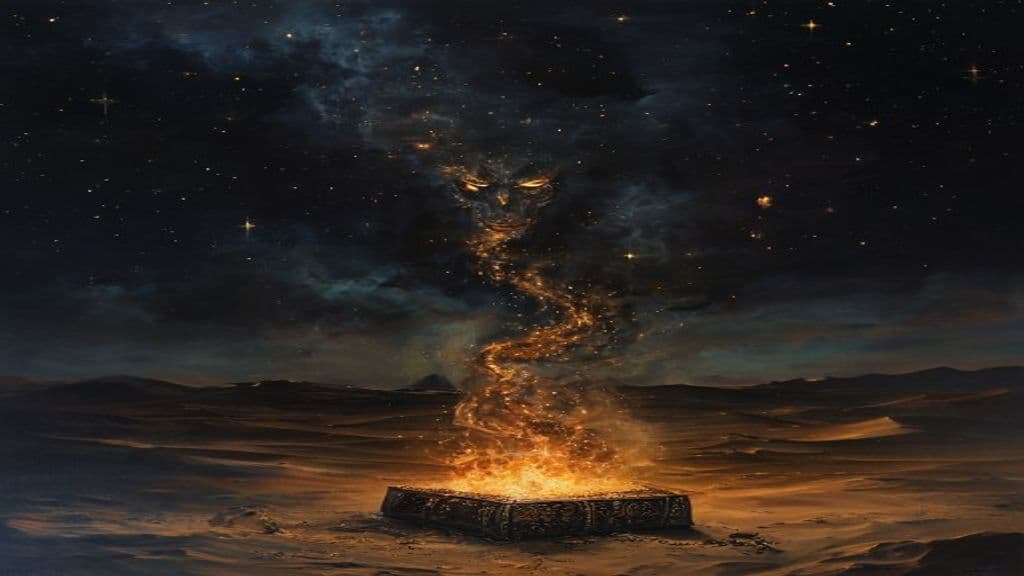
Traditional descriptions present Gaoh as a solitary old man and a giant, physically powerful enough to uproot trees. Some sources additionally describe him as a cannibal. Together these portrayals produce an image of an aged but enormous humanoid wind-being: solitary, fearsome in aspect, and capable of great physical violence tied to meteorological phenomena.
Gaoh controls the winds of the four cardinal directions (named Ya-o-gah, Bear of the north wind; Da-jo-ji, Panther of the west wind; O-yan-do-ne, Moose of the east wind; and Ne-o-gah, Fawn of the south wind) and more broadly governs seasonal change. He can produce storms and violent winds when restless; in some traditions his physical exertions (for example, attempts to break chains in the Seneca account) directly cause winds, while quiet follows when he rests. He is described as mostly benevolent in function—ordering seasons—but capable of destructive, stormmaking violence and is attributed predatory traits (cannibalism) in some tellings. In certain accounts the winds act as guardians of his home, while in others they are winds kept locked inside to be released by higher authority.
Weaknesses
- conditionbound or chained (Seneca motif: Gaoh chained to a rock becomes quiet when resting)
Wards
- otherNo specific wards recorded in supplied sources
Adekagagwaa
Adekagagwaa is a Haudenosaunee sun deity associated with summer who is described as exercising authority over other weather spirits and participating in an annual cycle of departure and return tied to the seasons.
Great Spirit
A supreme, often-immanent life force or creator-being present in the traditional spiritual beliefs of many Indigenous peoples of what is today Canada and the United States; concepts and names vary by nation and may refer to a single creator, a pervasive sacred power, or a collective of mysterious sacred forces.
Gandharva
A class of non-human celestial or semi-celestial beings in Indic religions associated principally with music, song, dance, fertility, and an escort/guardian role for liminal arrivals (such as Soma or beings). In Hinduism they are minor deities and musicians of the devas; in Buddhist cosmology they are a low rank of devas and the term (gandhabba in Pāli/commentary) is also used doctrinally for a sentient intermediate state between death and rebirth.
Ganesha
Ganesha (Gaṇeśa), also called Ganapati or Vinayaka, is a widely revered Hindu deity identified by an elephant head who functions as remover of obstacles, patron of arts and learning, and god of beginnings; he is son of Shiva and Parvati and head of the gaṇas in many traditional accounts.
Gann mac Dela
Gann mac Dela is a legendary early Irish figure — one of the five sons of Dela of the Fir Bolg — portrayed in medieval pseudo‑historical sources as a founder king who, with his brothers, divided Ireland and briefly served as joint High King. He is presented as a dynastic/ancestral ruler within the Fir Bolg cycle rather than as an independent supernatural being.
Ganthet
Ganthet is one of the Guardians of the Universe, an ancient, non‑human member of the custodial order that founded and manages the Green Lantern Corps and its power system. Unlike many Guardians, he is repeatedly depicted as emotionally open and empathetic, acting as mentor, technician, and occasional dissident (notably co‑founding the Blue Lantern Corps with Sayd and at times renouncing or being separated from full Guardian rank).
Ganymede
Ganymede is a figure in Greek myth — a Trojan prince and exceptionally beautiful youth who is taken into the service of the gods, traditionally as cupbearer to Zeus/Jupiter. Classical sources portray him as a mortal son of Tros who is elevated into the divine household and sometimes granted immortal status.
Gaokerena
In Persian and Zoroastrian legends, Gaokerena is a mythic Haoma plant with extraordinary healing properties that grant immortality to resurrected bodies when eaten. (Note: - Power tier should be Ancient (deity-level) as it is a mythic Haoma plant with extraordinary healing properties and grants immortality, indicating a higher level of power. - Abilities need clarificat)
Garamas
Garamas (Ancient Greek Γαράμας) is a mythic eponymous ancestor named in Greek-language accounts to explain the ethnonym Garamantes and the city Garama in Libya. Presented in Hellenic mythographic tradition as a founder or first-born figure, he appears in genealogical and poetic fragments rather than as a described supernatural agent.
Gareth
Gareth is a literary knight of King Arthur's Round Table, traditionally presented as a younger son of King Lot and nephew of King Arthur. In medieval Arthurian romances (notably Thomas Malory's Le Morte d'Arthur and continental Vulgate/Post-Vulgate material) he functions as an exemplar of chivalric virtues—humility, martial skill, generosity—and as a narrative figure whose death helps precipitate the collapse of Arthur's realm.
Garokk
Garokk is a long-lived, apotheosized figure of the Savage Land in Marvel Comics: a petrified, stone-like being worshipped by the Sun People who has exhibited matter-and-energy-altering powers, near-immortality, and periodic resurrections across multiple storylines.
Garshasp-nama (Persian tradition)
A Persian epic poem featuring semi-divine characters and legendary figures, part of the cultural and literary traditions of the time. (Note: 1. Factual claims: The draft lacks specific information on the semi-divine characters' appearance, sensory cues, wards, and weaknesses. 2. Power tier: Given that the main hero, Garshasp, and his famil)
Community Record
- [1]Gaoh. Wikipedia: Gaoh (summary entry)wiki
- [2]Gaoh (Wikidata). Wikidata: Gaohother
- [3]Archive: Oral history interview with Stella Demas, George Ballis, Louis Demas, Marilyn Demas. Archive.org: oral history interview (included in supplied corpus)other