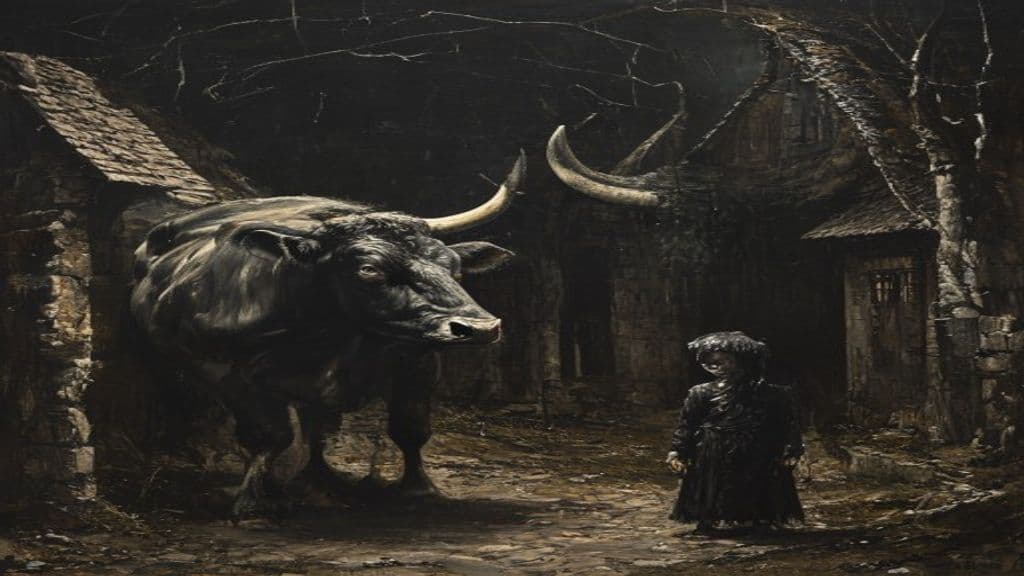
Gaueko can manifest in two distinct forms: a cow and a monster.
Gaueko punishes those who attempt to be brave or boastful during the night, implying that he has the power to enforce nocturnal behavior. He pronounces the phrase 'Gaua Gauekoarentzat, eguna egunezkoarentzat', which may indicate a linguistic or symbolic connection to his powers.
Weaknesses
- NoneUnknown
Wards
- NoneUnknown
Akerbeltz
Malevolent Basque spirit associated with sexual abuses and seductive powers, likely tied to the natural environment. (Note: - Power tier: Greater (Akerbeltz's abilities are more regional in scope and do not match the description of an Ancient entity) - Abilities: While source material mentions "sexual abuses" and "seductiv)
Artahe
Tutelary deity of Southern Gaul and Aquitania, providing protection and care to her associated group or place. (Note: - Power tier: Lower than Ancient (consider Greater, as she's a regional deity) - Sensory cues and weaknesses and wards are missing; add relevant information from source material - Abilities should inc)
Eate, Storm God in Basque Tradition
Eate is a storm god worshipped by the ancient Basques, associated with powerful weather events and control over fire and ice. (Note: - Power tier should be Ancient, as the source describes Eate as a "storm god", implying a more deity-level power. - Abilities: add "possibly" is unnecessary; rephrase to make it clear that control ove)
Odei (Basque mythology)
A Greater supernatural entity associated with thunderstorms, personifying storm clouds in Basque mythology. (Note: - The origin story summary should specify that it's the personification of storm clouds, not just associated with them. - Power tier: There is no clear indication in the source material that Odei's ab)
Tubal
Patriarchal ancestral figure in Basque tradition associated with Caucasian Iberia, son of Noah, and considered a cosmic ancestor. (Note: - Power tier should be Ancient, not Primordial, as Tubal is a deity-level figure in biblical tradition. - Abilities section should be removed or rephrased, as there is no information about Tubal's abi)
Gashadokuro
A fifteen-times-human-height skeletal yokai formed from the bones of those who starved to death or died on battlefields, their unburied remains fused together into a hungry colossus.
Gate guardian
A gate guardian is a withdrawn piece of equipment (commonly aircraft, armoured vehicles, artillery, or locomotives) mounted as a static display at the main entrance of military bases, museums, clubs, or civic sites to symbolically mark, commemorate, and advertise the identity or history of the place. The term is primarily a modern, secular, institutional practice; a distinct scholarly usage applies the label to protective threshold figures in ancient contexts.
Gatsi and Gaim (Georgian Deities)
Pre-Christian Georgian deities associated with the chief idol Armazi, believed to govern all mysteries. (Note: 1. Power tier should be Primordial (as they are associated with the chief idol Armazi). 2. Specific abilities mentioned in the sources include governing all mysteries, but no further specifics are pro)
Gatumdug
Gatumdug (also rendered Gatumdag in some queries) is a Mesopotamian tutelary goddess of the city of Lagash, closely associated with that city's kings. She is attested in temple-building activity and in literary compositions tied to Lagash and Girsu in the period of classical Sumerian royal inscriptions.
Gaut
Mythical ancestor and national god with significant cultural and symbolic significance in Germanic tradition, associated with the Geats and Goths. (Note: * Power tier should be Primordial, given that Gaut is described as a mythical ancestor and national god, suggesting a higher level of power and influence. * Abilities section should be removed or revi)
Gautama Buddha (Siddhartha Gautama)
Siddhartha Gautama, most commonly called the Buddha, is presented in the supplied sources as a historical awakened teacher who founded Buddhism by attaining nirvana and teaching a monastic path. His life narrative—birth in Lumbini, renunciation, enlightenment at Bodh Gaya, teaching across the Indo‑Gangetic Plain, and parinirvana at Kushinagar—serves as the canonical model and institutional origin for Buddhist doctrine and the sangha.
Gautama Maharishi
Gautama (Maharṣi Gautama) is a canonical Vedic rishi presented in Hindu, and to some extent Jain and Buddhist, sources as an authoritative seer, teacher, and ritual expert. He is traditionally credited with the authorship/attribution of the Nyāya Sūtras in later philosophical reception and appears as a household sage in narrative cycles (notably the Ahalyā episode).
Community Record
- [1]