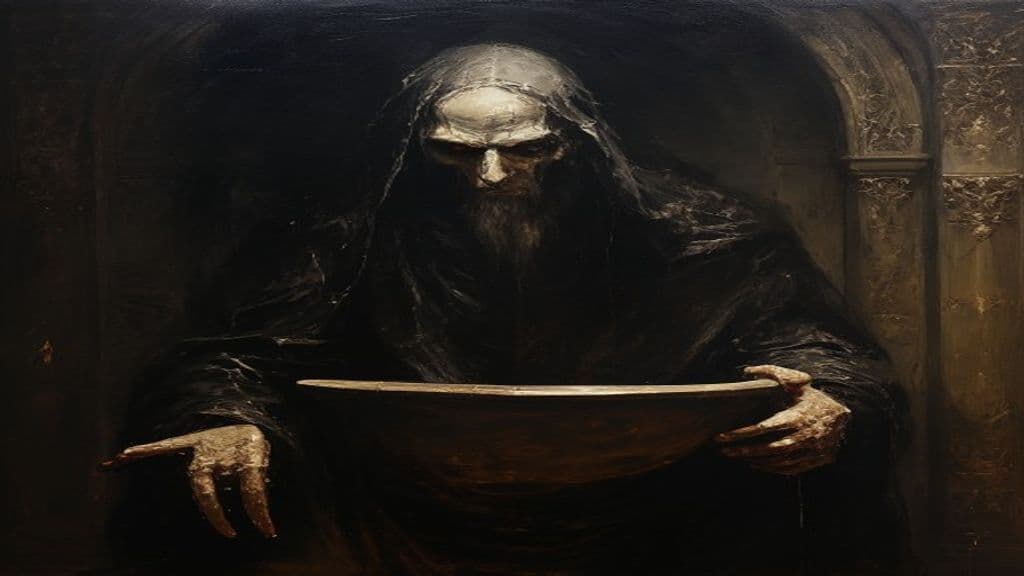
Tubal is considered a figure in Basque tradition, specifically a patriarchal ancestor of the Caucasian Iberians. In the biblical account, he is described as a son of Japheth and a descendant of Noah.
There is no physical description provided for Tubal in the sources.
There is no information about Tubal's abilities or behaviors beyond his role as an ancestor and patriarch of the Caucasian Iberians.
Weaknesses
- conditionbeing forgotten or ignored by his descendants
Wards
- ritualplaced by other ancestors or spirits of the land to maintain balance and respect for Tubal's role
Akerbeltz
Malevolent Basque spirit associated with sexual abuses and seductive powers, likely tied to the natural environment. (Note: - Power tier: Greater (Akerbeltz's abilities are more regional in scope and do not match the description of an Ancient entity) - Abilities: While source material mentions "sexual abuses" and "seductiv)
Artahe
Tutelary deity of Southern Gaul and Aquitania, providing protection and care to her associated group or place. (Note: - Power tier: Lower than Ancient (consider Greater, as she's a regional deity) - Sensory cues and weaknesses and wards are missing; add relevant information from source material - Abilities should inc)
Eate, Storm God in Basque Tradition
Eate is a storm god worshipped by the ancient Basques, associated with powerful weather events and control over fire and ice. (Note: - Power tier should be Ancient, as the source describes Eate as a "storm god", implying a more deity-level power. - Abilities: add "possibly" is unnecessary; rephrase to make it clear that control ove)
Gaueko
The spirit of the night, governing human activity and regulating nocturnal behavior in Basque mythology. (Note: 1. Power tier: Lower to Greater (Gaueko's abilities don't quite match Primordial-level powers, but his influence on nocturnal behavior and punishment suggest he's at least more powerful than a Lesser )
Odei (Basque mythology)
A Greater supernatural entity associated with thunderstorms, personifying storm clouds in Basque mythology. (Note: - The origin story summary should specify that it's the personification of storm clouds, not just associated with them. - Power tier: There is no clear indication in the source material that Odei's ab)
Tsuchinoko
A Japanese folkloric snake‑like cryptid described as a short-bodied serpent with a wide midsection, alleged venom and unusual behaviors (jumping, rolling, speaking). In modern Japan it functions as both a traditional folk creature and a subject of cryptozoological interest, bounty campaigns, and popular-culture adaptations.
Tsurube-otoshi
A Japanese tree-associated yōkai reported especially in Kansai and Tōkai regional traditions and in Edo-period kaidan collections. It is described variably as a bucket-like object, a severed head, or a ball of fire that drops from large, old trees to menace, abduct, or devour passers-by; some classical sources frame it as a fire-phase manifestation of an aged tree.
Tsurubebi
A type of fire yōkai depicted in Edo-period compendia and found in regional folklore as dangling bluish-white balls of fire associated with tree branches along mountain paths at night. Treated variously as an atmospheric ghost-light, a tree spirit manifesting as flame, or folkloric analogue to tsurube-otoshi.
Tuatha Dé Danann
The Tuatha Dé Danann (earlier name: Tuath Dé) are a named supernatural race in Irish mythology. In modern summaries they are widely treated as representing the deities of pre‑Christian Gaelic Ireland and function as a mythic otherworldly people within Gaelic mythic history.
Tuchulcha
Tuchulcha is an underworld chthonic being from Etruscan funerary iconography, attested chiefly in a single Tomb of Orcus II fresco at Tarquinia where the figure attends Theseus and Peirithous in the realm of the dead (Aita). Modern scholarship interprets Tuchulcha as an attendant daemon of the netherworld with ambiguous gender and composite animal features.
Tuisto
Divine ancestor in Germanic tradition, significant cultural importance. (Note: - Summary: too broad; clarify that Tuisto is specifically a god in ancient Germanic tradition. - Power tier: should be Ancient (deity-level) since Tuisto is described as a divine ancestor, implying he)
Tukh Manuk
Archaic rural shrines in Armenia, considered sacred or mystical sites imbued with spiritual significance. (Note: - Power tier: Minor Spirit (as no supernatural abilities are described) - Appearance: Mention that there is no description provided for Tukh Manuk's appearance - Abilities: Remove mention of "None", a)
Community Record
- [1]Wikipedia: Tubalwiki