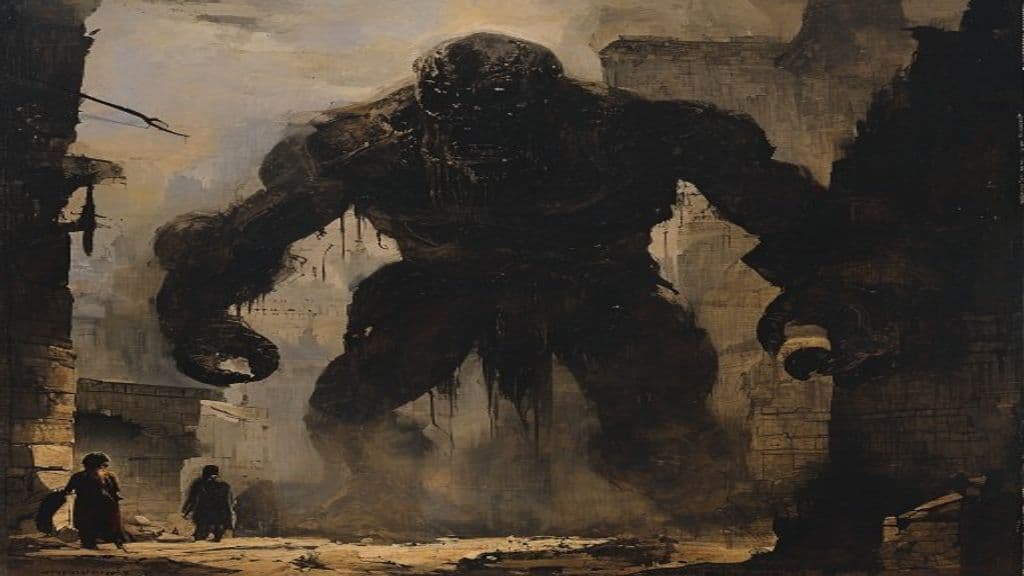
No origin story for any entity called 'Giants of Ath' is present in the provided materials. The supplied sources do not document a mythological origin or narrative for such beings.
No descriptions of appearance for 'Giants of Ath' are present in the supplied sources.
No information about powers, behaviors, or interactions of 'Giants of Ath' is attested in the provided materials.
Ghost Train
A folkloric apparition whose visible form is an entire train or rail vehicle rather than a single disembodied human spirit. Reported in multiple regions where railways have been significant, it appears variously as omen, commemorative phantom, or an imitation created by animal tricksters in local tales.
Ghost of Kyiv
A modern wartime legend and morale symbol that emerged in the first 30 hours of the Russian invasion of Ukraine (24 February 2022). Presented as a mythical MiG-29 ace credited in social media with multiple shoot-downs, the persona was later acknowledged by Ukrainian officials as a constructed 'superhero-legend' embodying collective pilot spirit rather than a verified individual or literal supernatural being.
Ghoul
A ghoul is a demon-like or monstrous humanoid originating in pre-Islamic Arabian religion, traditionally associated with graveyards and the consumption of human flesh. The concept later entered broader folklore and has been widely reused and transformed in modern fiction and popular culture.
Ghul (Ghoul)
A demon-like monstrous humanoid from Arabian folklore, traditionally associated with graveyards and the consumption of human flesh; described in scholarship as originating in pre-Islamic Arabian religion.
Giant
A recurring figure-type in myth, legend, and folktale characterized chiefly by humanoid form combined with prodigious size and strength. Giants function variably as monsters, culture-heroes, ancestral figures, or etiological agents that explain landscape features and large ancient remains.
Giant frog
The English label "giant frog" in the supplied sources is ambiguous: it names several very large real-world frog species (Blyth's river frog, Cyclorana australis, and the Goliath frog) and also appears as a short Wikidata classification linking the phrase to the category of youkai in Japanese mythology. The materials do not supply a single, unified folkloric entity or narrative for a specific giant-frog youkai.
Giants of Lier
A toponymic and historiographic label rather than a documented supernatural being in the supplied sources. The phrase reflects the broader European folkloric practice of attributing large prehistoric megaliths (e.g., hunebedden, 'Giants' graves') to 'giants'; a Wikidata metadata entry links the phrase to Lier (Belgium) but no primary folkloric narratives or ritual practices specific to 'Giants of Lier' are provided in the consulted material.
Giants of Valls
Large processional effigies associated with the city of Valls in Catalonia, described in available sources as 'processional giants' appearing in the town's traditional festivals and civic customs.
Giants of the Montbau neighborhood
A minimal attestation in a single catalog entry names a class of beings as the "giants of the Montbau neighborhood." Beyond this label, the source provides no descriptive, ritual, or contextual detail; the classification here is based solely on that one brief entry.
Giasone
Giasone is the Italian form of the mythic Greek hero Jason, presented in a 17th-century Italian opera (Cavalli's Giasone) and in retellings of the Jason and Medea cycle. He is a mortal leader of the Argonauts whose success in the quest for the Golden Fleece depends on martial courage and the active intervention of supernatural agents—most notably Medea's sorcery and chthonic powers.
Gibborim
A Hebrew term (plural of gibbor) meaning "mighty ones," used in the Hebrew Bible to denote exceptional martial valor (e.g., David's mighty men) and, in later interpretation, applied to legendary or antediluvian "men of renown" sometimes associated with giants or Nephilim. The concept spans ordinary elite warriors to interpretive traditions of larger‑than‑life ancient figures.
Gibil (Girra)
Gibil (Akkadian Girra) is a Mesopotamian deity personifying fire in its constructive (furnaces, metallurgy, ritual purification) and destructive (lightning-set conflagrations, burning fields) aspects. He is attested in city cults (Shuruppak, Eridu, Nippur) and invoked in ritual and incantation literature (Maqlû, Šurpu, namburbi) for purification and counter-magic purposes.
Community Record
- [1]Ath. Wikipedia: 'Ath is a city and municipality of Wallonia located in the province of Hainaut, Belgium.'wiki
- [2]Episode 210 - Google's quantum supremacy, Zuckerberg testifies, and the CryptoBasic community gets attacked.. Archive description: uses 'giants' metaphorically in a technology context; contains no folklore about Ath.other
- [3]Around the Horn / PTI - September 16, 2003. Archive description: sports reference to 'Giants' (team); contains no folkloric material about Ath.other
- [4]ConnPod GeorgeFinklang (Connections). Archive description: unrelated program content; contains no references to giants of Ath.other