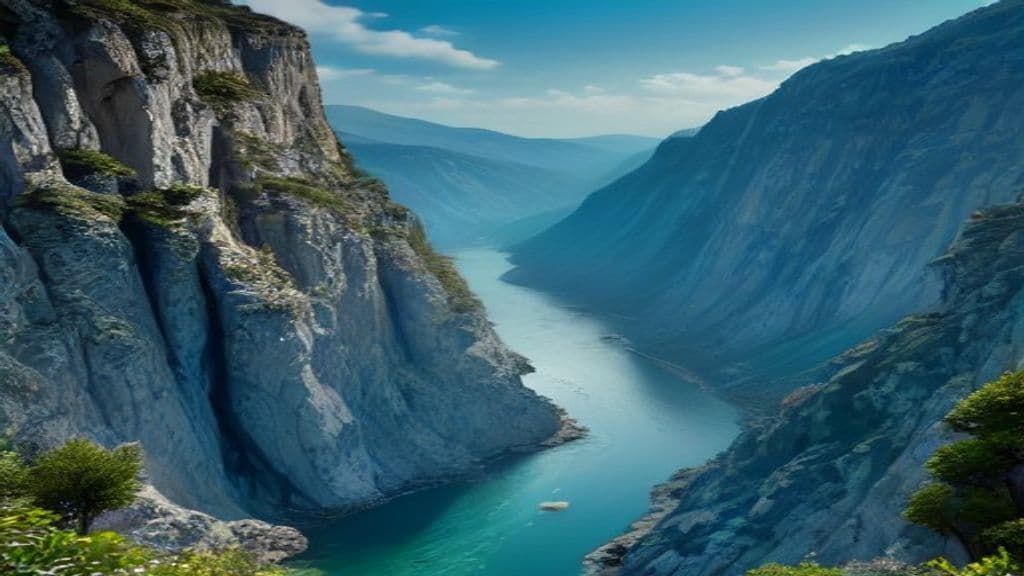
As a common noun, a gorge (canyon/chasm) is described in scientific and general sources as a deep cleft between escarpments or cliffs produced by weathering and the erosive activity of a river over geologic time scales. Separately, in Greek mythic genealogies the name Gorge (Ancient Greek: Γόργη) appears as an individual — for example, a Libyan princess listed among the Danaïdes — without an extended mythic life-story in the provided excerpts. A local Cretan tradition recorded in travel literature attributes the creation of Samaria Gorge to a Titan who slashed the land while Zeus occupied nearby Mt. Gygilos; this is presented as a mythic explanation for a particular landscape, not as a claim about the geological process.
When used as a geographic term, a gorge is a physical landform: a narrow, deep ravine between cliffs or steep mountainsides produced by river erosion. As a mythological personal name, surviving sources list familial and genealogical placement (e.g., one of the Danaïdes) but give no extant physical description, dress, or iconography of the person named Gorge in the provided excerpts.
No supernatural powers or agentive behaviors are attributed to 'Gorge' in the cited materials. The geological gorge results from natural processes (weathering and fluvial erosion) rather than volition. The mythic individual named Gorge is presented in genealogical records without attendant abilities or deeds in the available excerpts.
Weaknesses
- otherNot applicable / none attested in sources
Wards
- otherNot applicable / none attested in sources

Good Witch of the North (Baum)
A benevolent, regional witch and ruler of the Gillikin Country in L. Frank Baum's Land of Oz who appears briefly in The Wonderful Wizard of Oz (1900) to aid Dorothy with counsel and limited magic. Later stage and film adaptations renamed or conflated her (Locasta/Locusta/Tattypoo; film conflation with Glinda) altering popular memory of the character.
Goose Wife
A bird‑woman figure from Inuit and other Arctic oral traditions who alternates between human and avian form by removing or donning a feathered skin; she may become a human wife when her skin is taken and later return to the bird realm by reclaiming or fashioning feathers.
Gorai (place-name and surname)
Gorai is attested in the supplied sources as a place-name — a village on Salsette island in the Mumbai Suburban district — and as a family name/surname in archival records. The provided materials contain no documentation of a supernatural 'Gorai' or a forest-spirit tradition.
Goranchacha
Goranchacha is a legendary Muisca culture-hero portrayed as a miraculous son of the Sun who functioned as prophet, priest, and autocratic cacique of the northern Muisca. Colonial-era narratives describe him as instituting solar worship, commanding large-scale temple labor, enforcing harsh punishments, and prophesying the coming of foreign conquerors.
Gorazeh
A name for which no attested description, function, or ritual context is present in the single supplied source (an excerpt referencing Davāzdah Rokh in the Shahnameh). The available material does not establish Gorazeh as a supernatural being or provide any attributes.
Gordāfarīd
Gordāfarīd (Persian: گردآفريد) is a human heroine in Ferdowsi’s Shāhnāmeh (The Book of Kings). A warrior of the White Fortress (Dezh-e Sepid), she dons armour, sallies forth to challenge the Turanian commander Sohrab, delays the enemy advance, is defeated in single combat, and is spared by Sohrab; modern scholarship and performers treat her as a lasting symbol of female courage and prudence in Persian epic.
Gorgin
Gorgin is a human heroic figure in Ferdowsi's Persian epic the Shahnameh, active during the reigns of Kay Kavus and Kay Khosrow and described in sources as a son of Milad. Scholarship highlights his role in the Bijan episode, where analyses portray him as duplicitous and motivated by jealousy.
Gorgo
Gorgo is a polyvalent Greek mythic name applied to several related usages: a member of the gorgon/gorgoneion monstrous vocabulary (frightful phantom/monster), a goatish monster variant called Gorgo Aix associated with Titanomachy narrative, and a personal name borne by various mortal figures (e.g., a woman of Aegyptus, a Spartan queen). The term circulates between monstrous imagery, apotropaic iconography, and onomastic use, and was later reused in modern popular culture for monsters and namesakes.
Gorgons
In classical Greek myth a trio of monstrous sisters—Stheno, Euryale, and Medusa—daughters of Phorcys and Ceto, famed for a petrifying gaze; Medusa is mortal and slain by Perseus while her sisters are described as immortal. The name has been widely reused in modern culture for characters, bands, and projects.
Gorgophone (Perseid / Danaid)
Gorgophone (Ancient Greek: Γοργοφόνη, 'Gorgon‑slayer') is a personal name borne by at least two mythological women in ancient Greek tradition: a daughter of Perseus (a Perseid) associated with royal genealogies of Messenia and Sparta, and a Libyan princess counted among the fifty Danaïdes who married and murdered Proteus. The name functions genealogically and onomastically within heroic family cycles rather than as a distinct supernatural being.
Gorgophonus
Gorgophonus (Ancient Greek: Γοργοφόνον, 'Gorgon-killing') is a mortal Mycenaean prince in the Perseid genealogical cycle. He is recorded as one of the sons of King Electryon and Anaxo and is named among those killed by the sons of Pterelaus in the dynastic conflict that precedes Amphitryon's exile and the circumstances of Heracles' birth.
Gorgyra
Gorgyra is a name attested in modern reference summaries for a nymph associated with the Greek underworld (Hades). In these materials she is presented as an underworld resident who, in some accounts summarized by modern sources, is identified with or treated as an alternate name for Orphne and Styx and is said to have consorted with the river-god Acheron and to be mother of Ascalaphus. The name has also been reused in modern taxonomy and cultural works (butterfly genus, music projects, videogame personae).
Community Record
- [1]Canyon / Gorge definition (Wikipedia). "A canyon, gorge or chasm, is a deep cleft between escarpments or cliffs resulting from weathering and the erosive activity of a river over geologic time scales."wiki
- [2]Canyon (Wikidata Q150784). "geomorphological formation as narrow and deep ravine between cliffs or steep mountainsides"wiki
- [3]Gorge (mythology) (Wikipedia). Entry noting Greek personal name Gorge (Ancient Greek: Γόργη), possible derivation from adjective gorgos and listing as a Libyan princess among the Danaïdes (fragmentary in excerpt).wiki
- [4]Samaria Gorge and the White Mountains (travel summary). Local Cretan tradition recorded in travel literature: 'According to Greek mythology, one of the Titans living on Crete slashed the land with his knife to create the gorge while Cretan-born Zeus... placed his throne on top of Mt. Gygilos...' (mythic landscape-origin explanation).literary
- [5]Gorge (disambiguation) (Wikipedia). Disambiguation showing polyvalent contemporary uses of 'gorge' as geographic term, mythic name, and other cultural references.wiki