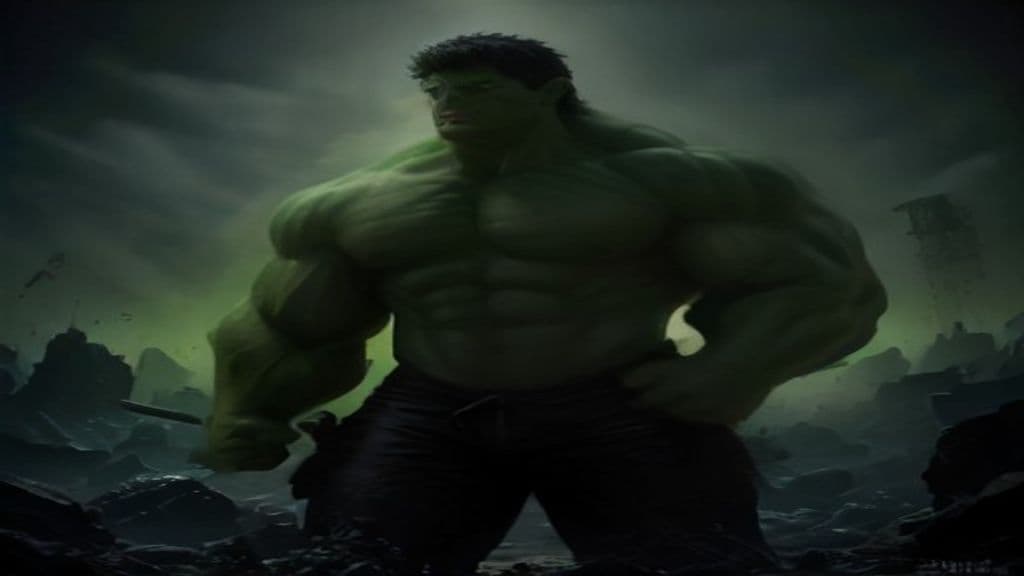
Dr. Robert Bruce Banner, a physicist, was accidentally exposed to elevated levels of gamma radiation during an experiment. Following this exposure Banner subsequently transforms into the Hulk when subjected to emotional stress. Creators Stan Lee and Jack Kirby drew explicit inspiration from earlier literary prototypes such as Frankenstein's monster and Robert Louis Stevenson's Dr. Jekyll and Mr. Hyde when shaping the character and his duality.
The Hulk is typically depicted as an enormous, massively muscular humanoid, usually green‑skinned and markedly larger than an ordinary human; early publication history briefly featured a gray coloration before green became standard. Visual portrayals across comics, television, and film emphasize great bulk, exaggerated musculature, and an imposing, often enraged facial expression; size, color tone, and specific costume details vary by continuity and adaptation.
The character's core power is superhuman physical strength that is frequently described in source material as scaling with his level of anger; portrayals range from near‑limitless strength in some comic narratives to variable, story‑dependent feats in others. Transformations between Banner and the Hulk are triggered by emotional stress; across continuities multiple Hulk personae exist with differing intelligence, temperament, and skills (e.g., savage brute, cunning gangster 'Joe Fixit', merged intellect 'Professor Hulk', warrior 'Green Scar', etc.). Narrative responses to the Hulk include military containment, intervention by other superheroes, and scientific or psychological attempts at control rather than ritualized folk remedies.
Weaknesses
- conditionNarrative/contingent vulnerabilities (no consistent folkloric weakness)
- otherContainment or opposition by military force, other superheroes, or targeted scientific/psychological intervention (story‑dependent)
Wards
- otherMilitary containment and tactical measures (e.g., pursuit or restraint by armed forces led by figures such as General Thunderbolt Ross)
- otherIntervention by other superheroes or allies (physical subdual, negotiation, or team strategies)
- otherScientific and psychological methods to manage Banner's condition (therapy, experiments, allies such as Doc Samson) — treated in sources as narrative devices rather than ritual
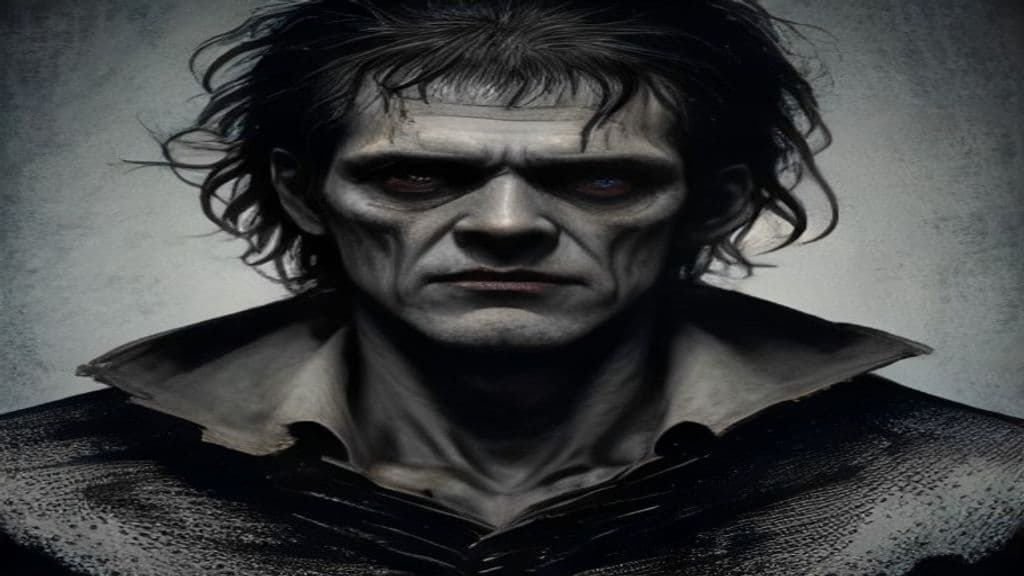
Betty Ross
Betty Ross is a fictional human character from Marvel Comics, introduced in The Incredible Hulk #1 (1962). She functions primarily as the Hulk/Bruce Banner's long‑running romantic interest and supporting character and has at times undergone superhuman transformations (e.g., Harpy, Red She‑Hulk) within the Marvel fictional universe.
Black Marvel
The Black Marvel is a Marvel Comics superhero identity first published in 1941. Primarily associated with the civilian Daniel Lyons, the Black Marvel is a Golden Age costumed adventurer whose origin involves tests administered by a dying Blackfeet chief (Man-to) and his medicine man (Running Elk); the character later appears in modern Marvel continuity in storylines involving wartime team-ups, murder and resurrection plots, and a Faustian bargain with the demonic Mephisto.
Bob, Agent of Hydra
Bob, Agent of Hydra is a fictional, non‑superpowered human character from Marvel Comics who functions as a low‑level HYDRA operative and recurring comic relief sidekick to Deadpool. He appears in Deadpool‑adjacent narratives (notably Cable & Deadpool) and in fandom, merchandising, and tabletop hobby contexts.
The Gray Man
A polyvalent label applied to multiple distinct figures: a local ghost of Pawleys Island, a figure in Scottish folklore called Fear liath, and numerous modern fictional or cultural uses. The sources provided do not present a single unified supernatural being but rather several separate referents sharing the same name.
The Great Race
A cosmic event in Lakota creation stories where humans and buffalo competed to establish supremacy, resulting in humans emerging victorious through cunning and strategy. (Note: 1. The power tier should be Primordial instead of Ancient. 2. Add sensory cues: dreams, omens, visions 3. Add weaknesses: loss of trust between humans and buffalo; spiritual disconnection from the nat)
The Great Renunciation
A pivotal event in Buddhist tradition, marking Gautama Buddha's transition from a life of luxury to one of asceticism. (Note: 1. Power tier: Minor Spirit is incorrect; The Great Renunciation is not an entity with powers or behaviors, so it should be classified as none or Primordial (since it's a pivotal event). 2. Sensory cu)
The Headmen
The Headmen are a team of supervillains appearing in American comic books published by Marvel Comics, created from earlier horror-story characters and first assembled as a team in The Defenders #21 (March 1975). They are human (or human-derived) antagonists who pursue schemes of scientific, political, and economic domination and are repeatedly opposed and defeated by superhero protagonists.
The Hook (the Hookman)
An American urban-legend figure, the Hook (or Hookman) is narrated as a violent outsider—commonly an escaped convict or patient—distinguished by a hook in place of a hand who attacks couples parked at lovers' lanes. The legend functions as a mid-20th-century cautionary tale warning against risky teenage behavior rather than as a documented supernatural being.
The Indestructibles
In ancient Egyptian culture, The Indestructibles refer to two bright stars, Kochab and Mizar, associated with eternity and the afterlife. (Note: - The power tier should be Primordial. - Appearance: correct, but note that Kochab is actually located in Ursa Minor, not the "bowl of Ursa Minor", which seems to refer to the Little Dipper. Mizar is )
The Love of the Nightingale (Philomela)
Adaptation of ancient Greek mythology, associated with transformation into a nightingale. Featured in the opera 'The Love of the Nightingale', reflecting the cultural values and worldview of ancient Greece. (Note: 1. The power tier should be Ancient (deity-level), as Philomela's transformation is a mythological event tied to divine intervention. 2. No source material mentions sensory_cues ("melancholic singing")
The Magic Jinn
A magical jinn from Arabian tradition with the ability to grant wishes, but at a cost. (Note: 1. Power tier: Primordial is not plausible given that granting wishes and providing assistance are abilities typically attributed to lower-tier entities (Greater or Lesser). 2. Origin story: Since The)
The Nine Diseases (Finnish)
The sons of Louhi, personifying various diseases and disasters. (Note: - Power tier: Primordial (as they are the sons of a goddess, their origins are more cosmic) - Appearance: Specify that there is no direct description in source material - Abilities: Clarify that they )
Community Record
- [1]Hulk - Wikipedia. Hulk. Wikipedia. Article summarizing character history, origins, abilities, and creators' influences.wiki
- [2]Hulk (film) - Wikipedia. Hulk (film). Wikipedia. Summary of film portrayal and description of physical transformation following gamma radiation exposure.wiki
- [3]Wikidata: Hulk. Wikidata entry for Hulk (Marvel Comics character).other
- [4]Archived media and fan pages referenced in research notes. Selected archived pages and fan resources referenced in supplied research notes describing adaptations and discussions of the character.other