
In the versions reported in the sources, the Grootslang is an ancient, primordial presence associated with deep caves and pools in the Richtersveld and along the Orange River. Jon Manchip White records a Bushmen account calling the creature “older than the world” and stating it “will protect its treasure for eternity,” framing the Grootslang as an origin/guardian force for particular liminal places where diamonds and other riches are found. Secondary commentary (e.g., Lawrence G. Green) speculates that sightings of very large pythons may underlie the legend; later retellings conflate the figure with other African cryptid motifs, producing hybridized variants in modern media.
Older accounts describe the Grootslang as an enormous serpent roughly 40–50 feet (12–15 m) long, leaving tracks about three feet (0.91 m) wide, and sometimes said to have diamonds in its eye sockets or to be coiled about hoards of gold and gems in its lair. Later popular-culture portrayals and some modern compendia add elephantine features (large bulk, trunk- or tusk-like aspects, or four legs); these hybridizing traits are traceable in the provided sources to later authors (e.g., Carol Rose) and modern media rather than to the older recorded local accounts.
Traditionally the Grootslang is described as a dangerous, treasure-guarding creature: it protects diamond-bearing caves and pools and is feared by local peoples and prospectors. Sources report it as a predator of livestock in riverside accounts and as an explanation for unexplained disappearances (for example, rumors arose linking the 1917 disappearance of a prospector in the Richtersveld to the Grootslang). Some retellings emphasize a menacing, overpowering sense of evil at sites associated with the creature. Modern accounts sometimes ascribe additional sensational abilities (e.g., devouring elephants) but these are later popular elaborations not attested in the older material provided.
Weaknesses
- otherNo canonical weaknesses recorded in supplied sources
Wards
- otherNo documented traditional warding formulas or rituals attested in the provided materials; avoidance of named sites is the recorded practice

Mokele-Mbembe
A water-dwelling entity in Central African tradition, described as reptilian or a member of an extinct sauropod lineage. (Note: 1. Power tier: should be Primordial (cosmic level) since it's often described as a legendary creature rather than a deity-level being. 2. Origin story: The source material does provide etymology, stat)
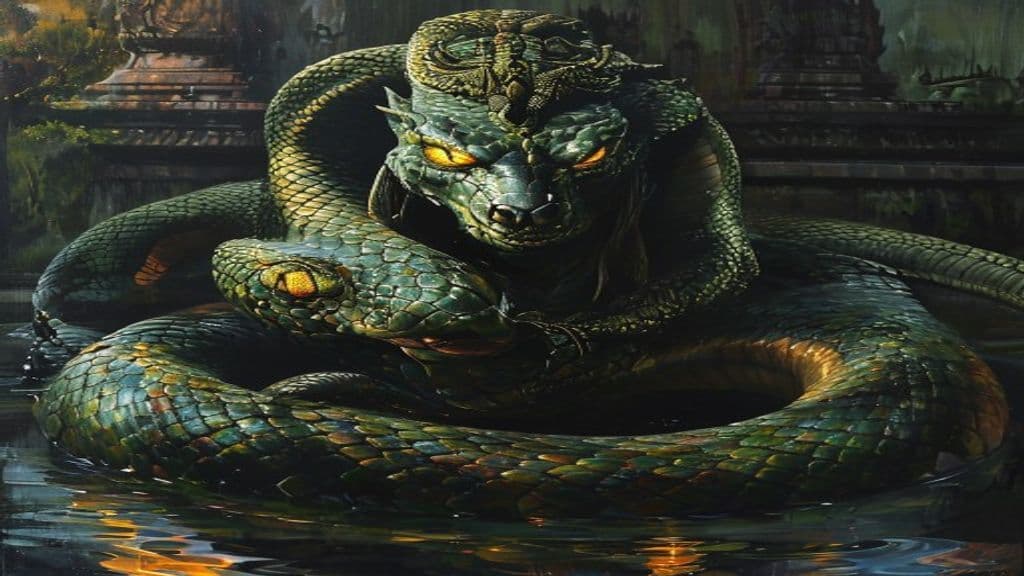
Naga
Divine serpent beings of Hindu, Buddhist, and Jain cosmology — powerful guardians of water, earth, and underground treasures. Revered as deities in South and Southeast Asia.
Griffin
The griffin (also griffon, gryphon) is a composite legendary creature combining the body, tail, and hind legs of a lion with the head, wings, and often taloned forelegs of an eagle. In classical and medieval Eurasian traditions it functions chiefly as a majestic guardian figure associated with rulership and the protection of treasure, and appears widely across artistic vocabularies rather than as a single codified religious being.
Griflet
Griflet is a human narrative figure of the Arthurian literary tradition, appearing across medieval romances and later retellings as a loyal young squire who rises to become a knight of the Round Table. He is a recurring martial attendant of King Arthur, notable in sources for battlefield service, frequent captures and rescues, and variant fates at the end of the cycle.
Grim Reaper
A Western cultural personification of death depicted as a hooded, often skeletal figure bearing a scythe. The Grim Reaper functions primarily as a symbolic emblem in art, literature, and popular media to represent death, mortality, and the process of dying rather than a discrete ritual agent in a documented traditional religion.
Gringolet
Gringolet is the named war-horse of Sir Gawain in Arthurian literature, depicted as an extraordinary mounted companion used in questing and battle. Across multiple medieval sources the steed functions as a marker of Gawain's chivalric identity, a partner in martial action, and occasionally bears hints of supernatural provenance.
Grivet
The grivet (Chlorocebus aethiops) is an Old World monkey species native to parts of northeastern Africa. The provided sources treat it as a biological taxon with ecological, behavioral, and historical-cultural associations (not as a supernatural being).
Groot
Groot is a fictional extraterrestrial tree-like sentient being (a Flora colossus) originating from Planet X in Marvel Comics. Introduced in 1960 as an invader, later reinterpretations recast Groot as a heroic figure and long-time companion of Rocket Raccoon within Marvel continuity and its adaptations.
Gryneus
Gryneus is a polysemous name attested in modern biological taxonomy (Callophrys gryneus, the juniper/olive hairstreak), as an epithet of the classical god Apollo in data records, as the name of a centaur slain in the Lapith–centaur fight in a mythic source, and as the Latinized surname of an early modern theologian (Ioannes/ Johann Iacobus Grynaeus). The supplied sources do not present Gryneus as a single supernatural entity within a living folk cosmology.
Guahaioque
Guahaioque is recorded in available sources as a minor deity of the Muisca people, described as the god of evil, stealing, lies, and death. The Muysccubun name is given as meaning "figure of the deceased." The documentary attestation is brief and does not include myths, iconography, or ritual detail.
Guajona
The Guajona (also called Lumia) is a nocturnal, hag-like creature from Cantabrian (and related Asturian) folklore said to enter homes and suck the blood of sleeping people—especially children—leaving victims pale and weak without necessarily killing them.
Gualicho
Gualicho (also spelled gualichu or walichu in place-names) is a Patagonian/Tehuelche folk term used to name a harmful supernatural influence or curse attached to places, events, or people. The term appears in regional toponymy and modern popular sources and was adopted as the genus name for a newly described theropod, but the supplied materials are primarily toponymic and paleontological references rather than detailed ethnography.
Gualichu
Gualichu (also rendered gualicho) is a harmful, non-worshipped spiritual force in Mapuche and Tehuelche-related folklore blamed for disease, calamity, and general misfortune. The term also extends to mean an evil spell or jinx and survives in regional speech as a noun and verb.
Guan Gong (Guan Yu / Guan Di)
Guan Gong is the honorific cult form of the historical late Eastern Han general Guan Yu (courtesy name Yunchang), a prominent follower of Liu Bei whose memory was transformed through literature and popular religion into a widely venerated 'Warrior Saint' figure with temples, images, and cultural presence across China and overseas Chinese communities.
Community Record
- [1]Grootslang (Wikipedia). Wikipedia contributors. 'Grootslang.' Wikipedia, The Free Encyclopedia.wiki
- [2]Grootslang (Wikidata). Wikidata entry Q2197693 for Grootslang.wiki
- [3]Episode 28 - Through the Wonder Hole (Archive item referencing regional accounts). Archive item: 'Through the Wonder Hole' (contextual/compilation material related to the Grootslang legend).other
- [4]Monsters of the Gods (archive catalog entry). Peebles, compendium entry referencing elephant-snake type monsters including Grootslang.other