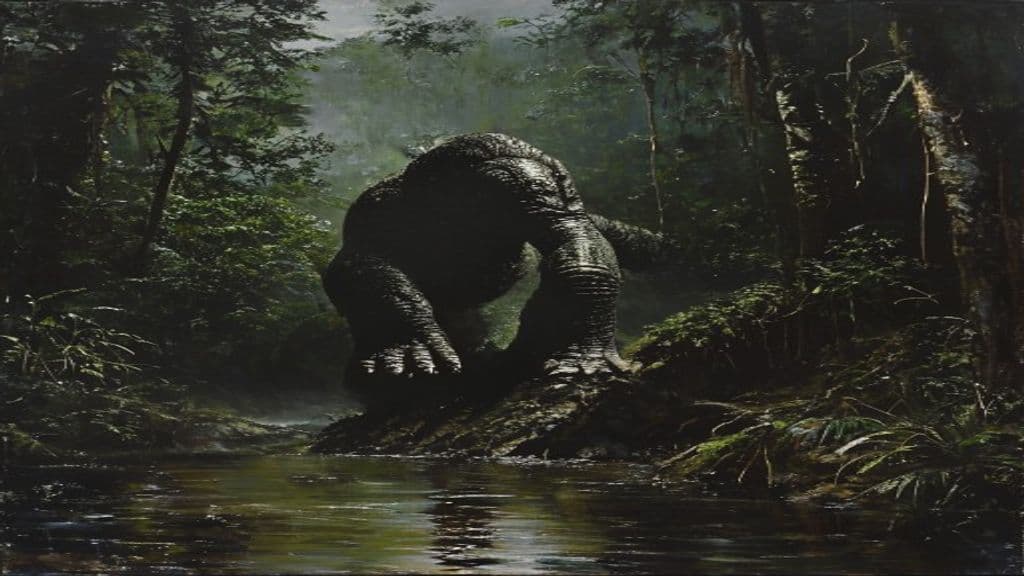
In Central African tradition, the name 'mokele-mbembe' is derived from Bantu languages, but no etymology is provided in the source material. It is described as existing in various forms, including a reptilian creature, spirit, or member of an extinct lineage of sauropods.
Mokele-mbembe is described as reptilian, but its specific physical characteristics are not specified.
The behavior and powers of mokele-mbembe are not detailed in the source material. However, it is implied that this entity exists in some form in the Congo River Basin.
Moehau
A creature of New Zealand folklore associated with Mount Moehau on the Coromandel Peninsula. In source materials the moehau is presented variably as a local wild/uncanny being linked by some to the Māori maero(maeroero), and by others treated as a modern folkloric label applied to alleged sightings, jokes, or misidentified objects and animals.
Moekākara
Legendary canoe in Māori tradition, used for migration to settle New Zealand. (Note: - Power tier should be "Primordial" since it's a legendary canoe used for migration to settle an entire country. - Summary: Add that Moekākara was captained by Tāhuhunui-o-te-rangi, an ancestor of Ngā)
Moggallāna (Mahāmaudgalyāyana / Maudgalyāyana)
Moggallāna (birth-name Kolita) is presented in early Buddhist texts as one of the Buddha's two foremost male disciples, famed for entering deep jhāna and using supernormal meditative powers to visit devas and observe the states of petas; his eyewitness reports form the narrative frame of the Vimanavatthu and Petavatthu and are used didactically to teach karma and ethical practice.
Mogollon Monster
A regionally anchored American folkloric cryptid reported along Arizona's Mogollon Rim, described as a large, bipedal, hairy humanoid whose accounts function as wilderness cautionary tales and local popular‑culture legend.
Mohini
South Indian spirit of a beautiful woman who died of a broken heart or by betrayal — she appears on roadsides at night, enchants men into following her, and leads them to ruin or death.
Moirai
In ancient Greek religion and mythology, the Moirai (μοῖραι) are a triad of personified destinies who spin, allot, and cut the thread of life. They function as apportioners of fate, ensuring that both mortals and gods live out the portions assigned by the universe's ordering principles.
Molus of Crete
Molus is a figure in Cretan mythic genealogy, presented in surviving sources as a son in the house of Minos and chiefly significant as the father of Meriones, the Cretan warrior at Troy. He is also attested in one account as the subject of a ritual image shown at a Cretan festival: an image of a headless man called Molus, linked to a tradition that he attempted to violate a nymph and was later found decapitated.
Momoy
Momoy is the Chumash lexical term for the sacred/medicinal plant Datura wrightii and, in Chumash contexts, the spirit-power associated with that plant. It is an entheogenic medicine used in ritual and healing contexts to induce visions, support spiritual wellbeing, and to help 'keep the soul in the body' during frightening encounters; it is also recognized as poisonous and dangerous if mishandled.
Momu
Momu is a figure in Chinese legendary tradition described as a legendary empress and goddess, remembered as a wife of the Yellow Emperor and traditionally credited with inventing the mirror and with a healing episode that led to her involvement in divine administration. Later popular traditions also group her among a set called the "Five Ugliest Women of Ancient China."
Monaciello (Munaciello)
A traditional Neapolitan household and city sprite, the Monaciello ('little monk') is a short, stocky, robed figure of local oral lore who inhabits Naples' underground waterworks and who visits homes, sometimes rewarding hospitality and sometimes playing spiteful tricks.
Mongolian Death Worm (Oov)
A cryptid or mythological animal said to live in the Gobi Desert, associated with death. (Note: 1. Power tier should be Lesser (local spirit) since it's a desert-dwelling creature with unproven abilities and no concrete description. 2. Appearance, Abilities, Sensory cues, Weaknesses, and Wards n)
Monkey-man of Delhi
A modern Indian urban‑legend and mass‑panic phenomenon centered on reports of a monkey‑like attacker roaming New Delhi in mid‑2001. Media coverage and eyewitness reports described a frightening, inconsistent figure blamed for nighttime attacks, injuries, and panic; subsequent investigations suggested a mix of hoaxing, copycats and mass hysteria.
Community Record
- [1]