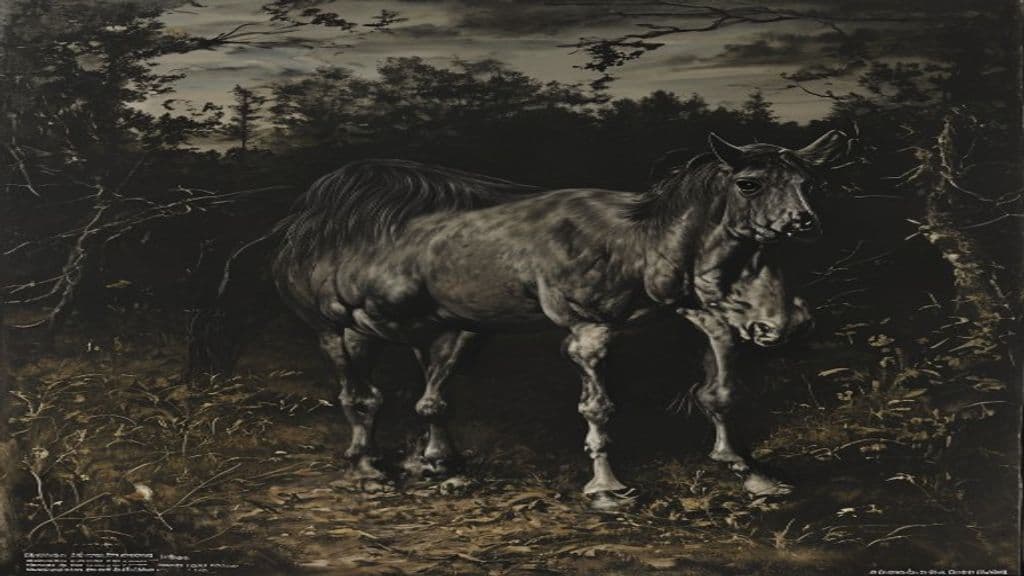
No cosmological creation narrative is recorded in the cited sources. The Gytrash appears in regional dialect and family tradition (notably the Brontës of Yorkshire) as a locally named supernatural category: a spectre or spirit that manifests in nonhuman forms along solitary roads. Joseph Wright's English Dialect Dictionary records the term as a dialect label for a ghost that takes animal form, while Branwell and Charlotte Brontë's notes and fiction place the term within Yorkshire household and roadside memory.
Sources consistently describe the Gytrash as taking nonhuman forms, most commonly as animals: horses, mules, large dogs or 'great black dog,' and in dialect material even 'a running or evil cow.' Charlotte Brontë's Jane Eyre describes horse, mule, and large dog forms and presents a literaryized, composite vision; Branwell Brontë's unpublished note expands forms to include a 'Black Dog dragging a chain,' 'a dusky calf,' and—in his localized account—an 'Old Dwarfish and hideous Man' (sometimes headless) and even inanimate objects like a rolling stone or self‑impelled cart wheel. The humanlike/headless and inanimate embodiments are explicitly attributed to Branwell Brontë's note.
The central trait in the sources is shape‑changing into animals or other uncanny forms. The Gytrash haunts solitary ways and encounters belated travelers: accounts state it may lead people astray, though some sources allow ambivalence—guiding lost travelers in certain tellings. It is also connected in some records with omens: Joseph Wright notes a belief in an 'evil cow' form as a sign of death, and Branwell Brontë links visits to the fortunes and bad omens surrounding a household. There is no evidence in the provided material for large‑scale or cosmically altering powers.
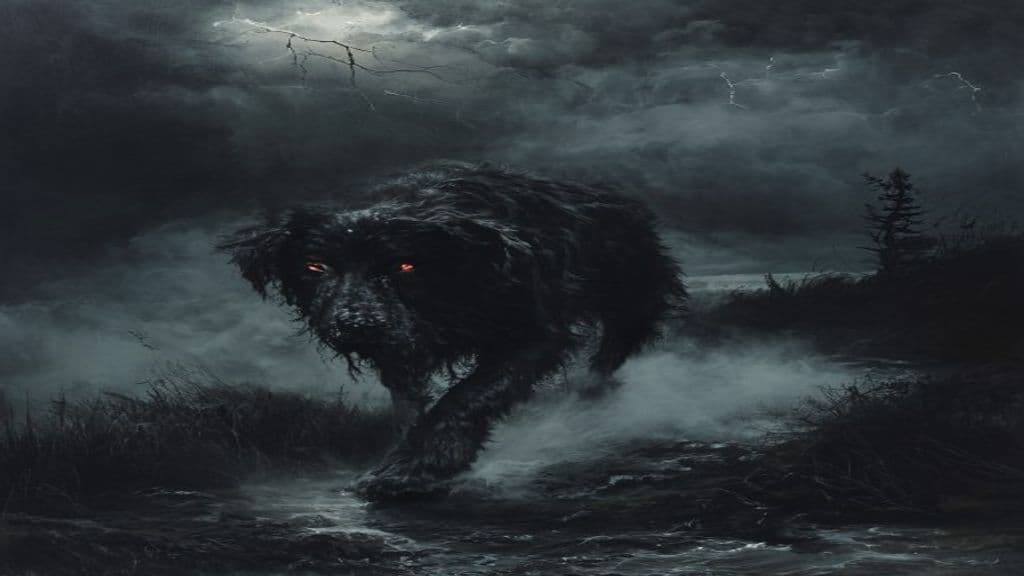
Black Shuck
A spectral black dog of East Anglian legend, with glowing red or green eyes. Its appearance is an omen of death. Its howl has been heard on clifftops during storms for centuries.
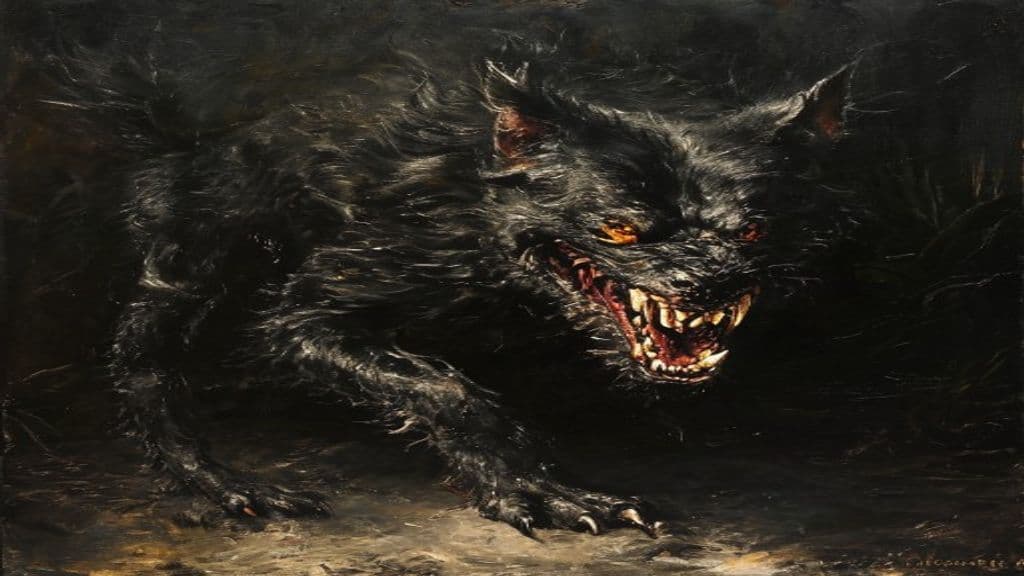
Barghest
A Northern English uncanny presence most often described as a monstrous black dog that serves as an omen of death; the term also covers variant local beings (ghosts or household elves) in some counties, making it a fluid category of liminal, threatening presences in regional folklore.
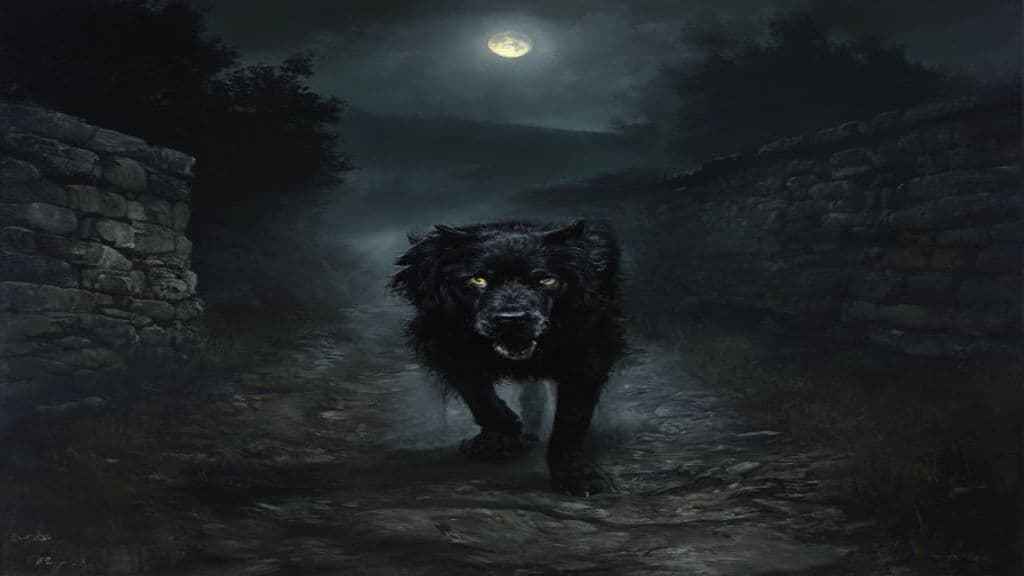
Gwyllgi
The 'Dog of Darkness' of Welsh folklore — a monstrous black hound with baleful red or yellow eyes that haunts lonely roads at night, its appearance an omen of death.
Gwion Gwion
A regional tradition/style of painted anthropomorphic rock art from the north‑west Kimberley region of Western Australia, characterized by finely rendered human figures with ornamentation. The tradition (also known by local names such as Kiro Kiro/Giro Giro) is archaeologically significant and the subject of debate over age and authorship.
Gwisin
In Korean folklore, gwisin are spirits or ghosts that are humans who have died. Sources describe the term as a class of departed-human spirit, noted as similar to yogoe or mamul and explicitly contrasted with non-human beings such as dokkaebi.
Gwragedd Annwn
In Welsh tradition the Gwragedd Annwn are female Otherworld fairies tied to freshwater—lakes and rivers—counted among the Tylwyth Teg. Depicted as beautiful women (often dressed in green) who live beneath lakes, they herd enchanted white cattle and occasionally cross into the human world.
Gwyllgi
The 'Dog of Darkness' of Welsh folklore — a monstrous black hound with baleful red or yellow eyes that haunts lonely roads at night, its appearance an omen of death.
Gyas
Gyas is a named mortal captain in Virgil's Aeneid, portrayed as one of Aeneas's seafaring leaders and a competitor in the funeral‑games boat race (Book 5). He is remembered for ordering his helmsman Menoetes to steer tightly and then casting him overboard when the order was not followed; later he is briefly reported to have beheaded Ufens (Book 12.460).
Gyges (of Lydia; Ring of Gyges tradition)
Gyges is a named human figure from Greek classical tradition: a founder/early king of Lydia (Gyges of Lydia) and the protagonist of the 'Ring of Gyges' moral thought-experiment. He is treated in historiography (notably Herodotus) as a political actor whose story is later used in philosophical discussion about invisibility, secrecy, and justice.
Géant (REJECT — not attested as a discrete supernatural entity)
The term 'Géant' in the provided sources is a French common noun meaning 'giant' and is attested chiefly as a descriptor used in place-names, festival puppets, commercial brands, and technical acronyms. The supplied materials do not document a cohesive folkloric supernatural being named 'Géant' with defined mythic origin, appearance, powers, or ritual practices; therefore this entry records the absence of evidence for a discrete legendary entity under this name in the provided sources.
Gün Ana
Gün Ana (literally 'Sun Mother') is the Turkic personification of the Sun attested in Kazakh, Kyrgyz, and related Turkic traditions as a maternal, life-giving sky-being associated with fertility, warmth, health, and protection of the vulnerable; she is placed cosmologically in the upper heavens and figures in creation accounts involving solar light.
Gütel
A variable household and folk spirit from German regional belief-forms that appears as a domestic sprite, hay-loft manikin, little earth-being, or the soul of an unbaptized child; its character ranges from helpful household attendant to mischievous or harmful tormenter depending on locality.
Gādhi
A sage in Hinduism, father of Vishvamitra and associated with ancient knowledge. (Note: 1. Power tier: Primordial (not Ancient) - as there are no supernatural abilities attributed to Gādhi. 2. Appearance: add information about Gādhi's physical appearance or description in Hindu texts. 3.)
Gāyatrī
Gāyatrī is the personified form of the Gāyatrī Mantra in Vedic–Puranic Hindu tradition: simultaneously a 24‑syllable Vedic metre, the hymn composed in that metre, and a goddess—often titled Vedamātā, the mother of the Vedas—who embodies sacred Vedic speech and knowledge.
HMS Friday
HMS Friday is an urban myth — a contemporary maritime legend that purports to tell of a Royal Navy ship deliberately commissioned and sailed on Fridays to disprove the superstition that beginning a voyage on a Friday is unlucky. The story is false: there was never a Royal Navy ship named HMS Friday, and the tale functions as a folkloric cautionary anecdote rather than a historical event.
Community Record
- [1]Gytrash. Wikipedia: Gytrashwiki
- [2]Jane Eyre, Chapter XII. Charlotte Brontë, Jane Eyre, Chapter XII (as quoted in sources)literary
- [3]Gytrash (Branwell Brontë note, quoted). Branwell Brontë unpublished note excerpt (quoted), reproduced on ancienttexts.orgfolk
- [4]Gytrash (alternative reproduction). Reproduction of Branwell Brontë quote and commentary (maryjones.us)folk
- [5]English Dialect Dictionary (entry cited by scholars). Joseph Wright, English Dialect Dictionary (entry summarized in secondary sources as defining 'gytrash' as a ghost taking animal form, including 'great black dog' and 'evil cow' as a death‑portent)academic
- [6]Gytrash (discussion of Brontë usage and folklore). Mimi Matthews, 'Jane Eyre and the Legendary Gytrash' (discussion of literary and folkloric sources)other