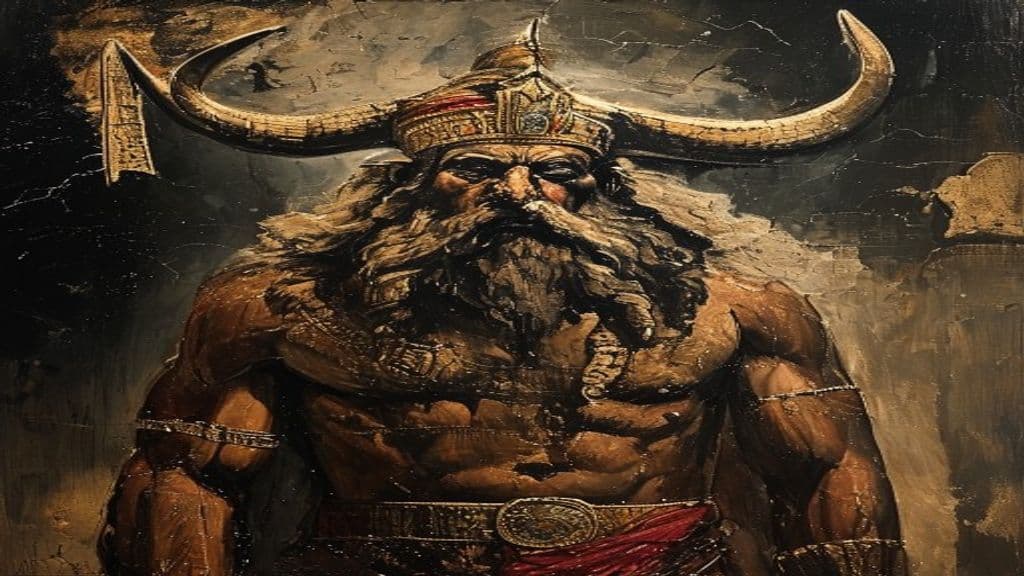
Attestations vary by region and period. In Ugaritic mythic cycles Haddu/Baʿal functions as the sky/storm lord who fights the sea-god Yamm and secures rulership among the gods (the Baal Cycle). Mesopotamian and Sumerian traditions use cognate forms (Adad, Iškur) and the Sumerogram dIM to denote the storm power; genealogical placement differs in texts and traditions (the deity appears with different parentage and family relations in different corpora), reflecting variant local theological schemes rather than a single canonical birth-narrative.
Textual and iconographic evidence (especially Mesopotamian/Akkadian) commonly portray the storm god as a bearded male figure wearing a bull-horned headdress and bearing martial/storm attributes such as a club and a thunderbolt or spear; the bull is a regular symbolic animal associated with him. Regional art and texts show some variation in depiction and emphasis across time and place.
Hadad/Adad/Iškur is associated with storm, thunder, and rain and is invoked as the deity who brings fertility to fields through rainfall and, conversely, can cause destructive storms and drought when absent or angered. In Mesopotamia he shares cultic association with the sun-god Shamash in the patronage of oracles and divination; mythic narratives position him as a warrior figure in contests that establish cosmic and cultic order.
Weaknesses
None recorded.
Wards
- ritualTemple cult, hymns, and votive offerings
- ritualDivination and oracle consultation (patronage of Adad and Shamash)

Shamash (Utu)
Shamash (Akkadian šamaš; Sumerian Utu) is the ancient Mesopotamian sun god, a principal deity responsible for the visible sun and for juridical, protective, and divinatory functions. He is venerated especially at Sippar and Larsa, appears in major myths as an ally of heroes, and is regarded as the divine witness whose sight underwrites justice and truth.

Baal
Baal (bāʿal) is a Northwest Semitic title meaning 'owner' or 'lord' that served as a theonym in the ancient Levant; in Ugaritic and Canaanite texts it appears as the name/title of a prominent storm and fertility god (often rendered Baʿal Haddu) who features centrally in the Baal Cycle and in regional cults tied to rain, fertility, and kingship. In later monotheistic literatures the term becomes a polemical label for rival or foreign deities and is reinterpreted in various receptions.
Community Record
- [1]Hadad - Wikipedia. Wikipedia contributors, 'Hadad,' Wikipedia, The Free Encyclopediawiki
- [2]Hadad - Biblical Cyclopedia. Biblical Cyclopedia, entry 'Hadad'other
- [3]Hadad - International Standard Bible Encyclopedia. International Standard Bible Encyclopedia, entry 'Hadad'other
- [4]Hadad Statue - Wikipedia. Wikipedia contributors, 'Hadad Statue,' Wikipedia, The Free Encyclopediawiki
- [5]1 Kings 20 (biblical references to Ben-Hadad etc.). 1 Kings 20 (biblical chapter), referenced in source setliterary
- [6]Hadad | The amazing name Hadad: meaning and etymology. Abarim Publications, 'Hadad: meaning and etymology'other