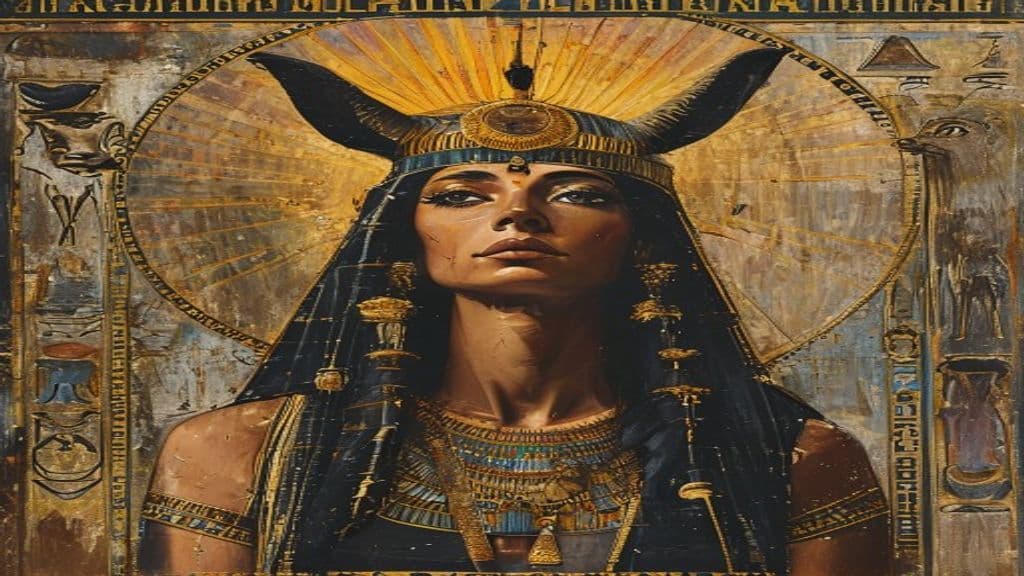
The name ḥwt-ḥr literally means 'House of Horus'. In Egyptian texts Hathor is presented relationally as mother or consort to principal solar and royal gods (Horus, Ra) and thereby as a symbolic mother of the pharaoh. She appears early in Egyptian history (precedents in Predynastic art), is clearly attested by the Old Kingdom, and remains an important deity through the New Kingdom into the Roman era. She also fused with or absorbed local bovine goddesses (for example Bat) in some periods and locales, producing many localized Hathor manifestations (the texts speak of 'Seven Hathors' and numerous other forms).
Hathor is frequently depicted as a cow and most commonly as a woman wearing a headdress of cow horns enclosing a sun disk. Other attested forms include a lioness, a cobra, and a sycomore tree. She appears in temple reliefs and royal iconography, often in funerary and cult scenes (for example standing behind major statues or participating in offerings), and is associated with ritual implements such as the sistrum.
Egyptian texts present Hathor both as a beneficent goddess—embodying beauty, music, dance, joy, love, sexuality, fertility, and maternal care—and as one of several goddesses who function as the Eye of Ra. In the Eye-of-Ra role she can act protectively on behalf of Ra and the cosmic order and can also take a vengeful, combative form. Her attributes and behaviors vary by period and locality; she also assists the deceased in transition to the afterlife and is integrated into royal ideology as the divine mother/consort within the household of gods.

Sekhmet
Sekhmet is an ancient Egyptian lioness-headed goddess who functions as the vengeful 'Eye of Ra', a solar agent of divine punishment, and simultaneously as a powerful healing and protective deity invoked against disease. Her mythology and cult deploy the same ambivalent force for destruction and restoration, with ritual practices developed to both propitiate and emulate her pacification.
Isis
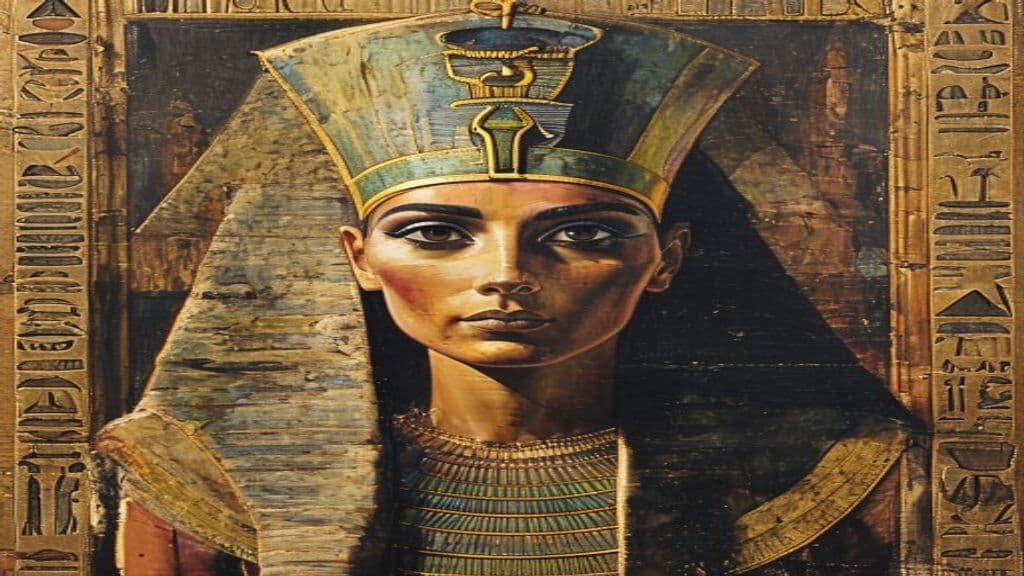
Isis is a major goddess of ancient Egyptian religion, a member of the Heliopolitan Ennead who functions as sister and consort of Osiris, mother and protector of Horus, a funerary and royal protector, and a locus of potent magic whose cult spread through the Hellenistic and Roman Mediterranean.
Mut
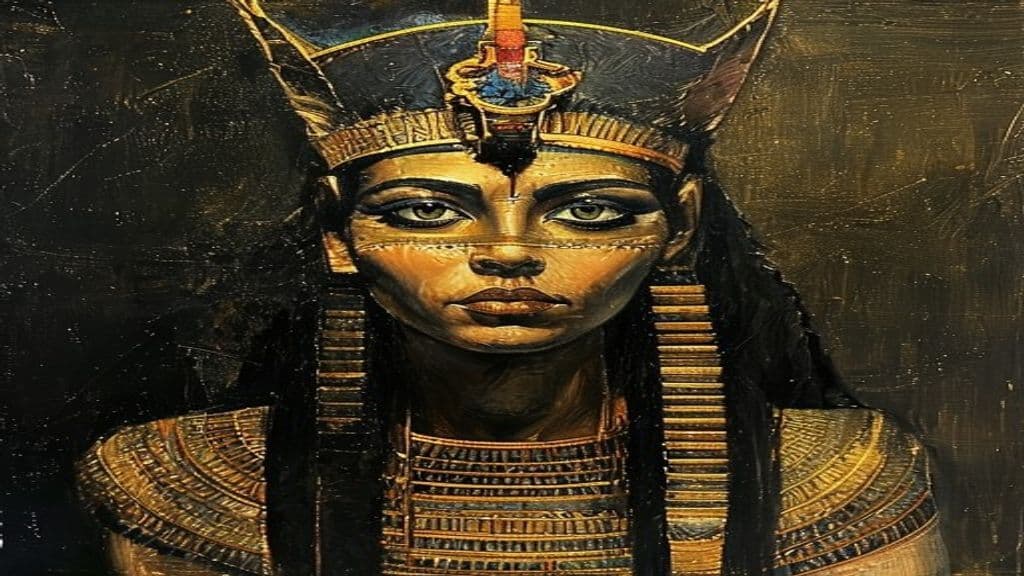
Mut is an ancient Egyptian mother goddess associated with the primordial waters (Nu), the Theban Triad, and the Eye of Ra corpus. She functions as a cosmic maternal principle, a local patroness of Thebes with temples and priesthood, and a shifting consort/maternal figure within Amun-centered theology.
Community Record
- [1]Hathor (Wikipedia summary). Wikipedia, 'Hathor' (summary and sections on roles, iconography, and cult centers)wiki
- [2]Relief of Ramesses I (Hathor in temple reliefs). Archive.org, description of Ramesses I temple relief showing Isis and Hathor behind Osiris and the queen shaking two sistraother
- [3]DECRETUM SEKMHETIS (modern spoken invocation). Archive.org item: modern spoken decree invoking Sekhmet (not an ancient Hathor ritual; cited for thematic comparison regarding Eye-of-Ra language)other
- [4]Hymns to Hathor (Egyptian texts). Attalus.org, 'Hymns to Hathor' (attestation of hymnic liturgy)other