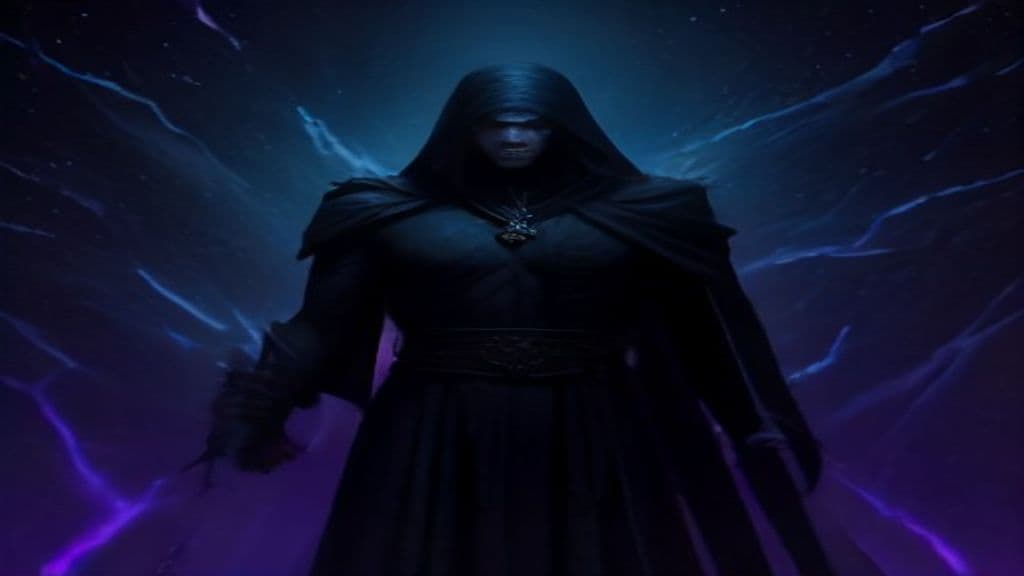
Hiroim was trained as a Shadow Priest and dedicated to the story of the Sakaarson, the prophesied figure said to unite the people of Sakaar. For believing he could be the Sakaarson he was expelled from the order. He was later chosen to be personal guard to the Red King and uphold an alliance between the Shadows and the Empire; after refusing the Emperor's order to kill the emperor's adolescent son, he broke his oath and was sent to the Maw (the Empire's gladiator training school). Following two arena victories he forged a Warbound pact with fellow gladiators, and after the death of Caiera he inherited her ability to manipulate the Oldpower. After Sakaar's destruction he absorbed the powers of the Sakaar Shadow Priests and accompanied the Hulk to Earth, taking part in the World War Hulk events and subsequent storylines.
Sources identify Hiroim as one of the Shadow People/Sakaarans; specific biometric details are not provided in the sources. Narrative events note that he later loses his left arm in a battle with Doctor Strange. He has been depicted in comics and in media adaptations (Planet Hulk animated film; Hulk and the Agents of S.M.A.S.H. episode) as a member of the Shadow People and as a Warbound gladiator.
As a Shadow Person Hiroim possesses enhanced physical abilities and a slowed aging process. Trained as a Shadow Priest, he can use the Oldpower to transform into mystic rock. After Caiera's death he inherits her ability to manipulate the Oldpower, and after Sakaar's destruction he absorbs the Shadow Priests' powers, which he uses during the World War Hulk conflict on Earth. He is shown defeated in combat by Doctor Strange (losing his left arm), later sacrifices himself to stop the Leader when the Leader uses his powers to create a gamma radiation dome, and is temporarily resurrected during the Chaos War storyline.
Weaknesses
- othervulnerable to defeat and death in combat (defeated by Doctor Strange; ultimately sacrifices himself to stop the Leader)
Wards
None recorded.
Hippothoon
Hippothoon (Ancient Greek Ἱπποθόων, romanized Hippothóōn), also called Hippothous, is a mythic human-figure and ancestral hero of Eleusis in Attica. Presented as a son of Poseidon and Alope and a successor-king of Cercyon, he is the eponym of the Athenian phyle Hippothoontis and received local cultic honors in the historical period.
Hippothous
Hippothous (Ancient Greek: Ἱππόθοος, romanized Hippóthoos, lit. 'swift-riding') is not a single supernatural being but a personal name borne by multiple mortal figures in Greek myth and literature, who appear as princes, warriors, hunters, and kings across traditions such as the Danaid cycle, the Calydonian boar hunt, the Trojan War, Arcadian and Athenian genealogies, and Hellenistic romance.
Hippotion
Hippotion is a scientific genus of sphinx or hawk moths (family Sphingidae) erected by Jacob Hübner in 1819. The genus groups several species of moths found across multiple regions and is treated in entomological, natural-history, and pest-management sources rather than folkloric tradition.
Hira (mythical monster)
A legendary buffalo-like creature from West African tradition, known for its incredible force and brutality. It is a feared entity among hunting and fishing communities along the Niger River. (Note: 1. Origin story should be included in the article based on the source material (mentioning the Songhai people, Bozo people, and M. A. Dupuis Yakouba's collection). 2. Power tier may need reevaluation;)
Hiraṇyagarbha
Hiraṇyagarbha (Sanskrit: हिरण्यगर्भ, 'golden womb') is a Vedic and later Hindu cosmological concept: a primordial golden seed or 'cosmic egg/womb' from which the manifested universe is said to originate. It is presented variously as an impersonal formative principle, the 'Soul of the Universe' in Upanishadic language, and in Purāṇic and exegetical contexts as the first-born or creator (identified with Prajāpati or Brahmā).
Hiro-Kala
Hiro-Kala is a fictional Marvel Comics supervillain: the son of the Hulk and Caiera and twin brother of Skaar. In Marvel narratives he masters Sakaar's Old Power, combines it with the Power Cosmic into a 'New Power', and performs planetary-scale acts including attempting to seize K’ai’s Worldmind and move a planet toward Earth.
Hirpi Sorani
Infernal fire god in ancient Etruscan and Roman pantheon, associated with volcanic fires and solar forces. (Note: 1. Power tier should be Ancient (deity-level) instead of Primordial. 2. No physical description is provided in the source material; delete or rephrase "Appearance" section accordingly. 3. Since specif)
Historiola (Greek tradition)
A narrative tool used for magical purposes, providing a paradigm for desired action. (Note: - Power tier: Downgrade to Ancient (deity-level), as it does not interact with humans and its abilities seem more akin to a tool or concept rather than an entity with primordial powers. - Appearance: )
Hito-gitsune
A household-associated small carnivore spirit from western Japan (Chūgoku region) that attaches to certain families, providing wealth in belief but causing illness, behavioral change, social stigma, and transmission across households. It is represented in regional traditions as a marten/fox/weasel‑like possessing spirit rather than a singular individualized deity.
Hitogami (Arahitogami)
Hitogami, often rendered Arahitogami (現人神), is a term in Shinto denoting a kami who is a human being — a divinity identified with or embodied in a human. The term is attested in classical Japanese sources such as the Nihon Shoki and is treated in modern reference works as a category of Shinto deity.
Hitotsume-kozō
A class of Japanese yōkai depicted as a bald child or young monk with a single central eye; typically a mischievous, comparatively harmless apparition that startles people and appears in Edo-period picture-books, local tales, and calendar-based folk practices.
Hitotsume-nyūdō
A Japanese yōkai appearing as a one‑eyed ōnyūdō (large monk). Found in roadside and procession narratives, it is variously explained as an autonomous monkish spirit, a transformed or admonishing monk figure from Mount Hiei, or as a kitsune/tanuki disguise in local traditions.
Community Record
- [1]Hiroim - Wikipedia. Hiroim. Wikipedia. https://en.wikipedia.org/wiki/Hiroimwiki
- [2]Hiroim (Wikidata). Hiroim (Q3785764). Wikidata. http://www.wikidata.org/entity/Q3785764wiki