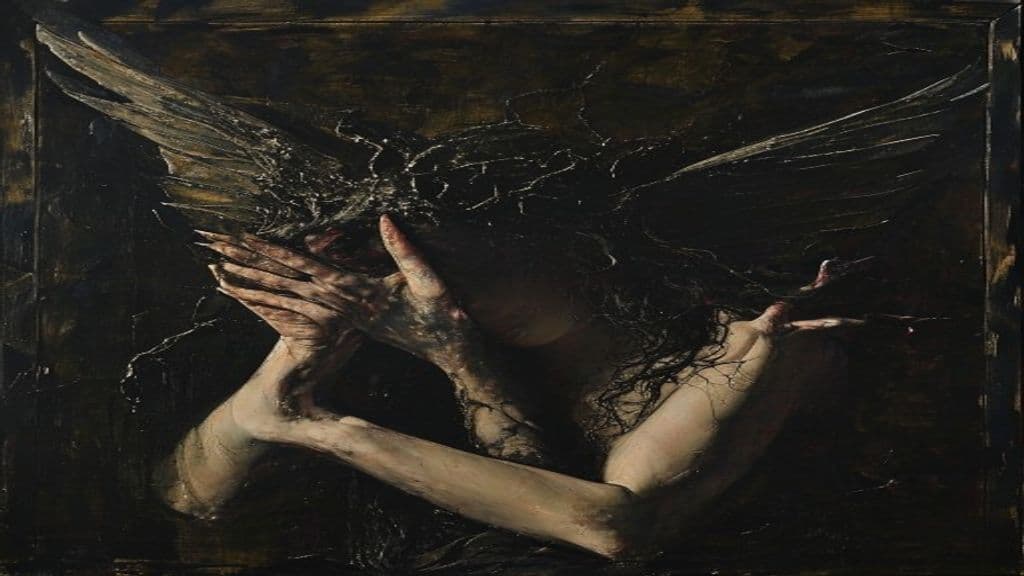
In Jewish folklore, the Incubus is described as a male demon that preys on female humans in their dreams. Its nature is one of exploitation and manipulation, particularly targeting women's vulnerabilities during sleep.
No specific physical description is provided; it appears in women's dreams as a psychological or metaphorical presence.
The Incubus seduces female humans in their dreams, leading to a bond forming between them and eventually physical interactions. It requires vaginal ejaculation discharge to survive, which it achieves through the production of a hybrid child known as a cambion.
Weaknesses
- Holy symbolsCross
- Purification ritualsMikvah
- ExorcismsRitual of Exorcism
Wards
- Protective charms and talismansTalisman of Protection
- Holy objectsTorah Scroll
Inanna
Inanna is a major ancient Mesopotamian goddess, primarily worshipped in Sumer and later identified with the Akkadian Ishtar. Her domains include love, sex, war, political power, divine law and procreation; she is a principal cult figure of Uruk and bearer of the mes, the decrees of civilization.
Inanna of Zabalam
A city-tutelary manifestation (hypostasis) of the Mesopotamian goddess Inanna/Ishtar associated with the city of Zabalam (Sumerian Sugal). Attested from the Uruk period through later Mesopotamian historical phases, she appears in temple hymns, royal inscriptions, and theophoric names and could be treated either as a distinct local goddess or as a local aspect of the pan-regional Inanna.
Inari
Inari is a major Shinto kami of Japan associated primarily with rice and the rice harvest, agriculture, food/prosperity, foxes as messengers, and, in broader practice, industry. Venerated at thousands of shrines (most prominently Fushimi Inari-taisha on Mount Inari), Inari receives offerings and votive donations such as torii gates and food (notably inari-zushi).
Inari Ōkami
Inari Ōkami is a major Shinto kami primarily associated with rice cultivation, fertility, food, and general worldly prosperity; over time Inari's patronage expanded to trades such as swordsmithing and commerce, and the figure is syncretically identified with various Buddhist and Shinto deities. Inari is venerated at thousands of shrines across Japan and is closely tied to white foxes (kitsune) who act as messengers in popular belief.
Inca Human Sacrifice Entity
A supernatural force in Inca tradition believed to demand human sacrifice, particularly children, as a form of placation. (Note: 1. The summary should mention that the entity demands appeasement, not just placation. 2. Power tier should be Ancient (deity-level) instead of Primordial (cosmic). 3. The source material does not sup)
Inca Tradition
Polytheistic framework with pan-regional, regional, and local divinities influencing daily activities and grand ceremonies in the Inca Empire. (Note: 1. Power tier: Primordial (not Ancient), as it's a pan-regional framework influencing daily activities. 2. Appearance: Add information from source material about what the Inca deities looked like or h)
Indarapatra at Sulayman (monstrous antagonists)
A quartet of monstrous antagonists (Kurita, Tarabusaw, Pah, and the seven‑headed bird/Balbal) from the Maguindanao epic Indarapatra at Sulayman who devastated Mindanao in a mythic past and were slain through royal heroism, enchanted arms, and a heavenly jar of water.
Indonesian Mythology
The mythology of Indonesia is a diverse and complex collection of myths, legends, and supernatural beings from various cultural traditions. It reflects the syncretization of Hindu, Islamic, and Christian biblical influences, resulting in a unique and dynamic worldview. (Note: 1. Power tier should be Primordial, but it's too vague for entities that embody cosmic forces. Consider rephrasing to "Cosmic Deity" or more specifically, the role of Iswara and Durga in Indonesian my)
Indra
Indra is a major Vedic deity, king of the devas and lord of Svarga (heaven), associated primarily with the sky, storms, lightning, rain, rivers and martial heroism; he is central in the Rigveda and later appears across Hindu, Buddhist and Jain cosmologies with varying status.
Indrajit (Meghanāda)
Indrajit, also called Meghanāda, is the eldest son of Rāvaṇa in the Indic epic tradition (the Rāmāyaṇa). A mortal royal and mighty warrior, he is famed for mastery of celestial weapons (astras), sorcery/tantra, and aerial/illusion warfare, and for briefly capturing the god Indra.
Indrani
Indrani (Sanskrit: Indrāṇī), also called Śacī / Shachi and Poulomī, is the queen and consort of the Vedic and Puranic god Indra. Presented in Vedic hymns and later epic and Purānic narratives, she functions as Indra's wife, a personification of aspects of his power in some hymns, and an agentic figure in courtly celestial stories such as the Nahusha episode.
Indrik (Indrik-zver')
A singular marvelous beast in Russian folklore, the Indrik (Indrik-zver') is described in medieval compilations such as the Dove Book as the "king of all animals" who dwells on a sacral "Holy Mountain"; the creature is gigantic and horned and is said to make the earth tremble when it stirs.
Community Record
- [1]