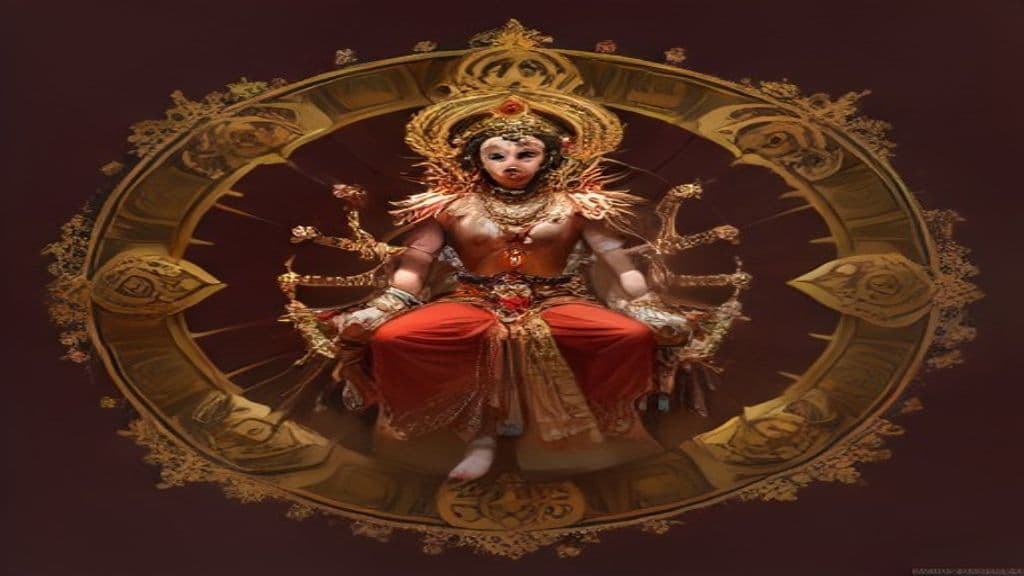
Born to the rakshasa king Rāvaṇa as his eldest son and crown prince of Laṅkā, he receives the name Meghanāda (literally 'roar of the clouds') because his birth cry was said to sound like thunder. For the feat of subduing and imprisoning Indra, king of the devas, he acquired the epithet Indrajit, 'conqueror of Indra'. His prowess is presented as the product of ascetic training, boons, and mastery of celestial weapons and sorcery within the epic cosmology.
Sources give limited direct physical description; he is portrayed as a princely warrior associated with royal martial accoutrements such as a celestial chariot (granted as a boon) and battlefield regalia. Narrative episodes emphasize his aerial presence—fighting from clouds, becoming invisible, and mounting celestial chariots—rather than detailed bodily description. His birth omen (a thunderlike cry) is a named feature of his origin.
Indrajit's powers in the sources derive from boons, ascetic practice, and expertise in astras and tantra. He repeatedly employs illusion and invisibility, fights from the sky and clouds, and uses named divine weapons (notably Nagapāśa, a trap of serpents, and the Brahmāstra). He captured Indra and held him prisoner for years. Narratives attribute to him mass-casualty uses of weapons (some accounts report very large numbers of vanaras killed by the Brahmāstra) and tactical retreats when battle conditions turn against him. He is also described as capable of rendering opponents unconscious by sorcery.
Weaknesses
- ritualDestruction of the Nikumbhila yagna (yagna to goddess Prathyangira)
- conditionReported boon condition: some accounts state he could be killed only under a special condition (for example, by a common man who had not slept for fourteen years)
Wards
- ritualDestruction of the Nikumbhila yagna (Prathyangira yagna)
- otherIntervention by Garuḍa to counter Nagapāśa (narrative rescue of Rāma and Lakṣmaṇa)
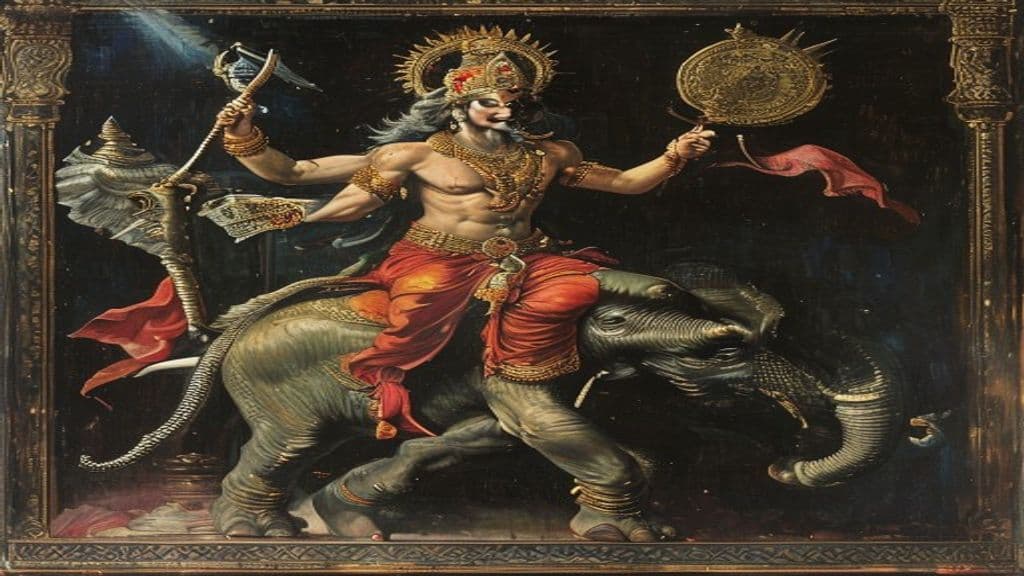
Indra
Indra is a major Vedic deity, king of the devas and lord of Svarga (heaven), associated primarily with the sky, storms, lightning, rain, rivers and martial heroism; he is central in the Rigveda and later appears across Hindu, Buddhist and Jain cosmologies with varying status.
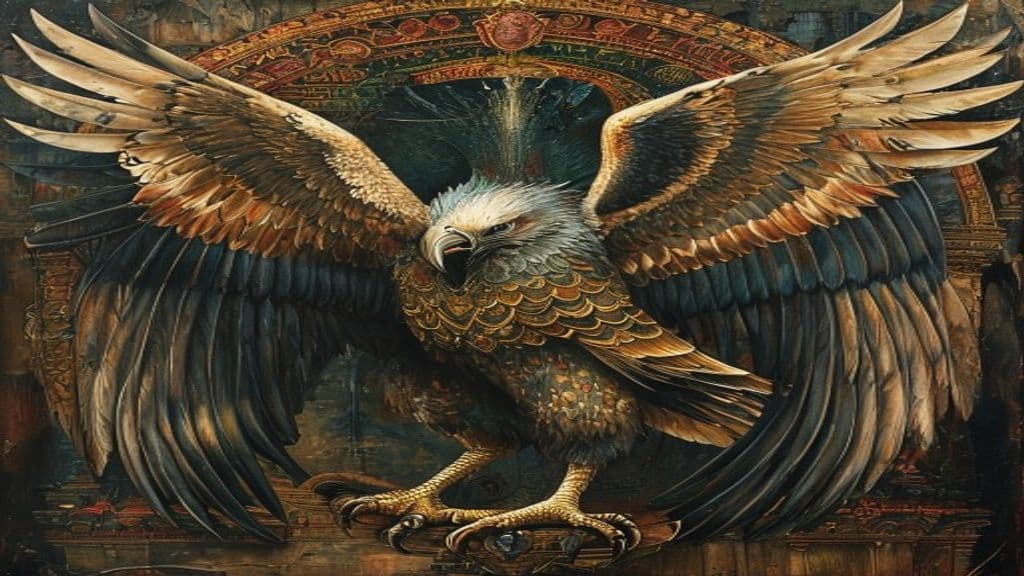
Garuda
Garuda is a divine, eagle-like being in South Asian traditions best known as the vahana (mount) of the god Vishnu. In Vedic, Purānic and later texts he appears as a powerful, solar-associated bird-personage who is both an individual mythic personality (son of the sage Kaśyapa and Vinatā) and an archetype invoked in temple iconography and theological metaphor.
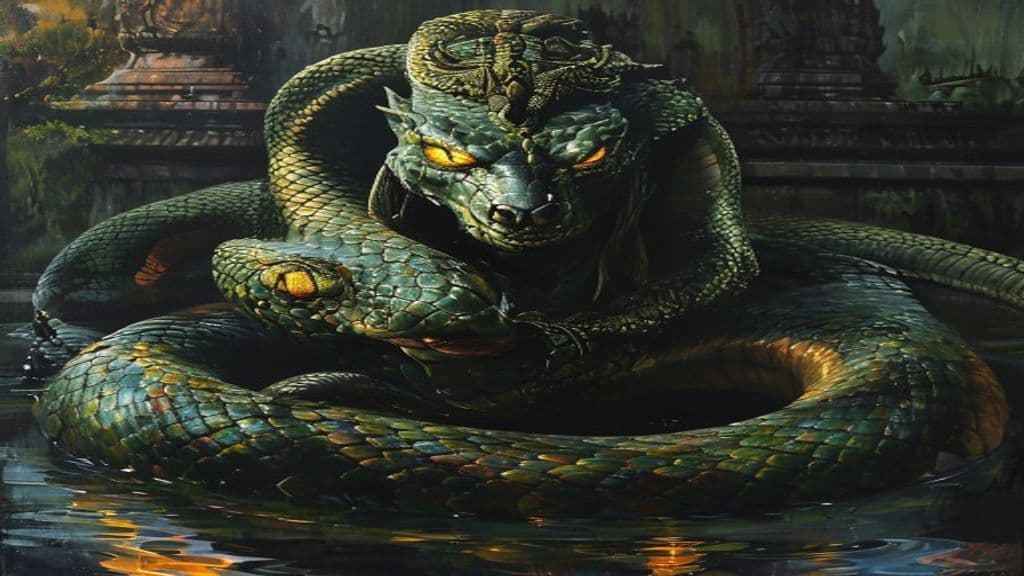
Naga
Divine serpent beings of Hindu, Buddhist, and Jain cosmology — powerful guardians of water, earth, and underground treasures. Revered as deities in South and Southeast Asia.
Inca Human Sacrifice Entity
A supernatural force in Inca tradition believed to demand human sacrifice, particularly children, as a form of placation. (Note: 1. The summary should mention that the entity demands appeasement, not just placation. 2. Power tier should be Ancient (deity-level) instead of Primordial (cosmic). 3. The source material does not sup)
Inca Tradition
Polytheistic framework with pan-regional, regional, and local divinities influencing daily activities and grand ceremonies in the Inca Empire. (Note: 1. Power tier: Primordial (not Ancient), as it's a pan-regional framework influencing daily activities. 2. Appearance: Add information from source material about what the Inca deities looked like or h)
Incubus (Jewish Tradition)
A male demon that preys on female humans in their dreams, seducing them and leading to physical interactions. (Note: 1. Power tier should be Primordial (cosmic) is too high; a more fitting power tier would be Greater (deity-level), given its ability to manipulate humans' dreams and lead to physical interactions. 2. )
Indarapatra at Sulayman (monstrous antagonists)
A quartet of monstrous antagonists (Kurita, Tarabusaw, Pah, and the seven‑headed bird/Balbal) from the Maguindanao epic Indarapatra at Sulayman who devastated Mindanao in a mythic past and were slain through royal heroism, enchanted arms, and a heavenly jar of water.
Indonesian Mythology
The mythology of Indonesia is a diverse and complex collection of myths, legends, and supernatural beings from various cultural traditions. It reflects the syncretization of Hindu, Islamic, and Christian biblical influences, resulting in a unique and dynamic worldview. (Note: 1. Power tier should be Primordial, but it's too vague for entities that embody cosmic forces. Consider rephrasing to "Cosmic Deity" or more specifically, the role of Iswara and Durga in Indonesian my)
Indra
Indra is a major Vedic deity, king of the devas and lord of Svarga (heaven), associated primarily with the sky, storms, lightning, rain, rivers and martial heroism; he is central in the Rigveda and later appears across Hindu, Buddhist and Jain cosmologies with varying status.
Indrani
Indrani (Sanskrit: Indrāṇī), also called Śacī / Shachi and Poulomī, is the queen and consort of the Vedic and Puranic god Indra. Presented in Vedic hymns and later epic and Purānic narratives, she functions as Indra's wife, a personification of aspects of his power in some hymns, and an agentic figure in courtly celestial stories such as the Nahusha episode.
Indrik (Indrik-zver')
A singular marvelous beast in Russian folklore, the Indrik (Indrik-zver') is described in medieval compilations such as the Dove Book as the "king of all animals" who dwells on a sacral "Holy Mountain"; the creature is gigantic and horned and is said to make the earth tremble when it stirs.
Inel Qaghan
Inel Qaghan (Old Turkic: 𐰃𐰤𐰠:𐰴𐰍𐰣; Chinese: 泥涅可汗; personal name Ashina Fuju) was a historical Turkic ruler of the Ashina house, recorded as the third khagan of the Second Turkic Khaganate. He served as a military leader commanding the western wing and was killed in a dynastic struggle during the early 8th century.
Inkanyamba
A serpent-like water-and-storm spirit in southern African (principally Zulu and Xhosa) oral tradition tied to particular deep pools, rivers, and waterfalls. Folklore associates the inkanyamba with tornadoes, seasonal storms, rain and fertility, and with occasional predation on people and animals.
Inkarri
Supernatural vengeful entity that resurrects and avenges Atahualpa's death, restoring balance between Pacha Mama and humanity. (Note: 1. Power tier: Inkarri's abilities don't suggest Primordial level; it seems more like Greater or Ancient. 2. Appearance: Add a description of what Inkarri looks like after resurrecting (e.g., how its )
Inmyeonjo
A mythological creature in Korean tradition with human and bird characteristics. (Note: - Power tier: Lower than Primordial (should be Lesser or Greater) since no deity-level abilities are described. - Origin story: Remove statement since it's true that no specific origin story is mentio)
Community Record
- [1]Indrajit — Wikipedia. Wikipedia entry 'Indrajit' (accessed source material provided in research notes)wiki
- [2]Indrajit — MythFolklore.net entry. MythFolklore.net, 'Indrajit' summary (referenced in research notes)folk
- [3]Hinduism StackExchange discussion (astras used by Indrajit). Community Q&A summarizing variants about astras attributed to Indrajit (referenced in research notes)other