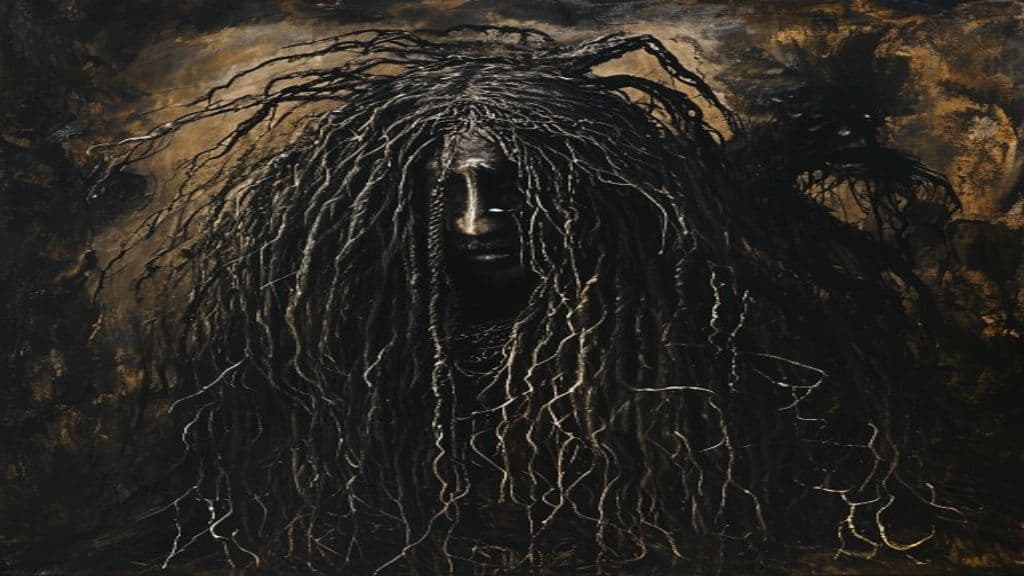
Physical description of a kishi is that it has multiple heads and long, tangled hair that falls over its face.
A kishi chief can regrow his head as soon as it is cut off. A group of kishis destroyed Kimanaueze's village and massacred its people.
Kinilau
In Hawaiian mythology, Kinilau is a figure described as the son of Menehune and Luanu'u, with significance related to ancestry. (Note: * Power tier: Primordial (Kinilau being a significant figure in Hawaiian genealogy and having multiple sons suggests he is at a higher power tier) * Sensory cues, wards, weaknesses: Not mentioned in s)
Kinnara
A benevolent, part-human and part-bird entity from Tibetan tradition associated with music and protection. (Note: - Power tier: Primordial (due to its association with Hindu and Buddhist mythology) - Appearance: The exact description isn't provided, but it's mentioned that they are part human and part bird; more )
Kinnaree
A benevolent hybrid figure from Hindu-Buddhist myth, presented in Thai tradition as a part-human, part-bird being closely associated with music, love, beauty, and the protection of humans. The motif persists in modern Thai cultural life as decorative and symbolic imagery.
Kiraman Katibin
In Islamic tradition the Kiraman Katibin (Arabic: كراماً كاتبين, 'noble writers') are a pair of angels appointed to record every person's deeds. They function as constant divine scribes whose registers inform God's knowledge and later reckoning, a role attested in the Quran and expanded in hadith and tafsir literature.
Kirby O'Donnell
Kirby O'Donnell is a fictional American treasure-hunter created by Robert E. Howard, operating in early-twentieth-century Afghanistan under the Kurdish-merchant disguise 'Ali el Ghazi'. He appears in three pulp-era adventure stories that center on searches for lost treasures and forbidden cities.
Kishar
Kishar (Akkadian Kišar) is a primordial female principle in Babylonian cosmology attested in the opening lines of the Enuma Elish. She functions as the paired earth-counterpart to the sky-principle Anshar and is genealogically the mother of Anu; surviving sources present her as an abstract, cosmological origin-aspect rather than an actively worshiped cult figure.
Kitana
Kitana is a fictional royal warrior character from the Mortal Kombat multimedia franchise. Presented in-universe as an Edenian princess/royal who becomes a recurring combatant in inter-realm conflicts and tournaments, she is best known for fighting with a pair of steel fans and for signature finishing moves introduced in Mortal Kombat II (1993).
Kitchen God (Zao Jun / Zao Shen)
The Kitchen God is a Chinese domestic deity associated with the household stove/hearth who monitors family conduct and annually reports that conduct to the Jade Emperor, influencing the household's fortunes. He is typically represented by a paper effigy or plaque kept above the stove and is the focal figure of year-end household rites around the Little New Year.
Kitsune
Fox spirits of Japanese mythology — intelligent, long-lived beings who gain additional tails (up to nine) as they age and grow in power. They serve as messengers of the god Inari and as powerful tricksters.
Kiviuq
Kiviuq is a pan‑Inuit culture‑hero and eternal wanderer of oral literature whose epic cycle of voyages and encounters with witches, spirits, giants, sea monsters, and cannibals is told across Greenland, Alaska, and the Canadian Arctic. Tales present him as an Inuk hunter‑traveler who survives by skill, tools (kayak, harpoon, dog sled), occasional supernatural events, and cunning; in some regional variants his prolonged life is cosmically significant.
Kivutar
Kivutar (also Kiputyttö, Vammatar) is a Finnish underworld-associated female spirit or goddess petitioned in runic songs to take human pains and injuries onto herself and remove illnesses by relocating them into stones, containers, the sea, or by boiling them away.
Kiwa
Male divine guardian of the ocean in Māori traditions. (Note: * Power tier should be Ancient, as the sources do not indicate a "primordial" level of power, but rather a deity-level guardian. * Abilities: Add specific abilities mentioned in the source material, s)
Community Record
- [1]Wikipedia: Kishi (folklore). 1wiki