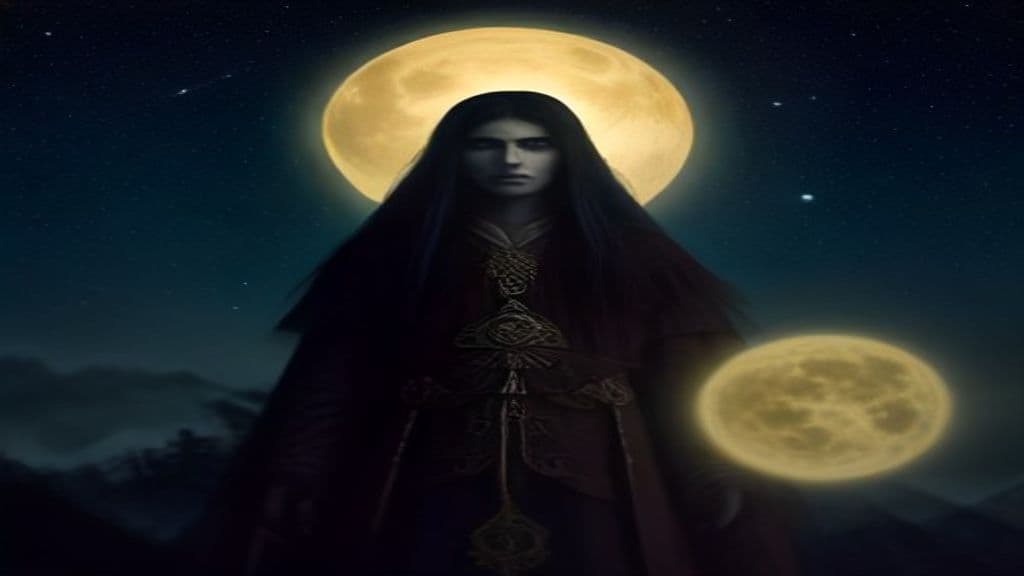
Accounts in the surveyed summaries present variant traditions. In many treatments Ülgen is described as an eternal being, "without either beginning or end." In some accounts he is said to be created from Kayra (Tengere Kayra Khan); in other registers he stands as the highest deity after Tengri or is sometimes identified with Tengri. These alternatives are recorded in the source material as differing or overlapping conceptions rather than a single uniform origin narrative.
The available sources do not give a detailed anthropomorphic description. Mythic placement and dwelling are prominent: Bai-Ülgen is said to live on the sixteenth floor of the sky, above the sun, moon and stars, in a golden house. He is associated with the Ulukayın (the cosmic axis between earth and sky) and with the horse, both of which are sacred to him. Ordinary humans may not reach him; only shamans (kams) with astral powers can attempt ascent to his realm.
Ülgen is credited with creative acts (making earth, heaven and all living beings, creating land for people to live on, the heads of humans and animals, and the rainbow), with control over atmospheric events and movements of stars, and with promoting goodness, welfare and abundance (food, water). He is described as patron and source of shamanic knowledge, protector of humankind against the opposing power Erlik, and a recipient of sacrificial worship (notably horse sacrifice). Shamans may attempt an astral ascent to learn impending dangers such as bad harvests if their offering is accepted.

Ay Ata
Ay Ata (Ay Dede) is the personified Moon in Turkic myth and traditional Tengrism, commonly glossed as 'Moon Father.' He is paired with the sun-being (Gun Ana / Kün Ana) in a layered sky cosmology and figures in folk tales, epic traditions, and shamanic prayer contexts.
Ayaz Ata
Ayaz Ata is identified in the provided source as a winter-associated figure originating from Tengrism and also as a fictional tale character who serves as the Turkic counterpart to Santa Claus and Ded Moroz. The single source presents both a religious origin (Tengrist) and a later folkloric/seasonal role without further detail.
Erkliğ Han
Erkliğ Han is a Turkic–Altai celestial lord associated with space, stars, meteorites (falling stars), and the planet Venus. Traditionally titled a Han (ruler), he is described in source material as responsible for visible stellar phenomena, linked in some lists with virility and read as a martial symbol by analogy to his action at sunrise.
Etügen Eke
Etügen Eke (also Etügen, Itügen, Etügen Ekhe) is an earth-mother goddess in Turkic and Mongolic Tengrism traditions, personifying the earth, fertility, homeland and natural forces. She is described in the sources as occupying a high place in the cosmic order, subordinate only to Kök‑Tengri, and is propitiated with seasonal sacrifices tied to pastoral and agricultural cycles.
Tengri
Tengri is the supreme sky/heaven principle in early Turkic and Mongolic religious frameworks, functioning as both the cosmic blue sky and a source of sovereign will, fate, and legitimacy. Central to Tengrism, Tengri is invoked in cosmology, political ideology, and shamanic/ancestor-associated practices.
Umay
Umay is a maternal fertility and child-care divine figure in Turkic myth and Tengrism, conceived as a celestial mother who guards unborn souls, protects infants and mothers, confers community prosperity, and is associated with the sun and the color yellow.
Yer iyesi
Yer iyesi is the familiar spirit or guardian of the earth and specific territory in Turkic/Tatar and related Tengrism traditions. Conceived as a land-attached iye, it appears in male and female forms (Yer Ata and Yer Ana) and is associated with protection of land and, in the female aspect, fertility and primordial presence at cosmogony.
Öndvegissúlur
In Norse tradition, Öndvegissúlur represented protection and defense, not just power and authority, as a pair of wooden pillars placed on each side of the high-seat in Viking-period Scandinavian houses. (Note: - Power tier: Primordial (as they are connected to the high-seat, which is associated with the All-Father Odin, and provide spiritual protection) - Abilities: Provide spiritual protection and defend a)
Ördög
Ördög (Old Hungarian: Ürdüng) is a shape‑shifting supernatural being from Hungarian mythology and early Hungarian paganism associated with dark or evil forces and the underworld. In post‑conversion sources it was identified with the Christian devil, though pre‑Christian accounts also present ambivalent roles such as an assistant in cosmogony and a collector of human souls.
Úłtsoh (LTSOH / LTSOH DOODA)
The forms Úłtsoh (rendered in sources as 'LTSOH' or 'LTSOH DOODA') appear only in the supplied materials as a Navajo-language lexical element used in contemporary art and advocacy project titles addressing uranium on Navajo lands and once as an apparent OCR/indexing artifact. The sources do not provide any traditional Navajo mythological, ethnographic, or folkloric descriptions of Úłtsoh as a night creature or spirit.
Ādityas
The Ādityas are a Vedic/Hindu class of solar deities, described as offspring of the goddess Aditi (and in later lists of Aditi and the sage Kaśyapa) who function collectively as manifestations/aspects of the Sun and as guardians who uphold Dharma. Their number and individual names vary by textual period — from six–eight in the Rigveda to a canonical twelve in later Brāhmaṇas and Purāṇas — and in later usage many individual Ādityas are assimilated into the single sun-god Sūrya.
Ādi‑Buddha (tradition)
The Ādi‑Buddha is a tantric Mahāyāna concept of the primordial or 'first' Buddha that functions as the dharmakāya or ground of awakened mind. In Tibetan traditions it is variously personified (e.g., Samantabhadra, Vajradhāra, or the Kalachakra figure) and is principally a doctrinal and meditative focus rather than a theistic creator god.
Community Record
- [1]Ülgen — Wikipedia. Wikipedia, 'Ülgen' (summary and quoted lines as provided in research notes)wiki
- [2]Ülgen — Wikidata. Wikidata entry for Ülgen (linked in research notes)other
- [3]Archive materials and miscellaneous links cited in research notes. Archive links listed in the research notes were provided as part of the source list; the primary summary used in these notes is the Wikipedia entry referenced above.other