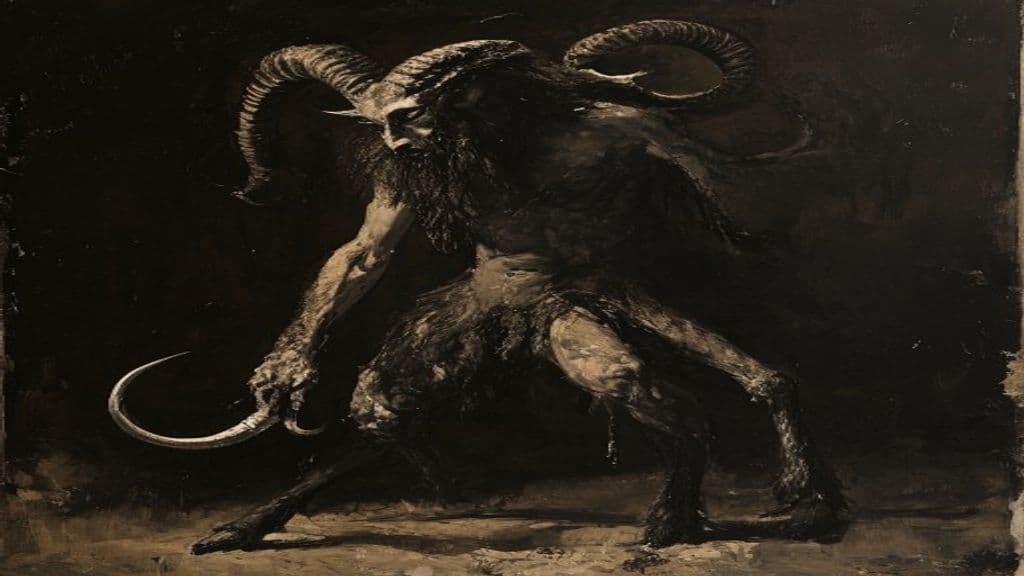
Sources record Ördög as an ancient figure of Hungarian mythic tradition; the Old Hungarian form Ürdüng attests the name's antiquity. In narrative accounts preserved in later sources Ördög is described both as a being who assisted Isten (God) in creating the world and as a resident of the underworld (Pokol) who tends a cauldron of sinful souls. After Christianization Ördög was identified with the Christian devil. The sources note uncertainty about whether the punitive meanings ascribed to Pokol developed only after Christian influence.
Ördög is commonly described as pitch‑black and humanoid in the upper body, with lower goat‑like portions (a description similar to satyr/faun imagery), cloven hooves, ram‑like horns, and a long tail ending in a blade. Some sources also note an overly large phallus. He is also explicitly said to be a shape‑shifter who may take other guises when on earth.
Ördög is described as a shape‑shifting, demonic creature able to take animal, elemental, or human forms (for example, a fox, a dark flame, or a Hungarian shepherd with dark, sparkling eyes). He dwells in the underworld (Pokol) and is depicted as stirring a large cauldron containing the souls of those who lived in sin; he is said to seek to add human souls to his charge. He is also described as testing or tempting humans, habitually making bets with people to see if they become corrupted. On earth he may hide in walls and emit subtle high‑pitched or squeaky noises.
Éber Finn
Éber Finn (Éibhear Fionn) is a legendary ancestral founder‑king in medieval Irish pseudo‑history. Presented in the Lebor Gabála Érenn–style narratives and related materials as one of the sons of Míl Espáine, he is a Milesian leader who helped conquer Ireland, received a share of the kingship, and whose descendants form an important dynastic line.
Ñusta
Ñusta is a Quechua term used in Inca and Andean contexts to denote a high-status woman or noblewoman—often translated as "princess"—who occupied elite social, political, and ritual roles within the Inca imperial order and continued to be significant in colonial-era interactions with Spaniards.
Ògún
Ògún (also Ogum, Gu, Egu) is a major West African and diaspora deity (orisha/vodun) associated with iron, metalworking, hunting, war and the crafts that use iron. In Yoruba cosmology he is described in some traditions as an Irunmọlẹ (primordial orisha) who cleared a path for other orisha and functions as patron and protector for blacksmiths, hunters, warriors, drivers and related occupations.
Ông Trời
In Vietnamese tradition, Ông Trời is a high-ranking deity associated with the divine realm and later merged with the Jade Emperor. (Note: 1. The power tier should be Primordial, not Ancient, since Ông Trời is described as one of the most important gods in Vietnamese cosmology. 2. Add information about Ông Trời's appearance, abilities, s)
Ông Táo (Kitchen God)
Ông Táo is the Vietnamese household/kitchen deity who serves as the family's advocate before higher gods and as an emissary between heaven and earth, especially salient in New Year (Tết) ritual contexts.
Öndvegissúlur
In Norse tradition, Öndvegissúlur represented protection and defense, not just power and authority, as a pair of wooden pillars placed on each side of the high-seat in Viking-period Scandinavian houses. (Note: - Power tier: Primordial (as they are connected to the high-seat, which is associated with the All-Father Odin, and provide spiritual protection) - Abilities: Provide spiritual protection and defend a)
Úłtsoh (LTSOH / LTSOH DOODA)
The forms Úłtsoh (rendered in sources as 'LTSOH' or 'LTSOH DOODA') appear only in the supplied materials as a Navajo-language lexical element used in contemporary art and advocacy project titles addressing uranium on Navajo lands and once as an apparent OCR/indexing artifact. The sources do not provide any traditional Navajo mythological, ethnographic, or folkloric descriptions of Úłtsoh as a night creature or spirit.
Ülgen
Ülgen is a benevolent creator and high-sky deity in Turkic traditional belief (often discussed under Tengrism). He is credited with creating earth, heaven and living beings, promotes abundance and welfare, and functions as patron of shamans; in sources he is usually distinct from Tengri but in some accounts identified or conflated with Tengri.
Ādityas
The Ādityas are a Vedic/Hindu class of solar deities, described as offspring of the goddess Aditi (and in later lists of Aditi and the sage Kaśyapa) who function collectively as manifestations/aspects of the Sun and as guardians who uphold Dharma. Their number and individual names vary by textual period — from six–eight in the Rigveda to a canonical twelve in later Brāhmaṇas and Purāṇas — and in later usage many individual Ādityas are assimilated into the single sun-god Sūrya.
Ādi‑Buddha (tradition)
The Ādi‑Buddha is a tantric Mahāyāna concept of the primordial or 'first' Buddha that functions as the dharmakāya or ground of awakened mind. In Tibetan traditions it is variously personified (e.g., Samantabhadra, Vajradhāra, or the Kalachakra figure) and is principally a doctrinal and meditative focus rather than a theistic creator god.
Ākāśagarbha
A Mahāyāna bodhisattva personifying the element of space (ākāśa) revered across Chinese, Japanese, Korean and Tibetan esoteric traditions as a treasury of boundless wisdom; traditionally invoked by dhāraṇī, mantra and visualization practices—most famously in the Gumonjihō—for memory, learning, purification and the fulfillment of requests.
Āraiteuru
In Māori tradition, Āraiteuru is a canoe associated with Ngāi Tahu's ancestors, not a supernatural being or spirit. (Note: * Power tier should be changed to "Greater" or removed, as Āraiteuru is not a supernatural being. * Abilities statement should clarify that it doesn't have supernatural powers, but could mention its i)
Community Record
- [1]Ördög (Wikipedia). Wikipedia contributors, 'Ördög', Wikipedia, The Free Encyclopedia, https://en.wikipedia.org/wiki/%C3%96rd%C3%B6gwiki
- [2]Ördög (surname) (Wikipedia). Wikipedia contributors, 'Ördög (surname)', Wikipedia, The Free Encyclopedia, https://en.wikipedia.org/wiki/%C3%96rd%C3%B6g_(surname)wiki
- [3]Az Ördög Megkísért (Archive). Az Ördög Megkísért, archive.org, https://archive.org/details/az-ordog-megkisertother
- [4]Világ folyása (3. kötet): Beszélyek by Károly Bérczy (Project Gutenberg). Károly Bérczy, Világ folyása (3. kötet): Beszélyek, Project Gutenberg, https://gutenberg.org/ebooks/67213other