
The Ādi‑Buddha concept appears in Indian tantric and Mahāyāna discussions of the dharmakāya or root Buddha (terms such as Dharmabuddha, Dharmatā‑buddha, Mūlatathāgata and Tathatājñāna‑buddha are cited in earlier literature). Specific tantric texts named in modern secondary sources as referencing an Ādibuddha include the Kalachakra Tantra and the Guhyasamāja Tantra; in Nyingma Dzogchen the Kunjed Gyalpo Tantra presents Samantabhadra in paradigmatic terms (calling Samantabhadra the 'All‑Creating King' in that tantra). Tibetan schools subsequently personified or identified the Ādi‑Buddha in tradition‑specific ways (Samantabhadra in Nyingma/Bön, Vajradhāra in Kagyu/Gelug/Sakya, and Kalachakra in Jonang), while some commentarial strands and later receptions (e.g., certain Indian commentaries that associate Mañjuśrī with an Ādibuddha role, and modern syncretic uses) expand the semantic field.
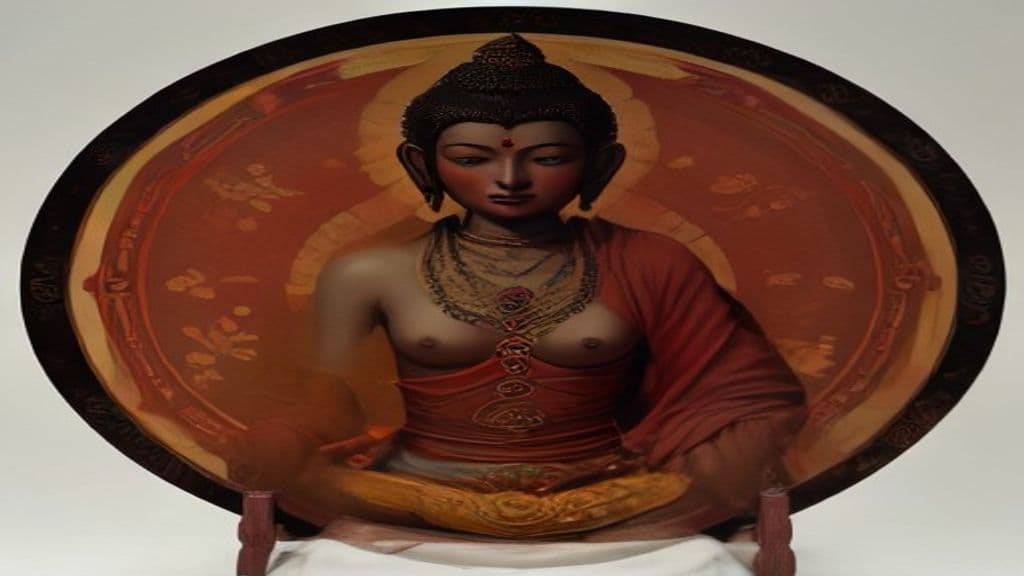
Presentation varies by tradition: Nyingma Dzogchen iconography commonly depicts the Ādi‑Buddha as Samantabhadra, often shown as a naked blue Buddha; Dzogchen teachers interpret this imagery symbolically (for example, Dzogchen Ponlop is quoted as interpreting the color blue as symbolizing spacious, unchanging quality and nakedness as an interpretive sign of the genuine reality beyond conceptual clothing). Other Tibetan identifications (Vajradhāra, Kalachakra) are named in the sources but detailed iconographic descriptions for those personifications are not provided in the supplied material.
Sources consistently describe the Ādi‑Buddha in ontological and epistemic terms rather than as an agent performing miraculous deeds. It is framed as the dharmakāya, the primordial ground or innate gnosis that pervades minds and stands as the basis for both samsara and nirvana (a reading emphasized in summaries of the Kalacakra tradition by Vesna Wallace). The Kunjed Gyalpo Tantra calls Samantabhadra the 'All‑Creating King' and describes phenomena as manifestations or displays of Samantabhadra, but commentators like Namkhai Norbu stress this wording is metaphorical and not a literal theistic creation claim—Samantabhadra denotes the unconditioned state from which appearances arise. Practically, the Ādi‑Buddha functions as the focus of tantric sadhana and Dzogchen instruction rather than as a hostile or intervening supernatural agent.
Weaknesses
- conditionNot applicable — traditional sources do not attribute vulnerabilities to the Ādi‑Buddha; it is presented as the primordial ground or innate gnosis rather than a being to be overcome
Wards
- otherNot applicable — sources do not give protections or warding rituals against the Ādi‑Buddha; the literature emphasizes recognition/realization rather than defense
Ông Táo (Kitchen God)
Ông Táo is the Vietnamese household/kitchen deity who serves as the family's advocate before higher gods and as an emissary between heaven and earth, especially salient in New Year (Tết) ritual contexts.
Öndvegissúlur
In Norse tradition, Öndvegissúlur represented protection and defense, not just power and authority, as a pair of wooden pillars placed on each side of the high-seat in Viking-period Scandinavian houses. (Note: - Power tier: Primordial (as they are connected to the high-seat, which is associated with the All-Father Odin, and provide spiritual protection) - Abilities: Provide spiritual protection and defend a)
Ördög
Ördög (Old Hungarian: Ürdüng) is a shape‑shifting supernatural being from Hungarian mythology and early Hungarian paganism associated with dark or evil forces and the underworld. In post‑conversion sources it was identified with the Christian devil, though pre‑Christian accounts also present ambivalent roles such as an assistant in cosmogony and a collector of human souls.
Úłtsoh (LTSOH / LTSOH DOODA)
The forms Úłtsoh (rendered in sources as 'LTSOH' or 'LTSOH DOODA') appear only in the supplied materials as a Navajo-language lexical element used in contemporary art and advocacy project titles addressing uranium on Navajo lands and once as an apparent OCR/indexing artifact. The sources do not provide any traditional Navajo mythological, ethnographic, or folkloric descriptions of Úłtsoh as a night creature or spirit.
Ülgen
Ülgen is a benevolent creator and high-sky deity in Turkic traditional belief (often discussed under Tengrism). He is credited with creating earth, heaven and living beings, promotes abundance and welfare, and functions as patron of shamans; in sources he is usually distinct from Tengri but in some accounts identified or conflated with Tengri.
Ādityas
The Ādityas are a Vedic/Hindu class of solar deities, described as offspring of the goddess Aditi (and in later lists of Aditi and the sage Kaśyapa) who function collectively as manifestations/aspects of the Sun and as guardians who uphold Dharma. Their number and individual names vary by textual period — from six–eight in the Rigveda to a canonical twelve in later Brāhmaṇas and Purāṇas — and in later usage many individual Ādityas are assimilated into the single sun-god Sūrya.
Ākāśagarbha
A Mahāyāna bodhisattva personifying the element of space (ākāśa) revered across Chinese, Japanese, Korean and Tibetan esoteric traditions as a treasury of boundless wisdom; traditionally invoked by dhāraṇī, mantra and visualization practices—most famously in the Gumonjihō—for memory, learning, purification and the fulfillment of requests.
Āraiteuru
In Māori tradition, Āraiteuru is a canoe associated with Ngāi Tahu's ancestors, not a supernatural being or spirit. (Note: * Power tier should be changed to "Greater" or removed, as Āraiteuru is not a supernatural being. * Abilities statement should clarify that it doesn't have supernatural powers, but could mention its i)
Čihrdād nask
A lost nask (book/volume) of the Sasanian Avesta that functioned as an authoritative account of mythical origins and the legendary history of humankind from Gayomard to the revelation of Zarathustra; it survives only in later summaries and commentaries (notably the Denkard and the Rivayats).
Čuma
Čuma (also kuga) is the personification of plague in Serbian folk belief, imagined as a woman who travels from a far land to infect people and homes. She is feared and placated through household cleanliness, avoidance of her name, and small offerings.
İn Cin
İn Cin (also written İn jinn) is a Turkish folkloric phrase and folk concept used to indicate that a place is entirely abandoned; it refers to two kinds of unseen inhabitants—İn and jinn—believed to occupy forgotten or desolated locations and make them unfit for human habitation.
İye
İye are Turkic spiritual proprietors or tutelary spirits understood as the unseen 'owners' or guardians of particular places, natural phenomena, objects, animals, households, or concepts. They mediate human relations with domains of the world and respond to human conduct—offering blessing when respected and retribution when violated.
Community Record
- [1]Adi-Buddha — Wikipedia. Wikipedia: 'Adi‑Buddha' entry (summarizes tantric and Tibetan usages, iconography, and scholarly comments)wiki
- [2]Kalacakra summaries & commentary (as cited). Vesna Wallace quoted in the Wikipedia entry summarizing Kalacakra usage of Ādibuddha as 'innate gnosis' and 'beginningless and endless Buddha'wiki
- [3]Dzogchen interpretive remarks (Dzogchen Ponlop & Namkhai Norbu citations). Wikipedia entry cites Dzogchen Ponlop on Nyingma iconography and Namkhai Norbu on metaphorical meaning of Samantabhadrawiki
- [4]Sang Hyang Adi Buddha — Wikipedia (modern reception). Article on Indonesian use of Sanghyang Adi Buddha as a modern syncretic reception (cited in research notes)wiki
- [5]Adi-buddha [Chapter I] — The Gods of Northern Buddhism (wisdomlib). Discussion of terminology and historical references to root/dharmakāya Buddhas (cited among research materials)other
- [6]Adibuddhas and the Five Tathāgatas — Fabrizio Musacchio (referenced). Modern scholarly/interpretive treatment cited in research notes on adibuddha identificationsother
- [7]Bibliographic and reception references (Biblical Cyclopedia; Theosophical Glossary) — modern receptions. Examples of later non‑canonical receptions and interpretive appropriations (not used as canonical tantric sources)other