
In Sumerian literary tradition Lugalbanda is presented as a legendary king of Uruk and a soldier in the campaigns of Enmerkar; he is listed in the Sumerian King List with an extraordinarily long reign (1,200 years), marking him as a mythic, antediluvian ruler. Over centuries the figure moves from narrative hero in the Enmerkar–Aratta cycle (notably the mountain tales) into a cultic, ancestral role: later royal hymns and temple records treat him as a holy parent and personal god, father of Gilgamesh and a recipient of offerings and temple cult.
The sources provide no consistent iconographic portrait. Narrative texts portray Lugalbanda as a rugged, active soldier and wanderer—often described in mountain and wilderness settings (e.g., 'Lugalbanda in the Mountain Cave' and 'Lugalbanda and the Anzu Bird')—which implies a heroic, outdoor figure in stories. Later cultic references address him as a divine/ancestral presence rather than enumerating a stable physical depiction; specific statues or standard iconography are not documented in the supplied material.
In epic narratives Lugalbanda displays heroic endurance, daring initiative, and survival in remote high places (missions in the Zabu mountains; seeking the Anzu bird's nest). In later cultic contexts he functions as a personal god and tutelary ancestor who may be invoked and honored (e.g., Gilgamesh swears by 'holy Lugalbanda' and offerings/anointing are made to him). The provided sources do not attribute specific supernatural powers such as flight or shape-change; his role combines heroic feats in mythic tales with a protective/ancestral cultic function.
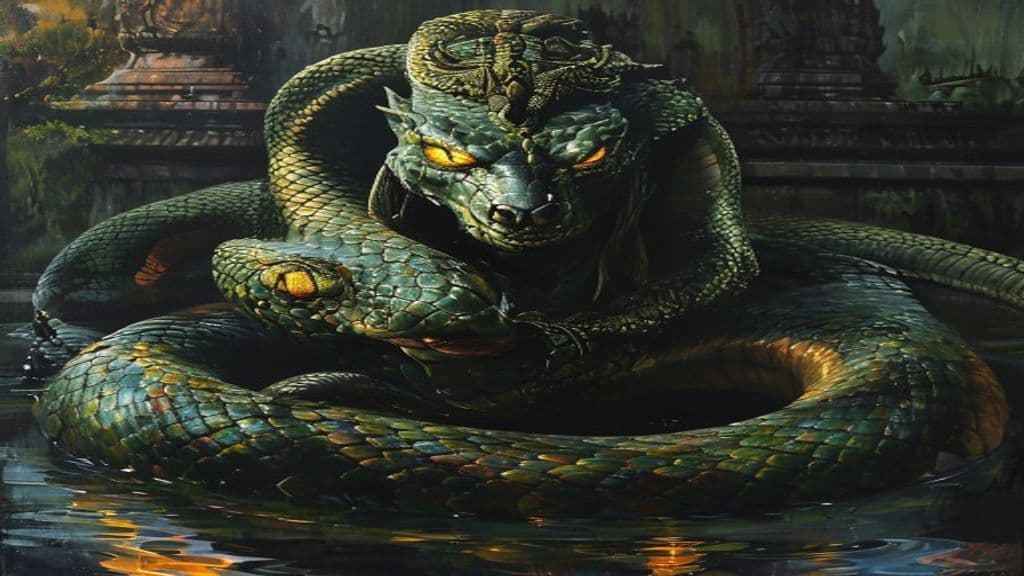
Naga
Divine serpent beings of Hindu, Buddhist, and Jain cosmology — powerful guardians of water, earth, and underground treasures. Revered as deities in South and Southeast Asia.

Ninsun
Ninsun is a Sumerian goddess of ancient Mesopotamia, mother of the hero Gilgamesh and consort of the deified king Lugalbanda. She functions as a divine intercessor, dream-interpreter, and a protective beneficent figure (sometimes called a lamma) invoked in royal legitimation and literary traditions such as the Epic of Gilgamesh.

Gilgamesh
Gilgamesh is a semi-divine legendary king of the Sumerian city of Uruk who features as the protagonist of a pan‑Mesopotamian epic tradition. Portrayed in literary sources as a demigod of superhuman strength, he is both a historical monarch recorded in king lists and a later object of cultic veneration.

Enmerkar
Enmerkar is a Sumerian legendary king and culture-hero of Uruk (Unug), presented in the king-lists and in the Matter of Aratta poems as a ritual-priest king (en) and founder-figure who secures Inanna's favor, contests the distant city of Aratta, and is credited in narrative with instituting writing on clay tablets.

Anzû (Imdugud)
Anzû, also called dZû or Imdugud, is a large storm-associated bird-figure in Sumerian/Akkadian/Babylonian myth. Portrayed as a hybrid (commonly a massive bird with a lion's head or as a half-human storm-bird), Anzû is credited in mythic narratives with seizing the Tablet of Destinies and thereby challenging the authority of chief gods such as Enlil.
Community Record
- [1]Lugalbanda — Wikipedia. Wikipedia: Lugalbandawiki
- [2]Lugalbanda in the Mountain Cave — ETCSL translation. ETCSL: Lugalbanda in the Mountain Cave (translation)literary
- [3]Lugalbanda and the Anzu Bird — Gateways to Babylon. GatewaysToBabylon: Lugalbanda and the Anzu Birdliterary
- [4]Lugalbanda in the Mountain Cave — Gateways to Babylon. GatewaysToBabylon: Lugalbanda in the Mountain Caveliterary
- [5]Lugalbanda and the Anzu Bird — story summary. Online retelling/summary of the Anzu episodeother