
In Shakta theological and Purānic contexts Mahākālī is presented as the supreme feminine power (Adi-Śakti) identified with Great Time/Death (the feminine form of Mahākāla). In some interpretations she is identical with ultimate reality (Brahman) rather than a subordinate spirit; within the Devi Māhātmya and related Puranic-tantric material she is a manifestation of the fierce destroying-transforming aspect of the Goddess. In Jain traditions she is adapted differently: Mahākālī appears in Śvetāmbara and Digambara lists as a sasana-devi or yakṣiṇī — an attendant-protector associated with particular Tīrthaṅkaras and the sangha — with variant local descriptions across subtraditions.
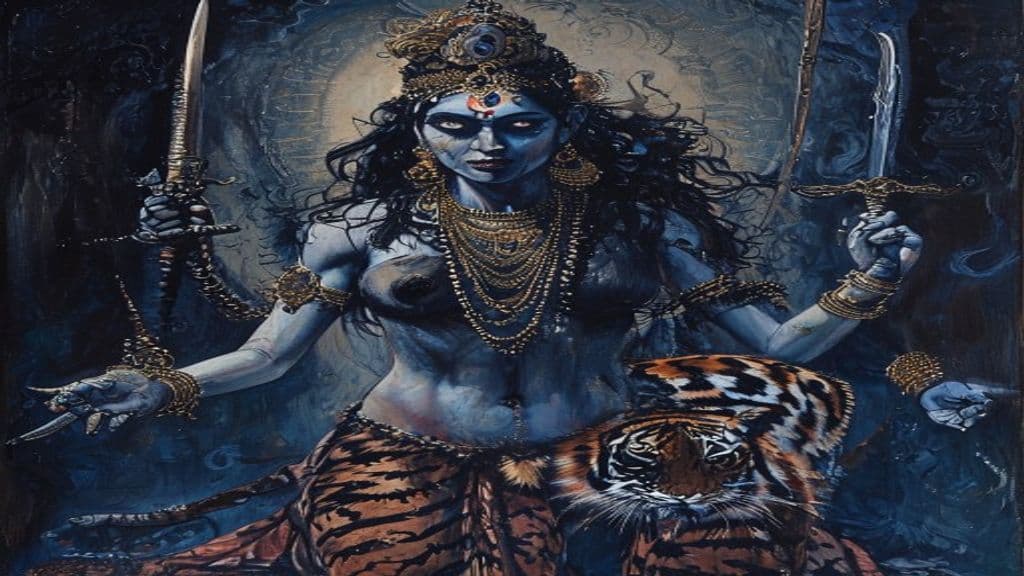
Mahākālī is commonly depicted with a dark blue or black complexion and fierce, liminal iconography. A frequent four-armed form bears weapons and a skull-cup in which blood is caught; descriptions in the corpus emphasize red, intoxicated eyes, dishevelled hair, a lolling tongue, and adornment with a garland of severed heads and a skirt of arms in popular art. More complex forms include multi-headed and multi-armed images (e.g., dashamukhi/ten-headed or ekamukhi with ten arms) whose many implements signify her subsuming of other deities' powers. Iconography also places her standing on the inert body of Śiva or on corpses or flaming graves, linking her to charnel-field imagery. Jain textual descriptions vary: Śvetāmbara and Digambara accounts agree she 'rides on a man' but differ about armaments, and one Digambara text represents her as golden and standing on a corpse while bearing a bow, sword, fruit and other weapons.
Mahākālī is associated with universal functions of time, death, destruction, transformation, rebirth, and liberation. In Shakta theology she is the activating Shakti whose energies bring manifestation into activity and who, when displayed with the implements of many gods, is treated as the source or controller of their powers. Her destructive fury is a theological motif whose moderation is linked to the presence of Śiva or Mahākāla — Śiva's presence is described in sources as what can restrain her activity. In Jain contexts her role is protective and attendant as a sasana-devi/yakṣiṇī invoked for safeguarding Tīrthaṅkaras and the sangha.
Weaknesses
- conditionpresence of Śiva / Mahākāla restrains destructive fury
Wards
- ritualpropitiation / invocation in devotional contexts
Maheshvara
Maheshvara is a Sanskrit-derived divine name meaning "Great Lord" used in Hindu/Shaiva theology as an epithet of Shiva and, in certain Buddhist commentarial texts, as the name of a powerful deva who presides over the Maheshvara Heaven (the "Great Heaven of Ease"). The figure's theological status differs by tradition: in Shaivism Maheshvara functions as a principal divine identity of Shiva, while in Buddhist cosmologies he is represented as a great sovereign deity within a multi-tiered pantheon.
Maheśvara (Sabbalokādhipatī Devā)
Buddhist deva and teacher of spiritual knowledge, associated with the god Shiva in Hinduism. (Note: 1. Power tier should be Primordial, not Ancient (Maheśvara's association with Shiva and his role as a deva suggest a higher level of power). 2. No information about origin story, appearance, sensory c)
Mahishasura
Mahishasura (Sanskrit: महिषासुर, IAST: Mahiṣāsura) is a bovine asura in Hindu tradition, commonly described as a shape‑shifting buffalo‑demon who wages war against the devas and is ultimately slain by a manifested goddess (Durga/Mahishasuramardini). The episode is narrated in the Devi Mahatmya (part of the Markandeya Purana) and is commemorated in festival cycles such as Navaratri and Durga Puja.
Mahuika
Mahuika is a Māori fire deity and personified source/keeper of fire in myth, chiefly known for providing the secret of making fire to the culture-hero Māui. She is linked by kinship to other supernatural beings (consort Auahitūroa; children Ngā Mānawa) and appears in etiological narratives including accounts of island formation.
Mahādevī
Mahādevī (Sanskrit: महादेवी, IAST: Mahādevī) is the supreme feminine divinity in Hindu Shakta theological tradition, presented in the cited sources as the primordial feminine principle (Adi Parashakti, Mulaprakrti) who is both the unmanifest absolute (nirguna Brahman) and the manifest goddess (saguna) from whom the universe and other deities proceed.
Mahāgaṇapati
Mahāgaṇapati is a grand, tantric and sectarian form of the Hindu god Gaṇeśa venerated in Ganapatya traditions as a supreme manifestation (Mahā‑Gaṇapati) and incorporated into tantric ritual corpora that include mantra, yantra, kavaca, a stotra and a thousand‑name litany. Tantric texts associate this form with six abhichāra rites used for coercive ends, and Ganapatya doctrine regards him as a pre‑creational and post‑dissolution supreme being who brings forth Brahmā.
Mahāmāyūrī
Mahāmāyūrī is a bodhisattva and female Wisdom-figure in Mahāyāna and Vajrayāna Buddhism, venerated chiefly as a protective deity whose sutra and mantras are employed in ritual to avert harm and remove afflictions. She is associated with peacock symbolism and appears in temple art and liturgical practice across South and East Asian Buddhist contexts.
Mahāsammata
In Buddhist tradition, Mahāsammata is a ruler elected by farmers according to the principles of Dhamma. (Note: 1. Power tier should be Primordial since the sources describe him as the founder of eleven world monarchs and a figure connected to the origins of Buddhist tradition. 2. Add sensory cues: Since he is )
Mahāsthāmaprāpta
Mahāsthāmaprāpta is a Mahāyāna bodhisattva associated with the Pure Land devotional tradition, commonly represented alongside Amitābha and Avalokiteśvara. His name is glossed in sources as 'arrival of the great strength' or 'one who has attained great power' and he is understood as embodying or representing the power of wisdom.
Mahāvīra
Mahāvīra (birth name Vardhamāna) is the twenty-fourth and final Tīrthaṅkara of Jainism in the present time cycle, a historical-religious reformer and supreme preacher who revitalized and systematized Jain doctrine and practice. He is venerated as the exemplary Jina (victor) whose life and teachings underpin major Jain rituals, textual traditions, and festivals such as Mahavira Janma Kalyanaka.
Maia
Maia is a figure of ancient Greek myth: the eldest of the seven Pleiades, a mountain-nymph (oread) daughter of Atlas and Pleione traditionally associated with Mount Cyllene in Arcadia, and the mother of the god Hermes. She functions in myths as a maternal and nurturing foster-figure and as an aetiological link between terrestrial narratives and the Pleiades star-cluster.
Maikubi
Maikubi is a localized yokai from Manazuru in Kanagawa Prefecture associated in modern sources with maritime misfortune; summaries portray it as a three‑headed sea creature whose presence coincides with shipwrecks and other sea disasters.
Community Record
- [1]Mahakali - Wikipedia. Mahakali (Wikipedia entry)wiki
- [2]Rudra - The Dancing Destroyer (Archive). Archive: discussion of Rudraroopa and Tāṇḍava including Mahākālī in performance contextother
- [3]Hand Movements in Dance (Vol. II) (Archive). Archive: references to dance traditions and Mahakali Caves performance contextsother
- [4]Kankalamalini Tantra (reference). Referenced tantric text in source list (no ritual text reproduced in supplied excerpts)other
- [5]Vira Sadhana (reference). Referenced tantric/sādhana literature in source list (no stepwise ritual content in supplied excerpts)other
- [6]Mahakali Caves (Subterranea of India). Toponymic and site usage showing name attached to geographic featuresother