
In the Purana corpus — most prominently the Devi Mahatmya portion of the Markandeya Purana — Mahishasura appears as an asura who, after gaining a boon that no man could kill him, defeats the devas in battle. The devas' combined energies then manifest as a warrior goddess (Durga) whose shakti defeats Mahishasura. The episode is placed within the Purana cosmology (narratively tied to Manu cycles and Manvantaras in the Purana tradition) and serves as the mythic occasion for the goddess's birth and martial activity. Some Puranic variants and later texts attribute the slaying to different goddess‑forms (Lakshmi, Katyayani, Bhadrakali, or regional consorts), but the core narrative in the Devi Mahatmya frames the event as the gods' response to the asura's success and as a theological demonstration of the goddess's power.
Sources describe Mahishasura primarily as bovine in nature — a 'buffalo' or 'buffalo-demon' — and as a shape‑shifter who can change his outer form while retaining demonic intent. Iconographic traditions commonly depict the climactic encounter as the goddess (Durga/Mahishasuramardini) poised over or piercing a buffalo‑like adversary; regional traditions (notably the Chamundi/Mysore memory) preserve a monumental local association in which a statue of Mahishasura is linked to the hill and city memory. Beyond the designation 'buffalo' and the capacity for transformation, the provided sources do not supply fixed anatomical detail for every possible form.
Mahishasura's notable attributes in the sources are his boon of invulnerability specified as 'no man could kill him,' his military success in defeating the devas, and his capacity for deceitful shape‑shifting. His victories over the gods precipitate the devas' collective creation of a martial goddess whose shakti is potent enough to overcome the boon and slay him. Scholarly readings presented in the sources also treat Mahishasura as symbolically representing chaotic or ignorant forces concealed by deceptive appearances.
Weaknesses
- conditionboon exception via goddess manifestation
Wards
- ritualInvocation and worship of the goddess (Durga/Mahishasuramardini) — commemorative/ritual emphasis
- ritualAnnual festival observance (Navaratri/Durga Puja culminating in Vijayadashami) — communal reenactment of the goddess's victory
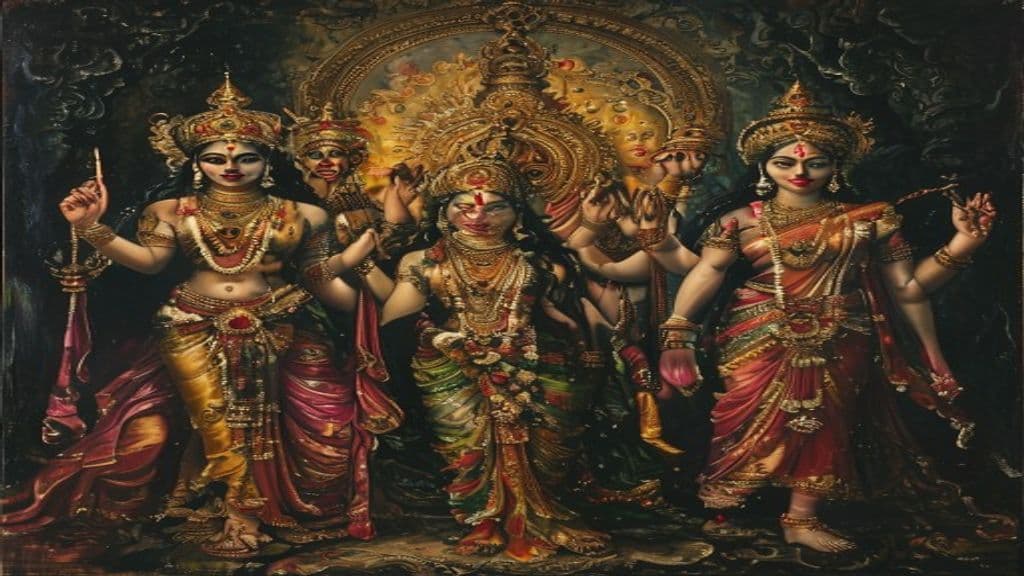
Devi
Devi (Sanskrit: Devī) is the general term for goddess in Indian religious thought, signifying the divine feminine or Shakti; in different texts and traditions she appears as individual goddesses (e.g., Parvati, Lakshmi, Saraswati) or as the supreme reality (notably in Shaktism and certain Upanishads). Sources treat Devi both as a class/category of female divinities and as a philosophical identification with ultimate reality.
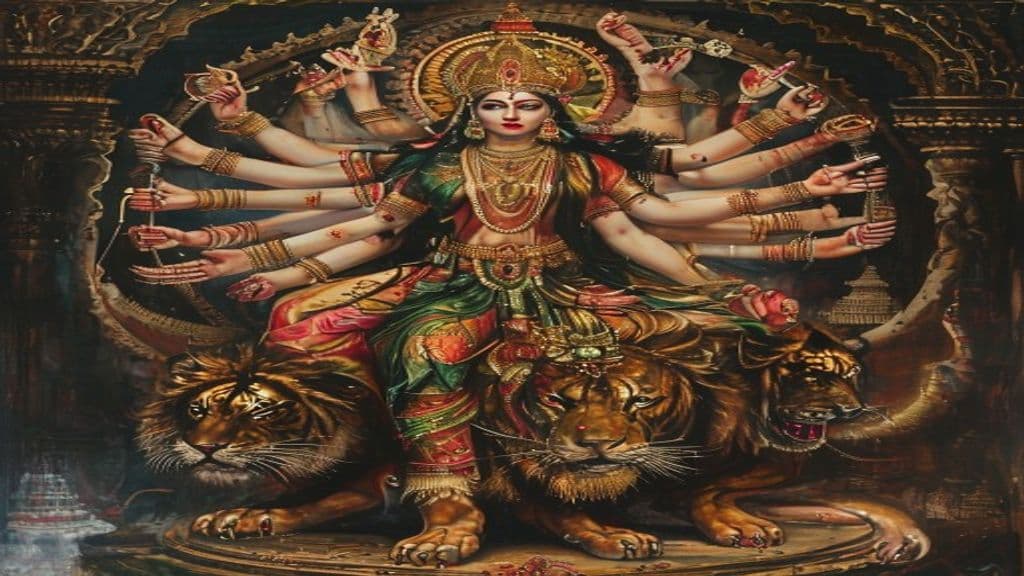
Durga
Durga is a major Hindu goddess, central to the Shakta tradition as an aspect of the Divine Feminine (Mahadevi). She is venerated as a protective, martial mother-goddess who combats demonic forces (notably Mahishasura) to uphold dharma, and is celebrated in major festival cycles such as Navaratri and Durga Puja.
Adi (asura)
Adi is attested in modern reference works as the name of an Asura who 'appears in the Matsya Purāṇa.' Beyond this single-line citation in secondary sources, no descriptive material about the figure is provided in the supplied research notes.
Adi Shakti
Adi Shakti (also Adi Parashakti, Mahadevi, Adya Shakti) is the primordial feminine power in Hindu/Shakta theology, regarded as the ultimate reality (Para Brahman) and the source from which all goddesses and gods manifest. She is both an impersonal cosmic principle (Mulaprakriti) and a focus of devotional invocation in temples, mantras, and pilgrimage sites such as Shakti Peethas.
Adi Vinayaka
Adi Vinayaka (Ādi Vināyaka; also called Nara Mukha Vinayaka) is a named iconographic and devotional form of the Hindu god Ganesha portraying the deity with a human head, described in sources as the form before the episode of decapitation by Shiva. It is rarely worshipped and appears in a small number of South Indian shrines and in devotional/musical repertoires.
Aditi
Aditi is a major Vedic goddess in Hindu tradition who personifies the boundless, infinite cosmic principle and functions as the maternal matrix from which many celestial deities (the Ādityas and other groups) are born. In the Vedic hymns she is invoked as a protective liberator who guards petitioners, provides wealth and safety, and frees devotees from hindrances such as sin and sickness.
Agni
Agni is the Vedic personification of fire in Hindu tradition: a sacred, mediating principle that manifests as terrestrial fire, atmospheric lightning, and celestial sun, and that receives and conveys sacrificial offerings. Prominent in the Rigvedic corpus, Agni functions as sanctifier, witness of rites of passage, and a transformational inner principle in later Upanishadic literature.
Ahalya
Ahalya is a mytho-legendary woman of South Asian (primarily Hindu) narrative tradition, described as created by the god Brahma, married to the sage Gautama, seduced (or tricked) by Indra, cursed by her husband, and ultimately redeemed by Rama. Her tale is a locus for themes of creation, desire, curse/penance, and redemption and she is counted among the ritual-mnemonic panchakanya.
Aindri (Indrani / Shachi / Paulomi)
Aindri (commonly rendered in sources as Indrani, also called Shachi or Paulomi) is a Hindu goddess presented as the queen-consort of Indra. She is depicted in the available material as a courtly queen associated with beauty, pride and kindness who also appears in at least one account as an active martial participant in the devas' battles with asuras.
Akhilandeswari
Akhilandeswari (Akhilandeshwari) is a major South Indian manifestation of the Hindu Goddess Adi Parashakti/Parvati, venerated as the presiding goddess of the Jambukeswarar Temple in Thiruvanaikaval. In temple tradition she is portrayed as a penitent/student of Shiva and figures in local legends, ritual schedules, and festivals that emphasize both maternal and fierce aspects.
Akshayavata
In Hindu mythology, Akshayavata is a sacred banyan tree and/or lake that symbolizes eternal life. It is mentioned in both Hindu and Jain traditions and associated with the Puranas. (Note: - The power tier should be "Greater" or at least "Ancient", as it is associated with the Puranas, which are considered ancient texts. - No specific physical description is provided, but that doesn't m)
Alakshmi
Alakshmi is an inauspicious female supernatural figure in Hindu tradition, presented as the negation or shadow-counterpart of the prosperity-goddess Lakshmi. She personifies poverty, grief, jealousy and social discord and is managed in domestic ritual and festival practice.
Alamelu
Alamelu (also Alamelu Manga / Alarmel Mangai) is a South Indian devotional name for the goddess Padmavati, identified in sources as an avatar of Lakshmi and the consort of Venkateswara; the name is also used widely as a female personal name and in titles of cultural works in Tamil and Telugu contexts.
Amrita (Buddhist tradition)
In the context of Indian religions, particularly within Hinduism and Buddhism, Amrita is a divine elixir that grants immortality and eternal life. (Note: - Power tier should be Ancient (deity-level), not Primordial. - Origin story appears accurate but lacks specificity on when Amrita was first mentioned in the Rigveda; add more detail. - Abilities are )
Community Record
- [1]Mahishasura (Wikipedia). Wikipedia contributors, 'Mahishasura,' Wikipedia, The Free Encyclopedia.wiki
- [2]Mahishasura (Wikidata entry). Wikidata: Q663318 'Mahishasura'.other
- [3]MAHISHASURA (archive item referencing related media). Archive item: MAHISHASURA (media collection).other
- [4]Durga - Goddess of Wars, Strength & Protection [model/visual resource] (Archive). Archive: Durga - Goddess of Wars, Strength & Protection (visual/model resource).other
- [5]Aigiri Nandini | Mahishasura Mardini Stotram with Lyrics (Archive audio/text). Archive: Aigiri Nandini / Mahishasura Mardini Stotram (audio and lyrics).other